
When to Replace Gas Bottle: Signs, Tests, and Safety Guide 2026

Imagine you're right in the middle of searing a steak or boiling pasta when the blue flame suddenly flickers and dies. Running out of LPG mid-meal is a major headache, especially if you aren't confident about handling high-pressure cylinders or checking levels yourself. You want to avoid that cold stove feeling, but knowing exactly when to replace gas bottle units can feel like guesswork if you don't have the right information.
We understand that domestic stress. You need a reliable, no-nonsense way to keep your kitchen running without the fear of a sudden outage. In this guide, you'll discover the exact signs that your LPG cylinder is empty and learn how to safely organise a replacement in Cape Town. We'll show you the most effective tests to check your remaining gas and explain the safety indicators that suggest it is time for a new bottle. From simple DIY checks to professional delivery logistics, we provide the clarity you need for a frictionless home energy experience.
Key Takeaways
- Recognise the visual and auditory cues, such as flame colour changes and burner sputtering, that signal your LPG supply is running low.
- Use the reliable condensation test to measure your gas levels accurately instead of using dangerous methods like shaking the cylinder.
- Identify critical safety signs, including deep rust or structural dents, that tell you exactly when to replace gas bottle equipment to protect your home.
- Optimise your setup by selecting the correct cylinder size and maintaining a backup bottle to avoid running out of gas during meal preparation.
- Learn how to arrange same-day delivery and professional connection in Cape Town for a safe, reliable, and hassle-free exchange.
Spotting the Signs: How to Tell if Your Gas Bottle is Running Low
Cape Town winters are notoriously chilly. You rely on your gas heater to cut through the morning frost, but when that heater starts losing its punch, it's usually a sign your supply is dwindling. Identifying when to replace gas bottle inventory before it hits zero is the key to a stress-free home. You don't need fancy equipment to do this. Your stove and heater give you all the clues you need if you know what to look for.
During those cold Western Cape mornings, pay close attention to how your appliances behave. If your hob takes twice as long to boil the kettle or your room heater isn't throwing out the usual level of warmth, the pressure in your cylinder is likely falling. This drop in performance is one of the most common early warnings that your LPG is nearly finished.
Visual Cues from the Flame Colour
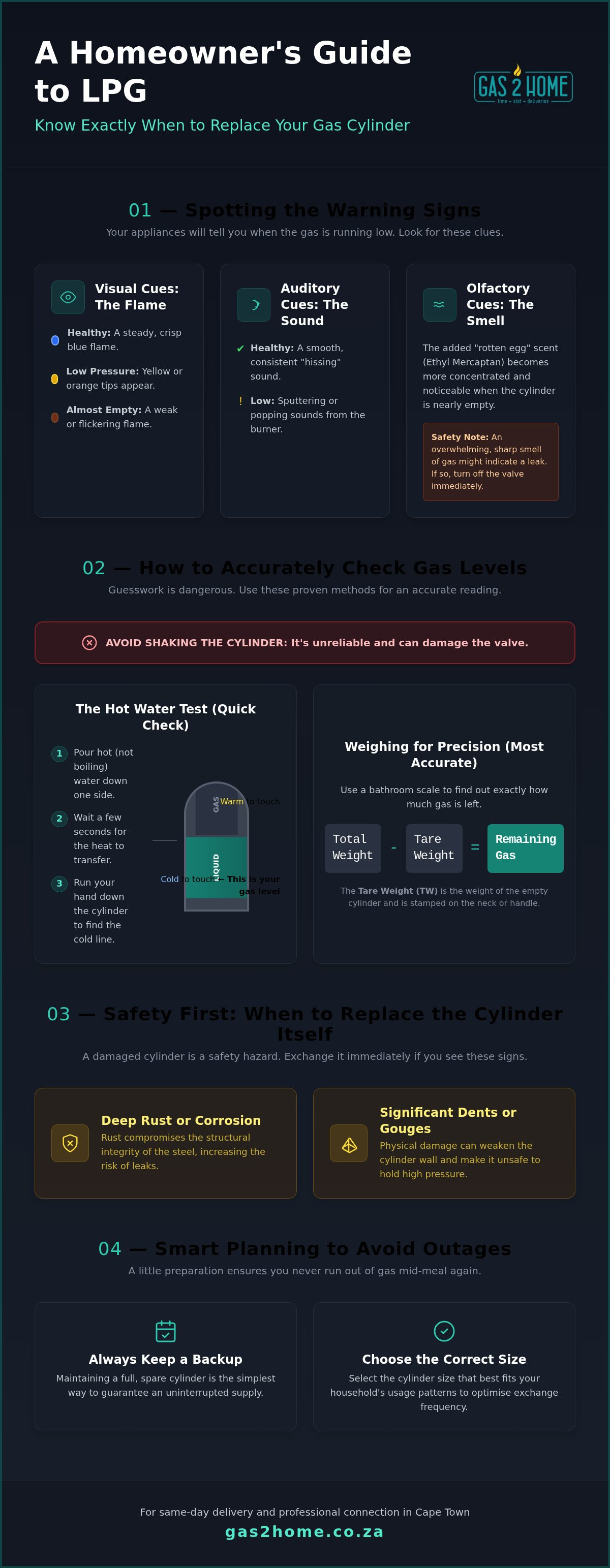
The flame on your burner is your most immediate diagnostic tool. A healthy, efficient burner produces a steady, crisp blue flame. This indicates perfect combustion of the Liquefied petroleum gas. If you start seeing orange or yellow tips, the pressure inside the bottle is likely dropping. As the liquid level hits the bottom, impurities can also cause the flame to change colour or flicker. Watch for these specific visual signals:
- Steady Blue: Your gas is flowing well and burning efficiently.
- Yellow or Orange Tips: This suggests low pressure or a build-up of heavy ends at the bottom of the bottle.
- Flickering or Weak Flame: The gas is struggling to reach the burner, meaning the bottle is almost empty.
Olfactory and Auditory Indicators
LPG is naturally odourless. Suppliers add a chemical called Ethyl Mercaptan to give it a distinct "rotten egg" scent for safety. When a bottle is nearly empty, this scent often becomes more concentrated and noticeable. Don't ignore a sudden increase in this smell; it's a built-in warning system telling you it's time for a swap.
Listen to your appliance as well. A full cylinder provides a smooth, consistent "hissing" sound as gas flows through the regulator. When levels are low, you'll often hear sputtering or popping sounds from the burner. This happens because the pressure is no longer consistent enough to maintain a steady stream. It's a clear auditory cue that you should think about when to replace gas bottle units to avoid being caught without fuel mid-cook. However, if you smell an overwhelming, sharp scent of gas, turn off the valve immediately, as this might indicate a leak rather than just a low level.
The Accuracy Test: Measuring Your Remaining LPG Levels
Many people try to guess their remaining gas by shaking the cylinder. This is unreliable and potentially dangerous. Shaking a high-pressure vessel can stress the valve or regulator connections, which might lead to leaks. It's also impossible to tell the difference between a bottle that's 10% full and one that's 20% full just by feel. To know exactly when to replace gas bottle inventory, you need a method based on physics rather than guesswork.
LPG is stored as a liquid under pressure. When you use your appliance, that liquid "boils" into gas. This process absorbs heat from the surrounding metal, making the liquid part of the cylinder significantly colder than the empty space above it. By identifying this temperature boundary, you can see exactly how much fuel you have left. If you find your levels are critically low after testing, it's a good time to order a replacement before you start your next meal.
The Hot Water Test Step-by-Step
This is the most popular way to check gas levels without a scale. It relies on the thermal conductivity of the metal. Follow these steps carefully to ensure accuracy and safety:
- Boil a kettle of water. Let it sit for a minute so it's hot but not dangerously boiling.
- Pour the water slowly down one side of the upright cylinder. Avoid pouring it directly over the valves or the regulator.
- Wait about five seconds for the heat to transfer through the steel.
- Run your hand down the wet side of the bottle. The metal will feel warm where there's only gas, but it will suddenly feel cold to the touch at the level where the liquid gas starts.
Weighing Your Cylinder for Precision
While the water test is great for a quick check, weighing the bottle is the only way to get a precise measurement. Every cylinder has a Tare Weight (TW) stamped clearly on the neck or handle. This is the weight of the empty metal bottle. To find your gas level, place the bottle on a scale and subtract the TW from the total weight. For example, if your 9kg bottle weighs 11kg in total and the TW is 8.5kg, you have exactly 2.5kg of gas remaining.
For 9kg braai bottles, a digital luggage scale is a perfect tool. For larger 19kg or 48kg units, you'll need a sturdy floor scale. Maintaining these high standards of measurement aligns with international OSHA safety regulations regarding container handling and storage. Knowing these numbers helps you decide precisely when to replace gas bottle stock so you aren't swapping out a bottle that still has several days of use left.
Safety First: When to Replace a Damaged or Outdated Cylinder
Understanding the state of your fuel level is only one part of home safety. While the hot water test tells you if you have gas, it doesn't tell you if the container itself is dangerous. High-pressure vessels require regular inspection to prevent leaks or structural failure. You must know when to replace gas bottle equipment based on its physical condition to protect your family and your property. A damaged cylinder is a liability that no amount of careful cooking can offset.
Safe handling starts with a quick visual check every time you disconnect or reconnect your appliance. If you notice anything unusual, do not attempt a DIY fix. Instead, swap the bottle for a professionally maintained unit. This proactive approach ensures your gas system remains a helpful tool rather than a domestic hazard.
Identifying Physical Degradation
Steel cylinders are tough, but they aren't invincible. You should look for specific types of damage that compromise the metal's integrity. Surface scratches are usually cosmetic and occur during transport, but deep dents or any visible bulges are critical red flags. A bulge suggests the internal pressure has deformed the steel, which is an immediate sign of impending failure.
Rust is another major concern, especially in the humid coastal climate of Cape Town. While light surface rust can be brushed away, deep corrosion around the base or the foot ring is a serious problem. You must be particularly wary of pitting. Pitting is a form of localised corrosion that creates small, deep craters in the metal and serves as a primary cause for immediate cylinder replacement. For more detailed advice on maintaining your setup, consult a professional Propane cylinder safety guide to understand the risks of neglected equipment.
Checking the Retest and Expiry Dates
In South Africa, LPG cylinders are legally required to undergo a professional retest every 10 years. This process ensures the valve remains functional and the cylinder body can still handle high pressure. You can find the retest date stamped into the metal on the protective shroud around the valve or on the foot ring at the bottom. If the date is older than a decade, the bottle is no longer legally compliant and should be exchanged immediately.
Check the valve itself for signs of wear, such as cross-threading or a handle that is difficult to turn. A stiff valve often indicates internal debris or mechanical fatigue. If you are unsure about the state of your hardware, read our guide on the Signs of a Bad Gas Connection to learn how to identify and fix common safety risks. Knowing when to replace gas bottle units based on these legal and mechanical milestones is the most reliable way to maintain a safe kitchen environment.
Planning Your Exchange: Timing and Cylinder Size Logistics
Knowing when to replace gas bottle inventory is only half the battle. You also need a logistical plan to ensure you're never left with a cold stove. In Cape Town, the most efficient way to manage your supply is through a cylinder exchange rather than waiting for a refill. An exchange is faster and guarantees that the bottle you receive has been professionally inspected and pressure-tested. It removes the uncertainty of keeping an old, potentially outdated unit in your home.
The most effective strategy to avoid domestic stress is to maintain a "two-bottle system." By keeping a full backup, you can swap to the secondary unit the moment the first one runs dry. This gives you a comfortable window to order a gas delivery without any disruption to your daily routine. It's a simple habit that provides complete peace of mind.
9Kg vs 19kg: Is it Time to Upsize?
If you find yourself ordering a replacement every few weeks, your current cylinder size might be too small for your needs. A 9kg bottle is the standard for occasional braais and small hobs. However, if you use gas for daily family meals or room heating during the damp Cape Town winters, a 19kg or even a 48kg cylinder is far more cost-effective. Larger bottles require fewer deliveries and offer a more consistent pressure for high-draw appliances like gas fireplaces.
For more details on choosing the right fit for your home, read The 9kg Gas Cylinder Ultimate Guide. It explains the specific benefits of the most popular size in the Western Cape and helps you decide if it's time to upgrade your setup.
Avoiding the Sunday Run-out
Timing is everything when it comes to local logistics. We operate from Monday to Saturday, which means a Sunday run-out can leave you stranded until the new week begins. Make it a habit to perform your level checks every Saturday morning. This allows you to secure a same-day delivery slot before the weekend rush.
When you book your exchange, ensure your empty bottle is disconnected and ready for the driver. This keeps the process fast and frictionless. Our team handles the heavy lifting and provides a professional connection service, ensuring your new 9kg or 19kg bottle is safely installed and ready for use. By planning ahead, you turn a potential emergency into a simple, managed task.
Hassle-Free Gas Replacement in Cape Town with Gas2Home
Once you've identified the visual signs or used the hot water test to decide when to replace gas bottle stock, you need a partner who understands local logistics. We specialise in making the exchange process as smooth as possible for residents across Cape Town. From the Southern Suburbs to the Northern Suburbs, our same-day delivery service ensures you aren't left waiting with a cold stove. We operate from Monday to Saturday, providing a reliable supply of 9kg, 14kg, 19kg, and 48kg cylinders directly to your door.
Our service is built on the idea of removing domestic stress. We know that running out of gas is an inconvenience, so we've streamlined every step of the journey. Whether you're preparing for a weekend braai or keeping your home warm during a winter storm, our team is ready to assist. We focus on speed and efficiency because we value your time as much as you do.
Professional Connection: Peace of Mind Included
Handling a high-pressure cylinder can be intimidating if you aren't used to the hardware. You shouldn't have to worry about whether the regulator is seated correctly or if the seal is perfectly airtight. Our delivery team doesn't just drop off a bottle at your gate; we provide a professional connection service as part of our standard delivery. This is a vital safety feature that ensures your home remains secure.
Every time we install a new cylinder, our experts perform a thorough leak test. We check the valve, the regulator, and the hose connections to ensure everything is functioning as it should. This hands-on assistance removes the fear of handling gas and guarantees that your appliance is ready to use immediately. For a detailed look at how to navigate our digital services, read our guide on How to Order Gas Online in Cape Town.
Simple Ordering and Payment Options
We've designed our system to be as frictionless as possible for the modern homeowner. If you notice your flame flickering or the bottle feeling light, you can simply send us a message via WhatsApp. It's the fastest way to get a response and secure your delivery slot. Alternatively, use our online platform to choose a specific time window that fits your schedule.
We believe in transparency and trust. This is why we offer the convenience of paying upon delivery for your exchange. It ensures you only pay once the full bottle is safely connected and tested in your kitchen or living room. You don't have to deal with complicated upfront billing or hidden fees. Ready to top up your supply? Order your gas bottle exchange now and let our professional team handle the rest.
Keep Your Kitchen Running with Confidence
Monitoring your flame behaviour and using the hot water test ensures you never run out of LPG unexpectedly. These simple habits, combined with regular checks for physical damage and retest dates, keep your home safe and efficient. Knowing exactly when to replace gas bottle units saves you from the frustration of a cold stove and the worry of handling outdated equipment.
We make the transition to a full cylinder effortless. As a trusted local Cape Town service, we provide same-day delivery with convenient time slots to fit your busy schedule. Every delivery includes a professional connection service, so you can be certain your new bottle is installed correctly and tested for leaks by our experts. Order your gas bottle exchange for same-day Cape Town delivery and enjoy the peace of mind that comes with a reliable energy supply. You've got the tools to stay prepared; we've got the logistics to keep you cooking.
Frequently Asked Questions
How do I know if my 9kg gas bottle is empty without a scale?
You can gauge the level by lifting the bottle to feel its weight or by observing the flame on your stove. A light bottle and a flickering, orange-tinted flame are strong indicators that your supply is low. For a more precise measurement, use the hot water method described earlier in this guide. These simple checks help you decide when to replace gas bottle units before you are left with an empty cylinder mid-meal.
Is it safe to use a gas bottle that has a bit of rust on it?
Surface rust is common and usually safe, but deep corrosion or "pitting" is a major safety risk. Pitting creates small craters that can eventually lead to leaks under high pressure. If the rust is located on the base or the foot ring, it can compromise the bottle's stability. Always inspect your cylinder before use and exchange any bottle that shows signs of structural degradation or deep, flaky rust patches.
Can I swap a different brand of gas bottle with Gas2Home?
Yes, we accept all legal and standard LPG cylinders for exchange regardless of the original brand. As long as your empty bottle is in a safe, reusable condition and hasn't exceeded its 10-year retest period, you can swap it for one of our professionally maintained units. This makes the transition to our service frictionless, allowing you to enjoy same-day delivery and professional connection without needing to buy a new bottle.
What happens if I run out of gas on a Sunday in Cape Town?
We do not offer delivery services on Sundays. If you run out of gas on a Sunday, you'll need to wait until Monday morning for a replacement. To avoid being stranded, we recommend checking your gas levels every Saturday morning. This allows you to book a same-day delivery slot and ensures your kitchen remains operational throughout the weekend. Maintaining a secondary backup bottle is the best way to prevent Sunday outages.
How long does a 9kg gas bottle typically last for a family of four?
A 9kg cylinder typically lasts between three to five weeks for a family of four using it solely for daily cooking. However, if you use the gas for room heating during Cape Town's winter months, a bottle can be depleted in as little as 10 to 15 days. Your specific usage patterns and the efficiency of your appliances will ultimately determine how often you need to arrange an exchange for your household.
Why does my gas bottle feel cold or have ice on it?
It is normal for a cylinder to feel cold or develop frost during periods of high usage. As the liquid LPG "boils" into gas to fuel your appliance, it draws heat from the cylinder's steel walls. If you are using a large amount of gas quickly, such as with a powerful heater, the temperature of the metal can drop below freezing. This effect is more pronounced on humid days or when the bottle is nearly empty.
How do I check for a gas leak after replacing my bottle?
Apply a mixture of water and dishwashing liquid to the valve and regulator connections. If you see growing bubbles, there is a gas leak that requires immediate attention. Never use a flame to check for leaks. While you can perform this test yourself, our delivery team includes a professional leak test with every connection. This ensures your setup is completely airtight and safe before our driver leaves your property.
What is the Tare Weight (TW) and why does it matter for my refill?
The Tare Weight represents the weight of the cylinder when it is completely empty. You'll find this figure stamped into the metal on the bottle's neck. By subtracting this number from the total weight of the cylinder on a scale, you can calculate the exact kilograms of gas remaining. This prevents the guesswork of "shaking" the bottle and ensures you maximise the value of every LPG exchange you order.