
Safe Gas Cylinder Connection Guide for Cape Town

A secure gas cylinder connection is far more than just a tight turn of a spanner; it's a precise sequence of safety checks designed to protect your home from Cape Town’s corrosive coastal air. Most residents feel a flicker of anxiety when swapping out an empty bottle, wondering if they’ve managed a safe gas cylinder connection or if a faint scent of LPG is cause for alarm. It’s completely natural to feel cautious when dealing with pressurised fuel in your domestic space.
You deserve to enjoy the convenience of gas without the nagging worry of leaks or faulty setups. This expert guide will help you master the art of safe installation, ensuring your home remains secure whilst you cook or keep warm. We’ll walk you through identifying different valve types, the correct way to tighten fittings, and how to perform a foolproof leak test. You will learn exactly how to achieve a smell-free setup and identify the specific moments when it's time to call in a professional for assistance.
Key Takeaways
- Understand the essential anatomy of your LPG setup to identify potential failure points before they become hazards.
- Master the step-by-step process for a secure gas cylinder connection, including the critical inspection of the rubber O-ring seal.
- Recognise how Cape Town's coastal environment accelerates corrosion on regulators and why keeping cylinders upright is a non-negotiable safety rule.
- Learn to perform routine maintenance checks on your orange hose to spot perishing or cracks before a leak occurs.
- Find out how to streamline your energy needs with professional connection services that take the guesswork out of LPG safety.
Understanding Your LPG Gas Cylinder Connection Setup
LPG provides Cape Town households with a reliable energy source that remains unaffected by local power outages. It’s a highly efficient fuel, but its safety depends entirely on the integrity of your gas cylinder connection. Every setup consists of four primary parts: the cylinder itself, the main valve, a regulator, and a reinforced hose. Most South African kitchens favour the 9kg and 14kg sizes because they offer a perfect balance between longevity and ease of handling.
The regulator acts as the brain of the system. It reduces the high pressure inside the bottle to a steady, low pressure that your appliance can handle. Without this component, the gas flow would be erratic and dangerous. Maintaining this setup correctly is essential for a worry-free home environment.
Key Components of a Safe Connection
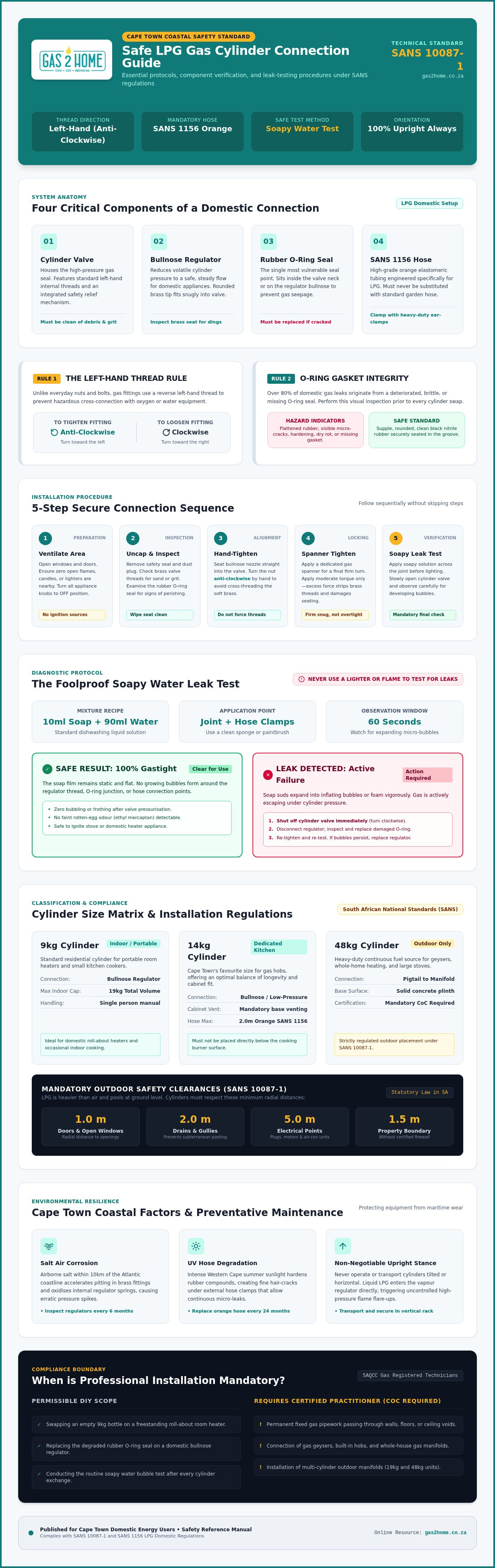
The bullnose regulator is the most common fitting for domestic cylinders. It features a rounded brass end that fits snugly into the cylinder valve. This design relies on a clean metal-to-metal or rubber-sealed fit to prevent leaks. For larger installations involving 19kg or 48kg cylinders, you will often see a pigtail connection. These are flexible, high-pressure pipes used to link cylinders to a central manifold or wall-mounted regulator.
Safety standards in South Africa are strict for a reason. You must only use the distinctive orange hose, which should be clearly marked with the SANS 1156 specification. This specific colour and grade ensure the material can withstand the chemical properties of LPG without perishing prematurely. Using a garden hose or unrated clear tubing is a major safety violation that can lead to catastrophic failure.
Size Matters: From 9kg to 48kg
Cylinder sizes dictate the type of equipment you need. While a compact camping bottle might use a simple screw-on burner, a 14kg gas bottle Cape Town setup requires a dedicated regulator and hose. Larger 48kg cylinders are typically installed outdoors. These larger units must follow specific distance requirements under SANS 10087-1, keeping them away from drains, windows, and electrical points.
One detail that often confuses new users is the thread direction. Most gas fittings use left-hand threads. This means you turn the nut anti-clockwise to tighten it. It is a deliberate safety feature designed to prevent people from accidentally connecting oxygen or water fittings to a gas line. Understanding this opposite world is the first step toward a secure gas cylinder connection.
How to Connect a Gas Bottle Safely: A Step-by-Step Guide
Before you begin your gas cylinder connection, you must prepare your environment. Safety starts with proper ventilation. Ensure your windows are open and any nearby ignition sources, like cigarettes or lighters, are far away. Double-check that your appliance is switched off at the control knobs. This prevents gas from flowing into the room the moment you open the cylinder valve.
The most critical component to inspect is the O-ring. This tiny rubber seal sits inside the valve outlet or on the tip of the regulator. If it’s cracked, perished, or missing, the connection will leak. Never attempt to use a damaged seal; instead, replace it immediately to ensure a gastight fit. Small details like this prevent massive domestic hazards.
The Connection Sequence
Start by removing the plastic safety seal and dust cap from your new cylinder. Position the regulator nozzle so it seats perfectly into the valve outlet. Remember the golden rule for gas fittings: it’s a left-hand thread. Unlike most household nuts and bolts, you turn the regulator nut anti-clockwise to tighten it. This can feel counterintuitive at first, but it is a vital safety standard designed to protect your home.
- Step 1: Align the regulator and valve carefully to avoid cross-threading the brass fittings.
- Step 2: Hand-tighten the nut as far as it will go whilst maintaining a straight alignment.
- Step 3: Use a gas spanner to give it a final, firm turn. Don’t use excessive force, as this can strip the threads or damage the regulator body.
If you’re ever unsure about performing these steps yourself, you can always rely on a professional gas connection service to handle the setup for you during your next delivery.
Testing the Seal
You must never test for leaks with a flame. The only safe DIY method is the soapy water test. Mix a few drops of dishwashing liquid with water and apply the suds liberally to the joint where the regulator meets the cylinder. Once the soap is applied, slowly open the cylinder valve to pressurise the system.
Watch the connection closely for any growing bubbles. If you see bubbles forming and expanding, you have a leak. Close the valve immediately and try re-seating the regulator. If the leak persists after a second attempt, the O-ring or the regulator itself might be faulty. A secure setup should remain completely still, with no bubbles and no scent of gas whilst the valve is open.
DIY vs Professional Gas Connection: Why Expert Setup Wins
While connecting a gas bottle might seem like a simple household chore, the margin for error is incredibly slim. Many DIY attempts result in over-tightened nuts or cross-threaded brass fittings, both of which compromise the integrity of your gas cylinder connection. Over-tightening can actually crush the internal seals, causing the very leaks you were trying to prevent. Expert technicians possess the "feel" for the correct torque, ensuring a gastight fit without damaging the equipment.
Cape Town’s coastal air presents a unique challenge for local gas users. The salt spray from the Atlantic and Indian Oceans accelerates corrosion on metal regulators and pigtails far faster than in inland regions. A professional eye is trained to spot the subtle pitting and rust that indicate a regulator is nearing the end of its safe lifespan. Ignoring these early warning signs often leads to equipment failure at the most inconvenient times.
There are also serious insurance implications to consider. Most South African home insurance policies require gas installations to be compliant with national safety standards. If an incident occurs and the cause is traced back to an improper DIY setup, your provider may have grounds to reject your claim. Using a professional service provides a layer of accountability and ensures you are following the best practices for signs of a bad gas connection that most homeowners might overlook.
The Gas2Home Advantage
Our "connected on delivery" service is designed to remove domestic stress entirely. We don't simply drop a cylinder at your gate; our technicians perform a comprehensive safety check every time they swap a bottle. We inspect the O-ring, check the hose for perishing, and ensure the regulator is functioning correctly before we leave. This service is especially valuable for those using 19kg or 48kg cylinders, which are heavy and difficult to manoeuvre into position without assistance.
When to Call the Pros
You should contact a professional immediately if you detect any of these red flags in your kitchen or heating setup. If you smell gas even when the cylinder valve is tightly closed, there is a serious fault in the system. Check your regulator’s age; if it is older than five years or shows visible rust, it needs a professional replacement. Finally, watch your flame. A healthy LPG flame is blue; if yours is consistently orange or flickering irregularly, it indicates a pressure issue or a blockage that requires expert attention.
Essential Maintenance and Safety Checks for Your Gas Setup
Maintaining a safe gas cylinder connection requires more than just an initial check. Ongoing vigilance ensures that small wear and tear issues don't escalate into significant hazards. You should perform a visual inspection of your entire setup at least once a month. Pay close attention to the orange hose. If you notice any "perishing" or tiny cracks when you gently bend the material, it is time for a replacement. These cracks are often the first sign of a future leak.
Adhering to specific replacement schedules is a non-negotiable part of domestic safety. Follow the "Five-Year Rule" for your orange hoses; even if they look perfect, the rubber compounds degrade over time. For regulators, many experts recommend a "Two-Year Rule" for inspections and potential replacement, especially in high-use environments. You can find the manufacture date stamped on most SANS-approved equipment to help you keep track of these cycles.
Storage habits are equally important. You must keep your cylinder upright at all times. Never lay it on its side, even during transport or when it feels nearly empty. LPG is stored as a liquid under pressure, and laying the bottle down can cause liquid to enter the regulator, leading to dangerous flare-ups. Ensure your storage area is well-ventilated and located at least three metres away from any heat sources or open flames.
Cape Town Specific Maintenance
Residents in coastal areas like Seapoint or Milnerton face unique challenges due to high humidity and salt air. This environment causes brass fittings to oxidise and seize. Periodically wipe down your fittings with a dry cloth to remove salt deposits. In wind-prone areas like the Southern Suburbs, ensure outdoor cylinders are chained or housed in a ventilated cabinet to prevent them from tipping over during a heavy South-Easter.
If you only use gas for braais in Cape Town during the summer, don't just leave your cylinder connected in the rain all winter. Disconnect the regulator, fit the dust cap, and store the bottle in a cool, dry, and ventilated spot. If you need a fresh bottle or a professional check before the season starts, you can order your gas delivery and connection online for total peace of mind.
The SANS 10087 Standard
South African law is very clear regarding gas safety under the SANS 10087-1 regulations. If you have a fixed installation, such as a gas hob or a built-in fireplace, you are legally required to have a Certificate of Conformity (CoC). This document proves the installation was done by a registered practitioner and is often a mandatory requirement for home insurance validity.
The standard also dictates minimum safety distances. Cylinders must be placed at least one metre away from doors and windows, and at least two metres away from drains or electrical points like plug sockets and air conditioning units. These gaps ensure that if a small leak does occur, the gas can dissipate safely rather than pooling in a low point or finding an ignition source.
Hassle-Free Gas Delivery and Connection in Cape Town
Gas2Home takes the complexity out of managing your home's energy. We understand that Cape Town residents lead busy lives, and worrying about a safe gas cylinder connection shouldn't be on your daily to-do list. Our service is built around three core pillars: speed, safety, and local reliability. We operate from Monday to Saturday, ensuring you have access to fuel when you need it most. Our team acts as a dependable neighbourhood partner, providing the quiet expertise you need for a frictionless experience.
Ordering via WhatsApp has become the preferred method for our regular customers. It is the fastest way to get your 9kg gas cylinder refilled or to request a larger 14kg, 19kg, or 48kg unit. Our delivery network is extensive, covering everything from the bustling CBD and the Atlantic Seaboard to Sunset Beach and the Southern Suburbs. We offer same-day delivery slots, so you don't have to put your life on hold while waiting for a refill.
Our Delivery Process
We operate a straightforward empty-for-full exchange system. When our driver arrives, they take your empty cylinder and replace it with a certified, safety-checked full one. We accept most major brand cylinders in good condition. The hallmark of our service is the professional gas cylinder connection we provide with every drop-off. Unlike standard courier services that leave a heavy bottle at your gate, our technicians bring the cylinder directly to your appliance.
We ensure the regulator is seated correctly and perform a live leak test before we consider the job done. This "connected on delivery" model removes the physical strain and the technical guesswork from the process. It is the gold standard for domestic safety in the Western Cape. For added peace of mind, we offer payment on delivery options. You only pay once you are satisfied that your gas setup is working perfectly and your kitchen is ready for use.
Get Started with Gas2Home
Placing your first order is simple. You can choose to book online through our streamlined portal or send us a quick message on WhatsApp. Our customers consistently tell us they prefer our scheduled time slots. It means no more "waiting all day" for a delivery truck that may or may not arrive. We respect your time and prioritise punctual service across the Cape Peninsula.
Ready for a safer home and a more reliable energy supply? Order your gas delivery and connection today and experience the convenience of a truly local, professional service.
Enjoy Safer Home Energy Today
Mastering a secure gas cylinder connection is the best way to protect your household whilst enjoying the many benefits of LPG. You now know how to inspect your equipment, identify the signs of wear, and perform a reliable leak test using simple soapy water. These small habits prevent big risks and ensure your kitchen remains a safe space for your family. Remember that Cape Town’s salt air demands extra vigilance, so keep your brass fittings clean and your hoses fresh.
If you would rather skip the heavy lifting and technical guesswork, our trusted local LPG experts are ready to assist. We have been serving the peninsula with reliable energy solutions since our founding, and we take pride in being your dependable neighbourhood partner. We include a professional connection with every exchange to give you total peace of mind before we leave your doorstep.
Don't leave your domestic safety to chance. With our same-day delivery slots and expert technicians, getting your fuel sorted is faster and easier than ever. Order your gas delivery and professional connection now to experience a truly frictionless service. We look forward to helping you keep your home running smoothly and safely.
Frequently Asked Questions
Is it safe to connect a gas cylinder myself?
It is safe to connect a gas cylinder yourself if you strictly follow the manufacturer’s instructions and perform a soapy water test. However, many Cape Town residents prefer the peace of mind that comes with a professional setup. A secure gas cylinder connection requires physical strength and a keen eye for damaged seals. If you’re unsure, it’s always better to let a technician handle the installation during your scheduled delivery.
Why does my gas cylinder connection smell like rotten eggs?
That distinctive "rotten eggs" smell is a safety odorant added to LPG to help you detect leaks. If you notice this scent around your gas cylinder connection, you must close the cylinder valve immediately and ventilate the room. The smell usually indicates a perished O-ring, a loose fitting, or a hole in the orange hose. Don't use any electrical switches or open flames until the scent has completely dissipated and the leak is fixed.
How do I know if my gas regulator is faulty?
You can identify a faulty regulator by checking for specific performance issues or physical damage. A healthy flame should be a steady blue; if it’s consistently orange or flickering, your regulator might be failing to manage the pressure correctly. In coastal areas like Milnerton, look for signs of salt-induced corrosion or rust on the regulator body. If the unit is older than five years or feels "sticky" to operate, replace it to maintain safety.
Which way do I turn the nut to connect a gas bottle in South Africa?
In South Africa, you must turn the regulator nut anti-clockwise to tighten it. This is known as a left-hand thread and is a standard safety feature for domestic LPG bottles. It prevents you from accidentally connecting high-pressure gas fittings to standard water or oxygen pipes. When you’re loosening the nut to swap a bottle, you will turn it clockwise. Always ensure the threads are aligned correctly before applying pressure to avoid cross-threading the brass.
How often should I replace my gas hose and regulator?
You should follow the industry standard "Five-Year Rule" for your orange SANS 1156 hoses. Even if they look fine, the rubber degrades internally over time. Regulators generally require a replacement or a professional inspection every two to five years. In Cape Town’s humid coastal environment, these components may perish faster due to salt air. Regularly check the manufacture date stamped on your equipment to ensure you stay within these safe operational limits.
Can I use a spanner to tighten my gas connection?
Yes, using a dedicated gas spanner is the best way to ensure a firm, gastight fit. You should hand-tighten the nut first to ensure the threads are properly engaged, then use the spanner for a final quarter-turn. Avoid using excessive force or oversized plumbing wrenches, as these can strip the soft brass threads or crush the rubber O-ring seal. A snug fit is the goal; over-tightening is a common cause of leaks.
What should I do if I find a leak during the soapy water test?
If you see bubbles forming during a soapy water test, close the cylinder valve immediately to stop the flow of gas. Disconnect the regulator and inspect the rubber O-ring for cracks or debris. Re-seat the regulator carefully and tighten it again before repeating the test. If bubbles still appear on the second attempt, the equipment is likely faulty. You must not use the appliance until a technician has replaced the damaged parts.
Does Gas2Home connect the gas bottle for me upon delivery?
Yes, Gas2Home provides a professional connection service included with every delivery from Monday to Saturday. Our technicians don’t just drop the bottle at your gate; they bring it to your appliance, perform the exchange, and ensure the system is gastight. We conduct a safety check on your hose and regulator during every visit. This service ensures you can start cooking or heating with total confidence the moment our team leaves.