
Safe Gas Cylinder Connection Guide for Cape Town

You’ve just finished a long day in Cape Town and want to cook a warm meal, but as you twist the regulator, that distinct smell of gas fills the kitchen. It’s a moment that stops you in your tracks. Many homeowners feel a genuine sense of anxiety when dealing with high-pressure cylinders. This is common when you face gas bottle connection problems like stubborn threads or perished seals. You want the convenience of LPG without the fear of a potential leak or explosion.
We understand that safety is your top priority. Master the art of safe gas cylinder connection with our expert guide. This ensures your home remains secure whilst you enjoy the convenience of LPG. You’ll gain the confidence to identify leaks and understand exactly when it’s time to call in a professional. This guide covers the essential SANS standards for South African homes and provides a clear process for managing your setup. We will walk you through different valve types, explain why some threads turn the wrong way, and show you how to achieve a secure, smell-free connection every time.
Key Takeaways
- Learn how to identify the essential components of your LPG setup, including the regulator and hose, to ensure every part is in working order.
- Discover how to solve common gas bottle connection problems like perished O-rings or cross-threading before they become safety risks.
- Master the simple safety checks that protect your home, such as inspecting the orange hose for cracks and keeping cylinders upright at all times.
- Understand how Cape Town’s coastal air affects your equipment and why regular professional inspections are vital for long-term safety.
- Find out how to streamline your gas supply with professional connection services that take the stress out of every delivery.
Understanding Your LPG Gas Cylinder Connection Setup
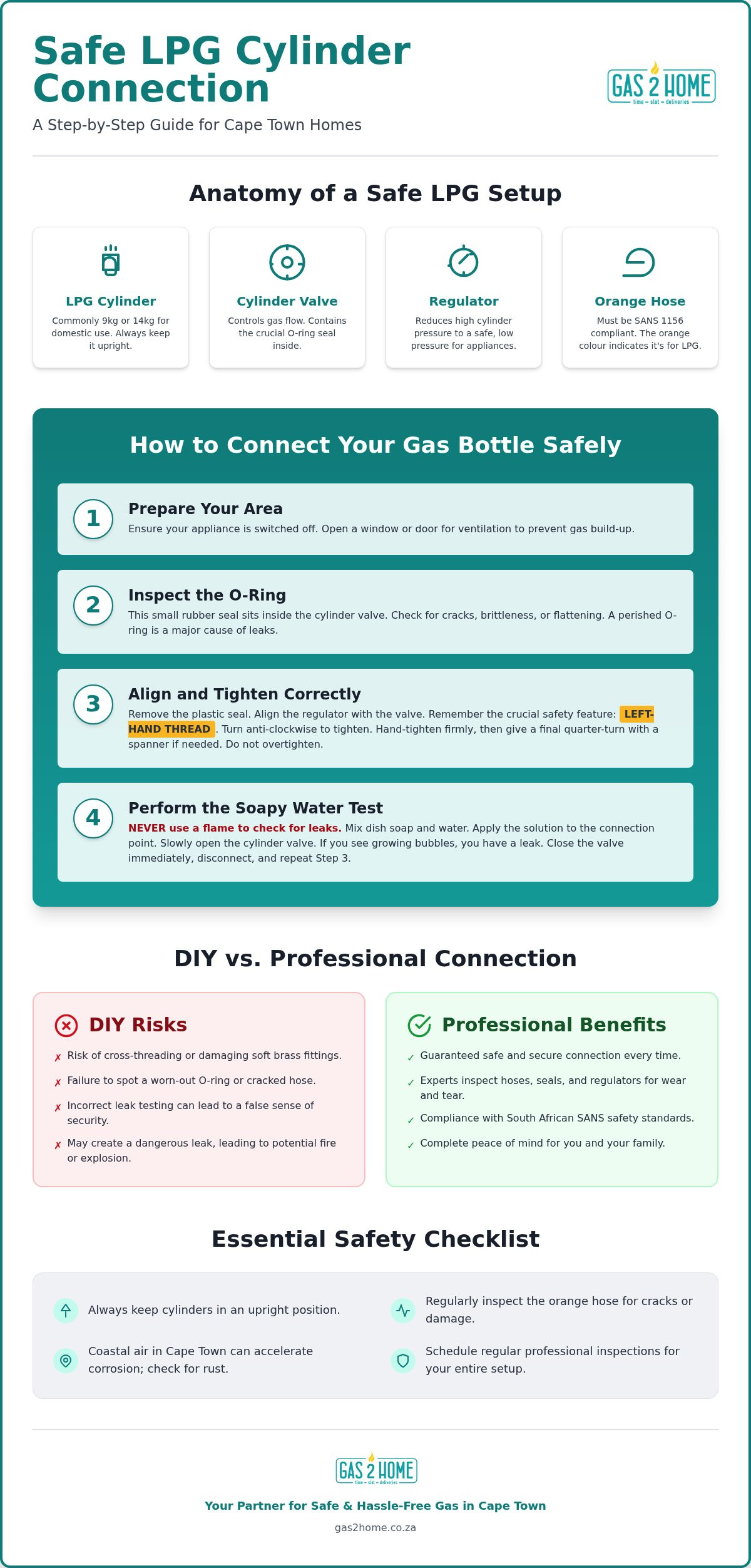
Liquefied Petroleum Gas (LPG) is a highly efficient fuel for Cape Town homes. It offers a reliable alternative to the electrical grid, providing instant heat for cooking and warmth. A safe setup depends on four main parts: the cylinder, the valve, the regulator, and the hose. If any of these components fail, you will likely encounter gas bottle connection problems that can disrupt your home routine or create safety risks.
Most South African kitchens rely on 9kg or 14kg cylinders. These sizes are the favourites because they are easy to handle and fit into standard cupboards. The regulator is the most critical safety device in this chain. It reduces the high pressure from the bottle to a low, consistent pressure that your stove or heater can handle safely. Without a functioning regulator, the gas flow would be uncontrollable and dangerous.
Key Components of a Safe Connection
The Bullnose regulator is the most common fitting for domestic use in South Africa. It features a rounded metal tip that seats directly into the cylinder valve. For larger installations involving 19kg or 48kg cylinders, we use a flexible connector called a pigtail. This connects the bottle to a wall-mounted manifold or fixed piping system. You must also use the correct orange hose. This hose must comply with SANS 1156 standards. The bright colour is a safety requirement; it indicates the material is specifically designed to handle LPG without perishing or leaking over time.
Size Matters: From 9kg to 48kg
Identifying your cylinder size is the first step in ensuring a secure fit. A 9kg gas cylinder setup is generally straightforward and usually involves a direct connection to a single appliance. Larger 48kg bottles often require more complex manifold systems to manage higher flow rates for whole-house heating or commercial use.
One of the most common gas bottle connection problems for new users is the left-hand thread. Unlike standard screws, most gas fittings tighten by turning to the left, or anti-clockwise. This is a deliberate safety feature. It prevents people from accidentally connecting gas equipment to water or oxygen lines. Understanding this "opposite world" of threads will save you from stripping the brass fittings or damaging the seal on your regulator.
How to Connect a Gas Bottle Safely: A Step-by-Step Guide
Connecting a gas bottle is a simple task, but it requires your full attention. Safety begins with preparation. Before you touch the cylinder, ensure your gas heater or stove is switched off completely. Open a nearby window or door to allow fresh air to circulate. This simple step prevents gas buildup in the unlikely event of a leak during the process.
Next, inspect the O-ring. This tiny rubber seal is the most important part of your connection. It sits inside the valve outlet on the cylinder. If the rubber looks cracked, brittle, or flattened, it won't create an airtight seal. Many gas bottle connection problems stem from a perished O-ring, which allows gas to hiss out even when the regulator is seemingly tight. If you aren't confident doing this yourself, you can always order your refill from a provider that includes professional connection as standard.
The Connection Sequence
Start by removing the plastic safety seal and the dust cap from your full cylinder. Keep the dust cap in a safe place for when the bottle is empty. Align the regulator nozzle perfectly with the valve outlet. Remember the left-hand thread rule: you must turn the nut to the left, or anti-clockwise, to tighten it. This is the opposite of a standard screw.
Tighten the nut by hand until it feels firm. You can use a spanner for a final quarter-turn, but be careful. Brass is a soft metal. If you apply too much force, you risk stripping the threads or damaging the regulator. A snug, hand-tight fit is usually sufficient to engage the seal and prevent leaks.
Testing the Seal
Never use a flame to test for leaks. The only safe way to check your work is the soapy water test. Mix a few drops of dishwashing liquid with water in a spray bottle or bowl. Apply the suds generously to the connection point and the length of the orange hose. Open the cylinder valve slowly and watch the suds closely.
If you see bubbles growing or multiplying, you are likely facing one of the most common gas bottle connection problems: a misaligned regulator or a worn seal. Close the valve immediately and re-seat the regulator. Whilst South African safety standards are governed by SANS, following international benchmarks like the OSHA LP-Gas regulations ensures you are using the safest possible methods. If the leak persists after re-tightening, the regulator or the cylinder valve may be faulty and will require professional attention.
DIY vs Professional Gas Connection: Why Expert Setup Wins
Attempting a DIY fix might seem like a quick way to save time, but it often leads to common gas bottle connection problems that compromise your safety. Brass fittings are soft. If you force a regulator into the valve at the wrong angle, you will strip the threads. This cross-threading creates micro-gaps where gas can escape. Over-tightening is another frequent mistake. Many people believe tighter is always better, but excessive force can crush the O-ring and cause it to fail prematurely.
Cape Town’s coastal environment adds another layer of risk to your gas setup. Salt spray in the air accelerates corrosion on metal regulators and valves. A professional eye can distinguish between superficial surface rust and deep corrosion that has compromised the internal spring mechanism. Technicians are trained to spot signs of a bad gas connection that the average homeowner might overlook, such as hairline cracks in the orange hose or a flattened O-ring that no longer provides a proper seal.
Insurance implications are also a major factor for South African homeowners. Most local insurance policies require fixed gas installations to be handled by registered professionals. If an incident occurs and the investigation reveals that a DIY connection was the primary cause, your claim could be rejected. Using a professional service ensures that your home remains covered and your family stays safe.
The Gas2Home Advantage
We believe safety shouldn't be an optional extra. Our "connected on delivery" service is the gold standard for Cape Town residents. Every time we deliver a cylinder, our technicians perform a thorough safety check. They swap the bottle, connect the regulator, and test the entire system for leaks before they leave your property. This service removes the physical stress of moving heavy 19kg or 48kg cylinders. You get peace of mind knowing the job was done correctly by experts who understand local logistics.
When to Call the Pros
Safety is about knowing your limits. Call a professional immediately if you smell gas even when the cylinder valve is turned off. This suggests a leak in the manifold or the appliance itself. You should also consider replacing your regulator if it is older than five years or shows visible rust. Finally, check your flame colour. A healthy LPG flame is blue. If your stove produces an orange or flickering flame, it indicates incomplete combustion or a regulator failure. Don't take chances with your home's security; get expert help when things don't look right.
Essential Maintenance and Safety Checks for Your Gas Setup
Prevention is always better than a midnight emergency. Proactive maintenance is the best way to avoid common gas bottle connection problems before they disrupt your home. Start by inspecting your orange hose, which must be SANS 1156 compliant. Bend the hose slightly at different points. If you see tiny hairline cracks or the material feels brittle, the rubber is perishing. This is a major safety risk that requires an immediate replacement.
You must also follow the industry standard replacement cycles. We recommend the Two-Year Rule for regulators and the Five-Year Rule for hoses. Even if a regulator looks fine on the outside, internal components like the diaphragm can wear down or lose tension. Additionally, always keep your cylinder in an upright position. Never lay a bottle on its side, even for transport. Liquid gas can enter the regulator if the bottle is tilted, which leads to equipment failure and potential fires.
Cape Town Specific Maintenance
Living near the ocean brings unique challenges for gas users. If you live in Seapoint, Milnerton, or Blouberg, salt spray in the air will cause brass fittings to oxidise and turn green. This buildup can interfere with the thread's ability to seat properly. Wipe your fittings with a dry cloth regularly to prevent this crust from forming. For residents in the Southern Suburbs or on the slopes of Table Mountain, wind protection is vital. Ensure outdoor cylinders are secured in a ventilated cage or strapped to a wall. This prevents the wind from knocking them over or causing the hose to rub against abrasive surfaces. If you are storing gas for your braai during the winter months, keep the cylinder in a cool, well-ventilated area away from direct sunlight.
The SANS 10087 Standard
South African law is very specific about how gas should be managed. The SANS 10087-1:2024 standard governs all domestic installations. If you have a fixed gas setup, such as a built-in hob or a geyser, you must have a valid Certificate of Conformity (CoC). This document is essential for insurance purposes and is required when you sell your property. The regulations also specify minimum safety distances that you must respect. For example, a cylinder cannot be placed closer than 1 metre to any door or window. It must also remain at least 5 metres away from any electrical point, such as an outdoor plug or a pool pump. If your current setup doesn't meet these rules, it is time to arrange a professional connection service to bring your home up to standard.
Hassle-Free Gas Delivery and Connection in Cape Town
Managing your home's energy shouldn't be a chore. Gas2Home simplifies the entire journey from the moment you place an order to the first ignition of your stove. We know that many residents struggle with gas bottle connection problems, especially when dealing with heavy cylinders or confusing thread directions. Our service is designed to eliminate that friction. By choosing a professional delivery partner, you ensure your home remains safe without having to master every technical detail yourself.
We cover a wide range of Cape Town neighbourhoods. Whether you are in the busy CBD, the windy streets of Sunset Beach, or the leafy Southern Suburbs, our team is ready to assist. We offer same-day delivery slots to fit into your busy schedule. You don't need to wait at home all day. Pick a time that works for you, and we will be there. Our goal is to provide a frictionless experience that removes domestic stress.
Our Delivery Process
Our system is built on a straightforward empty-for-full exchange. We accept all legal South African cylinders for exchange, provided they are in a safe, reusable condition. Unlike services that simply drop a bottle at your gate, we provide a complete professional connection. Our technicians carry the heavy bottle to your installation point, connect the regulator, and perform a safety check. We only leave once we are certain your setup is secure and leak-free. For your peace of mind, we also offer payment on delivery, ensuring a transparent and trustworthy transaction every time.
Get Started with Gas2Home
If you are new to LPG, learning how to order gas online in Cape Town is the first step toward a more efficient home. Most of our regular customers prefer ordering via WhatsApp. It is the fastest way to get your refill organised and confirm your delivery slot immediately. Our scheduled time slots are a favourite amongst busy professionals who cannot afford to waste hours waiting for a delivery van. We value your time as much as your safety. Ready for a safer home? Order your gas delivery and connection today and let us handle the heavy lifting for you.
Secure Your Home with a Professional Gas Setup
Maintaining a safe home environment starts with a reliable LPG setup. You now know how to inspect your O-rings, check for perishing hoses, and navigate the "opposite" world of left-hand threads. These simple steps prevent common gas bottle connection problems and ensure your appliances run efficiently. Remember that Cape Town’s coastal air requires extra vigilance to stop corrosion before it damages your regulator.
You don't have to manage these technical details alone. We provide a frictionless service that takes the heavy lifting and the guesswork out of your hands. Our trusted local experts have been serving the Cape Town community with quiet expertise since our founding. Every exchange includes a professional connection and a thorough safety check as standard. We even offer same-day delivery slots to fit into your busy schedule.
Order your gas delivery and professional connection now
Stay safe and enjoy the convenience of a perfectly connected home.
Frequently Asked Questions
Is it safe to connect a gas cylinder myself?
Yes, you can connect a cylinder yourself if you follow the safety steps precisely. Many homeowners experience gas bottle connection problems when they rush the process or ignore the condition of the rubber seals. If you are uncomfortable handling high-pressure cylinders, it is much safer to have an expert do it. We include professional connection with every delivery to ensure your home remains secure and your setup is perfectly airtight before you begin cooking.
Why does my gas cylinder connection smell like rotten eggs?
That odour is a safety additive called ethyl mercaptan, designed to alert you to a leak. If you smell gas near the connection, close the cylinder valve immediately and open all windows for ventilation. This usually indicates a loose regulator or a damaged seal. Do not use any electrical switches or naked flames until the smell has completely cleared. Perform a soapy water test to locate the exact source of the leak before attempting to re-connect.
How do I know if my gas regulator is faulty?
A faulty regulator often shows physical signs like heavy corrosion, oil residue, or a buzzing sound whilst in use. You might also notice your stove flames are flickering or have turned a bright orange colour. In Cape Town, the salty sea air can cause the internal spring to fail faster than in inland areas. If your regulator is older than two years, it is time to replace it to maintain a safe and consistent gas pressure for your appliances.
Which way do I turn the nut to connect a gas bottle in South Africa?
In South Africa, you turn the nut to the left, or anti-clockwise, to tighten it. This is a left-hand thread, which is the opposite of a standard screw. This safety feature ensures that gas fittings are never confused with other utility connections. Always align the regulator by hand first to ensure the threads catch correctly. If you feel resistance, stop and re-align the nut to avoid damaging the soft brass fittings on your cylinder valve.
How often should I replace my gas hose and regulator?
You must replace your orange SANS 1156 hose every five years and your regulator every two years. These components degrade over time due to pressure and environmental factors. Using equipment past its expiry date is a common cause of gas bottle connection problems and potential leaks. Always check the manufacturing date printed on the hose. If the rubber feels brittle or shows hairline cracks, replace it immediately, regardless of how long you have owned it.
Can I use a spanner to tighten my gas connection?
You should only use a spanner for a final, gentle quarter-turn if the connection feels loose. Most modern bullnose regulators are designed for hand-tightening. Using excessive force with a spanner can strip the brass threads or permanently deform the rubber O-ring. If you cannot achieve a gas-tight seal by hand, there is likely a problem with the alignment or the rubber seal itself. A snug, firm fit is all that is required for a safe connection.
What should I do if I find a leak during the soapy water test?
If bubbles appear during your test, close the cylinder valve at once to stop the gas flow. Disconnect the regulator and check the O-ring for any grit or damage. Re-seat the regulator carefully and try the test again. If the bubbles persist, the seal is compromised or the regulator is faulty. Do not attempt to use the appliance. You must replace the damaged part or call a professional to ensure your connection is safe before ignition.
Does Gas2Home connect the gas bottle for me upon delivery?
We certainly do. Our service includes professional connection with every cylinder exchange. Our technicians don't just drop the bottle at your gate; they carry it to your kitchen or patio and ensure it is properly fitted to your appliance. We perform a safety check and a leak test on every delivery to give you peace of mind. This service is available from Monday to Saturday for all our Cape Town customers, covering all cylinder sizes.