
How to Connect a Gas Bottle to a Cooker in Cape Town

Have you ever stood over a heavy 19kg cylinder, wondering if you're turning the regulator the wrong way while your family waits for dinner? It's a common frustration for many households trying to connect gas bottle to stove Cape Town. Dealing with high-pressure LPG can feel intimidating, especially when you're worried about leaks or the physical strain of moving large bottles. We agree that you want a working kitchen without the nagging fear of a faulty connection.
This guide teaches you the essential safety steps for a secure connection and explains why professional support is the smartest choice for your home. We'll walk through identifying regulator types, mastering the left-hand thread, and performing the critical soapy water leak test. You'll also learn how to stay compliant with SANS 10087-1:2024 safety standards so you can cook with total confidence every night. By following a clear, step-by-step process, you can ensure your appliance is safe and ready for your next meal.
Key Takeaways
- Identify your equipment correctly to ensure your kitchen setup meets the latest South African safety standards.
- Follow a clear, step-by-step method to connect gas bottle to stove Cape Town using the correct left-hand thread technique.
- Master the simple soapy water test to confirm your connection is 100% airtight before you ignite a burner.
- Understand the legal requirements for a Certificate of Compliance (CoC) to protect your home and your insurance.
- Discover how professional connection services take the physical strain and safety guesswork out of your gas exchange.
Understanding Gas Bottle Connections for Cape Town Homes
Every safe kitchen starts with a solid foundation. To safely connect gas bottle to stove Cape Town, you must understand how the four main parts work together. Your setup includes the cylinder holding the fuel, the regulator controlling the pressure, the flexible hose, and the stove. Understanding LPG is the first step in ensuring your home remains a safe environment for your family. Each component must be in peak condition to prevent leaks and ensure a steady flame for your cooking.
Most households in the city rely on a 9kg gas cylinder for their daily needs. It is the most popular choice because it fits easily into standard kitchen cupboards and provides enough fuel to last several weeks. In South Africa, you will typically encounter Bullnose regulators which use a left-hand thread. However, some newer appliances use LCC27 connections. You must match your regulator type to your cylinder valve exactly to create an airtight seal.
Local conditions play a significant role in how long your equipment lasts. If you live near the coast in areas like Sea Point or Muizenberg, salt air and humidity accelerate corrosion. Check your metal regulator and hose clamps frequently for signs of rust or pitting. Coastal corrosion can weaken these parts over time, leading to microscopic gaps where gas can escape. Replacing these components every few years is a small price to pay for peace of mind.
Portable vs. Fixed Gas Supplies
Portable bottles offer incredible flexibility for Cape Town residents. They are the most efficient choice if you want to avoid the cost of a permanent gas installation. Under South African residential bylaws, you are legally permitted to store a maximum of 19kg of LPG indoors. This usually means one 9kg bottle connected to your stove and one spare. A reinforced orange LPG hose is the only safe way to connect these portable cylinders. It must be a single length without joins and should never exceed 2 metres.
Key Components of a Safe Connection
The regulator is the heart of your safety system. It reduces the high pressure inside the bottle to a steady, low pressure your stove can handle safely. Without a functioning regulator, the gas flow would be uncontrollable and dangerous.
The rubber O-ring or washer is the most common point of failure in any connection. This tiny seal sits inside the regulator nose and prevents gas from slipping through the threads. If the rubber looks cracked, brittle, or flattened, do not attempt to use it. Always keep a few spare washers in your kitchen drawer. Finally, ensure your hose clamps are tightened securely at both ends. These clamps provide the final permanent seal that keeps the gas inside the system where it belongs.
Step-by-Step Guide: Connecting Your LPG Cylinder to Your Stove
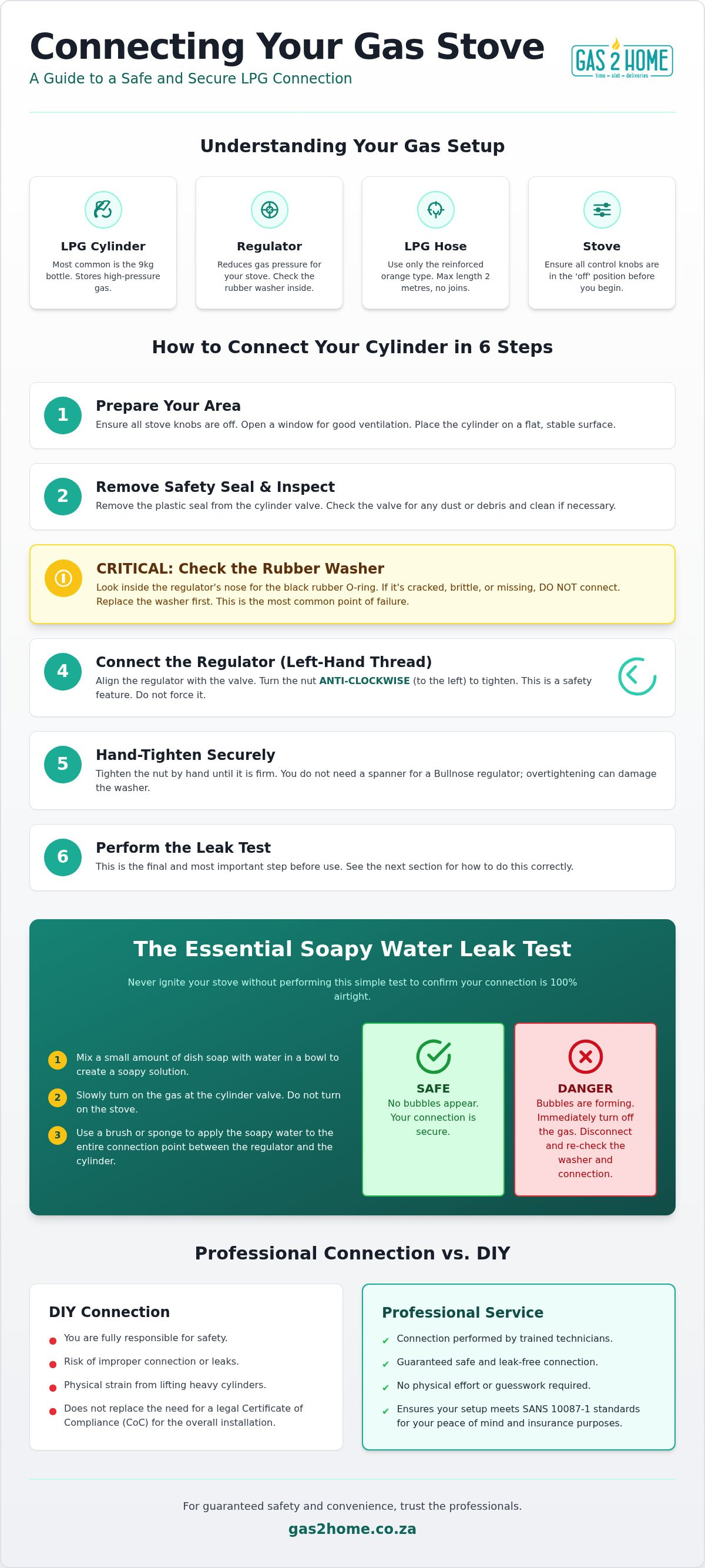
Before you touch the cylinder, check your stove. Every knob must be in the "off" position. Open a window to ensure the kitchen is well-ventilated. These small steps are critical for your safety. Once prepared, remove the plastic safety seal from the cylinder valve using your fingers or a blunt tool. Avoid using sharp knives that could nick the brass valve or damage the internal threads. Inspect the valve for any dust or debris before proceeding.
Now you are ready to connect gas bottle to stove Cape Town. Position the cylinder on a flat, stable surface. Pick up your regulator and align it carefully with the valve opening. This is where many people encounter their first hurdle. Most South African gas cylinders use a specific "left-hand thread" system that works in the opposite direction of standard household screws.
The Left-Hand Thread Explained
Standard screws and bolts follow the "righty-tighty" rule. Gas fittings are different. You must turn the regulator nut to the left, or anti-clockwise, to tighten it. This design is a safety feature. It prevents people from accidentally connecting gas equipment to high-pressure water or oxygen lines. Look for small notches on the nut; these usually indicate a left-hand thread. Avoid forcing the nut if it feels stuck. Cross-threading the brass valve is a costly mistake that often ruins the cylinder valve entirely.
Inspecting the Rubber Washer (O-Ring)
Before you tighten the connection, look inside the nose of the bullnose regulator. You should see a black rubber ring. This washer is the only thing standing between a perfect seal and a dangerous leak. Check for cracks, hardening, or missing segments. If the rubber feels brittle or looks damaged, stop immediately. Following South African gas regulations ensures your equipment is always fit for purpose. Never attempt to use a regulator if the washer is compromised.
Learning how to connect gas bottle to stove Cape Town properly is a vital skill for every homeowner. Tighten the nut by hand first. Once it is finger-tight, use a gas spanner to give it an extra quarter-turn. Do not over-tighten it; you only need a firm seal, not a permanent weld. Finally, open the cylinder valve very slowly. Listen carefully for a sharp hiss which indicates an immediate leak. If you hear nothing, you are ready for the final safety checks. If this process feels intimidating, remember that a professional connection service can handle the heavy lifting and technical checks for you.
Professional Installation vs. DIY: Safety and Compliance in South Africa
Deciding between a DIY approach and professional help is more than just a matter of convenience. When you connect gas bottle to stove Cape Town, you're handling a flammable substance under pressure. While many residents swap their own 9kg cylinders, understanding where the law draws the line is essential for your safety and your wallet. Professional installers provide a level of scrutiny that goes beyond just tightening a nut. They ensure your entire setup complies with the latest LPG safety standards, protecting your family from avoidable risks.
DIY connections often carry hidden dangers that are easy to overlook. You might miss subtle signs of a bad gas connection, such as microscopic cracks in the hose or a slightly misaligned regulator. Insurance implications are also a major factor. Most South African providers require proof that gas appliances were installed correctly. If a fire occurs and the investigation reveals a faulty DIY connection, your provider could legally deny your claim. Expert eyes can also spot a hose that has been perished by UV rays or kitchen heat before it becomes a hazard.
Understanding the Gas COC in Cape Town
A Certificate of Compliance (CoC) is a legal requirement for all fixed gas installations in South Africa. This includes any stove connected to a cylinder via permanent piping. A registered installer will check that your bottle placement meets distance regulations from doors, windows, and electrical points. If you're selling your home in Cape Town, you must provide a valid CoC to the buyer. While a portable 9kg bottle used with a simple hose doesn't always require a CoC, any modification to your home's gas lines must be certified by a registered practitioner.
Common DIY Mistakes to Avoid
One of the most frequent mistakes is using PTFE thread tape on bullnose regulators. These fittings are designed to seal using the rubber washer, and tape can actually prevent a proper seal. Over-tightening is another risk. It's easy to strip the soft brass threads on the valve, which ruins the cylinder and causes leaks. Many people also forget the golden rule of gas safety: always perform a soapy water test. Never rely on your sense of smell alone to confirm that a connection is airtight. Taking these precautions ensures your kitchen remains a safe space for everyone.
Essential Safety Checks After Connecting Your Gas Bottle
Once you have finished the physical setup, you must verify that the seal is airtight before you strike a match. Connecting the hardware is only half the job. When you connect gas bottle to stove Cape Town, your safety depends on a series of quick but non-negotiable checks. You cannot rely on sight alone to detect a problem. Instead, use your senses of smell and hearing to identify immediate issues. LPG has a distinct "rotten egg" odour added specifically to help you spot leaks. If you smell this scent or hear a faint hissing sound near the regulator, close the cylinder valve immediately.
How to Perform the Soapy Water Test
The soapy water test is the most reliable way to find a leak at home. Mix a solution of water and common dishwashing liquid in a small container. You want a thick, foamy lather. Use a sponge or a brush to apply the suds liberally over the regulator connection, the valve, and both ends of the orange hose. Open the gas valve slowly whilst the stove knobs remain off. Watch the bubbles closely. If they start to grow or multiply, you have a leak. This indicates that gas is escaping and pushing through the soap. Dry the connection, tighten the nut slightly, and test again. If the bubbles persist, the regulator or washer may be faulty.
Proper Storage and Ventilation
Your gas bottle must always remain in an upright position. This is a critical safety rule. LPG exists as a liquid inside the cylinder and only turns into a gas as it exits. If the bottle is tilted or lying down, liquid gas can enter the regulator. This causes a dangerous flare-up at the stove. Additionally, ensure your kitchen has constant airflow. Gas needs oxygen to burn cleanly, and good ventilation prevents the build-up of carbon monoxide.
Always store your cylinders in a well-ventilated area above ground level. LPG is heavier than air, meaning it will sink and collect in low-lying spots. Never store a bottle in a basement, near an open drain, or under a floor void. If a leak occurs in these areas, the gas won't dissipate, creating a significant fire hazard. If you ever suspect a large leak that you cannot stop by closing the valve, evacuate the room immediately. Do not use light switches, torches, or mobile phones near the leak, as a tiny spark can ignite the gas.
Taking these steps ensures your home remains safe whilst you enjoy the convenience of gas cooking. If you want to skip the stress of testing and tightening, book a professional gas connection service with your next delivery to ensure your setup is perfect from the start.
Seamless Gas Delivery and Connection Services in Cape Town
Many Capetonians find the technical side of gas safety a bit overwhelming. Gas2Home simplifies the entire process by combining reliable delivery with expert assistance. We understand that your priority is a working kitchen and a safe home. By choosing a service that handles the technical details, you remove the guesswork from your domestic routine. Learning the basics of ordering gas online in Cape Town is the first step toward a more convenient and secure household.
Our team doesn't just drop off a cylinder at your gate and leave you to figure out the rest. We provide a professional connection service with every single delivery. This means our trained staff will safely connect gas bottle to stove Cape Town while you watch. We check the seal, test the regulator, and ensure your burners ignite perfectly before we depart. This comprehensive approach ensures that you never have to worry about a loose fitting or a faulty washer again. It's the most reliable way to maintain your kitchen's safety standards without needing to own a specialized tool kit.
Why Our Connection-on-Delivery Service is a Favourite
Physical strain is a major concern for many of our customers. Lifting and manoeuvring a heavy 19kg or 48kg cylinder into a tight kitchen cupboard is difficult and potentially dangerous. Our delivery team handles all the heavy lifting for you. Beyond the physical help, we provide a vital safety check at every exchange. We inspect your regulator and orange hose for signs of wear, heat damage, or coastal corrosion. If we spot a problem, we'll let you know immediately. This proactive service gives you total peace of mind, knowing your stove is ready for use the moment we leave your home.
Ordering via WhatsApp for Ultimate Convenience
We've designed our system to be as frictionless as possible. Using WhatsApp is the fastest way to organise a gas exchange in 2026. You don't need to navigate complex websites or wait on hold. Simply send us a message to request your 9kg, 14kg, 19kg, or 48kg cylinder. We offer scheduled delivery time slots from Monday to Saturday, so you don't have to wait around all day. To keep things secure and straightforward, we offer payment on delivery. This local, trusted approach ensures you only pay once the job is finished and your stove is working perfectly.
Whether you're in Sunset Beach, Milnerton, or anywhere else in the Greater Cape Town area, we're your dependable neighbourhood partner. We take pride in our same-day service, ensuring that a mid-cook gas outage is nothing more than a minor pause. By trusting professionals to connect gas bottle to stove Cape Town, you're choosing a safer, easier way to manage your home's energy needs.
Enjoy Safe and Effortless Cooking Today
Managing your home's energy shouldn't be a source of stress. By mastering the left-hand thread and performing regular soapy water tests, you can maintain a high standard of safety in your kitchen. Remember that South African regulations limit indoor storage to 19kg, so keep your setup compliant to protect your home and insurance. Whilst you now have the steps to connect gas bottle to stove Cape Town yourself, you don't have to handle the heavy lifting alone.
Order your gas exchange now and let us handle the connection for you. Our service includes a professional connection with every delivery, ensuring your stove is ready for dinner immediately. We offer same-day delivery across Cape Town and the convenience of paying on delivery via WhatsApp. Safe cooking is just a message away. Get back to what matters most and leave the technical details to your local experts.
Frequently Asked Questions
Do I turn the gas regulator left or right to tighten it?
You must turn the gas regulator to the left, or anti-clockwise, to tighten the connection on a standard bullnose cylinder. This is known as a left-hand thread. It is a safety feature designed to prevent people from accidentally connecting gas equipment to standard right-hand threaded water or oxygen lines. Always ensure the nut is aligned straight before turning to avoid cross-threading, which can permanently damage the brass valve on your cylinder.
How do I know if my gas bottle connection is leaking?
The most reliable method is the soapy water test. Apply a thick mixture of water and dishwashing liquid to the joints and regulator whilst the valve is open. If you see growing bubbles, there is a leak. You can also identify a problem by the distinct rotten-egg smell of LPG or a faint hissing sound. If any of these signs occur, close the valve immediately and check the rubber washer for damage.
Is it legal to connect my own gas bottle to my stove in South Africa?
It is legal to connect a portable gas bottle to a free-standing stove yourself. However, any fixed installation involving copper piping or permanent structures requires a Certificate of Compliance (CoC). This certificate must be issued by a registered SAQCC Gas Practitioner. For your safety, it's often better to have a professional handle the initial setup to ensure your kitchen meets the latest South African National Standards (SANS) 10087-1 requirements.
Can I use a 19kg gas bottle for my indoor stove in Cape Town?
Yes, a 19kg LPG cylinder is the maximum size legally permitted for indoor storage in South African residential properties. This size is ideal for households that cook frequently and want to reduce the frequency of exchanges. To safely connect gas bottle to stove Cape Town, ensure the cylinder remains upright in a well-ventilated area. If you require more than 19kg of gas, the cylinders must be stored outside in a compliant cage.
What should I do if I smell gas in my kitchen?
Act quickly by closing the cylinder valve immediately to stop the flow. Open all doors and windows to ventilate the space. Don't turn on any lights, use electrical switches, or strike matches, as even a tiny spark can ignite the gas. If the smell persists after the valve is closed, move everyone out of the building. Contact a professional to inspect your regulator and hose before you attempt to use the stove again.
How often should I replace my gas regulator and hose?
You should replace your orange LPG hose every two to five years, or sooner if you notice cracks or hardening. In coastal Cape Town areas, salt air can cause components to perish faster. Regulators generally last between five and ten years. Check the date stamp on your equipment regularly. If the rubber washer inside the regulator nose looks flattened or brittle, replace it immediately to prevent leaks during your next exchange.
Does Gas2Home connect the bottle for me when they deliver?
Yes, we include a professional connection service with every delivery we make across Cape Town. Our team will physically connect gas bottle to stove Cape Town and perform a safety check to ensure everything is airtight. This service removes the domestic stress of handling heavy cylinders and gives you total peace of mind. We verify that your regulator and hose are in good condition so you can start cooking immediately without any safety concerns.
What is the difference between a bullnose and a clip-on regulator?
A bullnose regulator features a threaded brass nose that screws into the cylinder valve using a left-hand thread. This is the most common type used for 9kg, 14kg, and 19kg cylinders in South Africa. A clip-on regulator, often found on smaller camping cylinders, simply pushes down and locks onto the valve without threads. You must ensure your regulator matches your cylinder type exactly, as these two systems are not interchangeable and require different valves.