
How Long Does a 14kg Gas Bottle Last? Cape Town Guide

You are halfway through preparing a family dinner on a freezing July night in Cape Town when the stove flame suddenly flickers and dies. It is a frustrating moment that usually happens at the worst possible time. If you have ever wondered exactly how long does 14kg gas last before that final sputter, you are not alone. Most households struggle to estimate their usage because appliance labels are often filled with confusing technical jargon like MJ/h ratings.
We know that running out of gas unexpectedly is more than just an inconvenience; it is a disruption to your home's comfort and safety. You deserve to have total control over your energy supply without worrying about invisible leaks or sudden empty cylinders. This guide provides a practical way to calculate your remaining hours of warmth and cooking. We will break down the maths for common appliances, share professional tips to extend your cylinder's life, and show you the most reliable way to secure a refill in the Mother City. By the end of this article, you will be able to plan your gas usage with professional precision.
Key Takeaways
- Learn how to use MJ/h ratings on your appliance to calculate exactly how long does 14kg gas last for your specific stove or heater.
- Understand why the 14kg cylinder is the ideal choice for Cape Town households, balancing high capacity with manageable storage requirements.
- Discover how professional connection services and regular washer checks prevent "invisible" leaks from wasting your gas supply.
- Master the warm water trick and other practical habits to monitor your remaining gas and extend the life of every cylinder.
- Find out how to secure a reliable, same-day gas refill in Cape Town to ensure you never run out during a cold winter night.
What is a 14kg Gas Cylinder and Why Choose This Size?
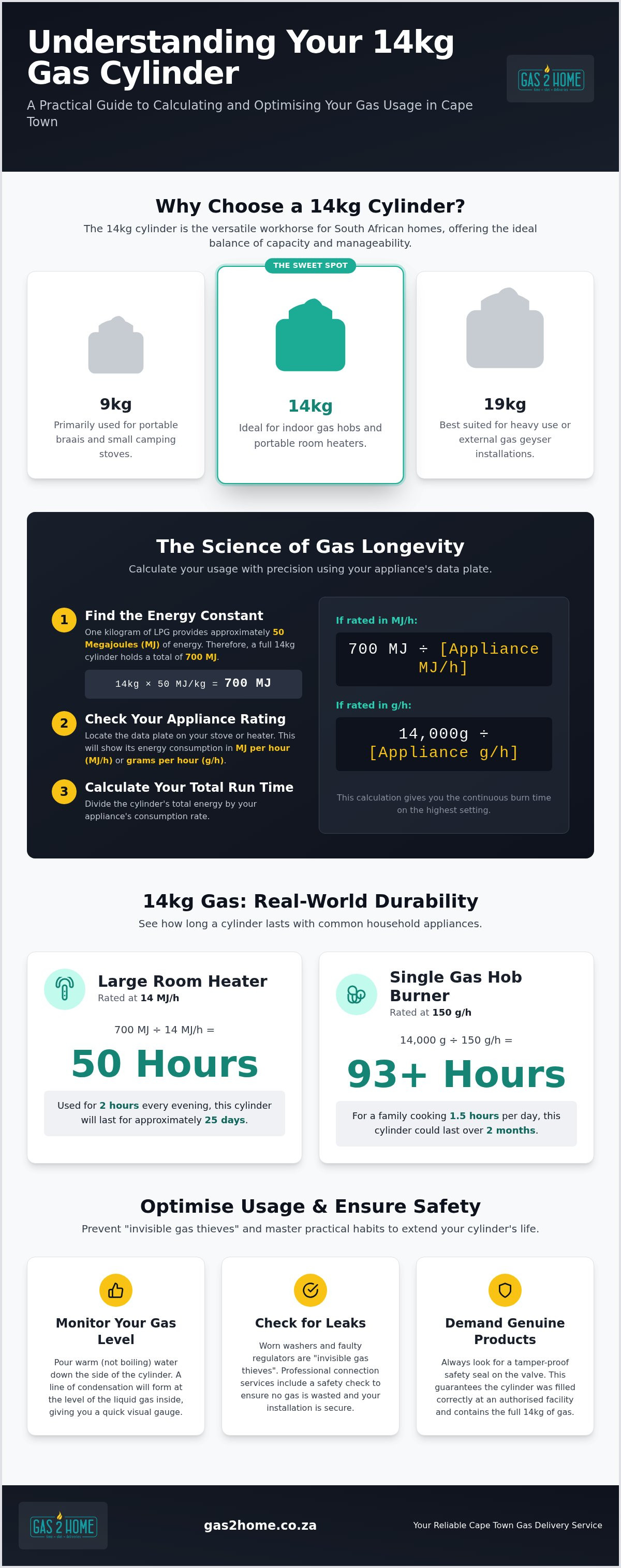
The 14kg gas cylinder is the versatile workhorse of South African homes. It sits perfectly between the smaller bottles used for summer braais and the heavy cylinders found in large industrial setups. For many Cape Town residents, this size represents the ideal balance of volume and manageability. A full 14kg cylinder typically weighs between 28kg and 30kg. This weight includes the steel bottle itself and the 14kg of fuel inside. Understanding this weight is the first step in answering the common question: how long does 14kg gas last?
What is Liquefied Petroleum Gas (LPG) is a highly efficient fuel, but your choice of container size determines how often you need to manage refills. The 14kg model is the medium-large domestic standard for several reasons:
- 9kg Cylinders: Primarily used for portable braais and small camping stoves.
- 14kg Cylinders: The sweet spot for indoor gas hobs and portable room heaters.
- 19kg Cylinders: Best suited for heavy domestic use or external gas geyser installations.
This size is particularly popular in Cape Town apartments and houses where space is at a premium but energy needs are high. It provides enough fuel to last through several weeks of regular cooking or a sustained cold snap without being too heavy to move into a kitchen cupboard.
The Benefits of the 14kg Bottle for Cape Town Households
Cape Town families often choose the 14kg size because it offers a superior balance between capacity and portability. Most standard three-panel gas heaters are specifically designed to house a 9kg or 14kg bottle. By opting for the 14kg version, you reduce the frequency of exchanges whilst ensuring the unit remains easy to manoeuvre between rooms. There is also a clear cost advantage. Exchanging a 14kg bottle often provides better value per kilogram of gas than the smaller 9kg alternatives. This makes it a smart choice for those looking to manage their household energy budget effectively during the winter months.
Identifying a Genuine 14kg Gas Bottle
Safety is paramount when handling LPG. You should always look for a tamper-proof safety seal on the valve when your cylinder arrives. This seal ensures the bottle was filled correctly at an authorised facility and contains the full 14kg of gas. Every cylinder has a tare weight stamped onto the metal shroud or base. This figure represents the weight of the empty bottle. If you know the tare weight, you can easily calculate how much gas is left by weighing the cylinder on a standard scale.
To ensure you receive a safe, genuine product, only use reputable Cape Town suppliers like Gas2Home. Professional delivery services include a safety check and connection. This helps you understand how long does 14kg gas last by ensuring no fuel is wasted through faulty regulators or worn washers.
The Science of Gas Longevity: Calculating Your Usage
Estimating gas usage doesn't have to be a guessing game. To figure out how long does 14kg gas last, you must first identify the energy demand of your specific appliances. Every gas-powered stove or heater sold in South Africa features a data plate. This small sticker or metal plaque contains a rating in Megajoules per hour (MJ/h) or grams per hour (g/h). Think of this number as your appliance's fuel economy rating. It tells you exactly how much energy the unit consumes when running at full capacity.
The math is simple once you know the constants. One kilogram of LPG provides roughly 50MJ of energy. Therefore, a full 14kg cylinder holds a total energy reserve of 700MJ. This is calculated by multiplying the 14kg of fuel by the 50MJ energy constant. To find your total run time, divide that 700MJ by the MJ/h rating on your appliance. For example, a large room heater rated at 14 MJ/h will provide exactly 50 hours of continuous heat on its highest setting. If you use it for two hours every evening, that single bottle will last you 25 days. Understanding this formula is the most reliable way to answer how long does 14kg gas last for your specific household needs.
It's important to distinguish between total hours and calendar days. The calculation gives you the burn time for a flame that never goes out. Since most cooking is intermittent and heaters are often turned down once a room is warm, your real-world results will usually exceed these basic estimates. You're effectively managing a reservoir of energy that you can tap into as needed.
Understanding Your Appliance Data Plate
If your data plate uses grams per hour (g/h) instead of MJ/h, the calculation is even more direct. A 14kg bottle contains 14,000 grams of gas. Divide 14,000 by the g/h rating to see your total hours. A single gas hob burner using 150g/h would take over 93 hours to empty the cylinder. Remember that using the medium or low setting significantly reduces gas flow. You can often double your cylinder's lifespan simply by simmering food rather than keeping the flame on high. It's a practical way to make your fuel go further.
The Impact of Ambient Temperature on Gas Behaviour
Cape Town’s winter mornings can make your gas act strangely. LPG is stored as a liquid and needs to boil into a vapour to reach your burners. When the temperature drops, this process slows down and the internal pressure decreases. You might notice a weaker flame when the bottle is nearly empty on a cold day. Adhering to official safety and storage standards by keeping your cylinder in a dry, sheltered spot helps maintain a consistent flow. If your calculations show you're running low, it's a good idea to order a refill online before the next cold front hits.
14Kg Gas for Cooking vs Heating: Real-World Durability
Cooking and heating place very different demands on your fuel supply. To understand how long does 14kg gas last, you must look at how frequently the flame is ignited and how long it stays lit. Cooking is typically intermittent; you might use the stove for thirty minutes in the morning and an hour in the evening. Heating, however, is often continuous. During a Cape Town cold snap, a heater might run for six hours straight. This difference in behaviour is the primary reason why one household might replace their cylinder every month whilst another only needs a refill once a quarter.
When calculating energy content for different household tasks, the duration of use is the most critical variable. Some residents also use the 14kg bottle for built-in outdoor braais. While this size provides excellent longevity for entertaining, those using portable units might find The 9kg Gas Cylinder Guide more relevant for their specific setup.
How Long Does 14kg Gas Last for a Gas Stove?
For a typical family of four cooking daily meals, a 14kg cylinder usually lasts between three and four months. This estimate assumes you are using a standard four-burner hob for breakfast and dinner. The specific burner you choose makes a massive difference in consumption. A small simmer burner uses significantly less gas than a high-output wok burner. You can maximise your cylinder's lifespan by using lids on all pots; this simple habit traps heat and allows you to turn the flame down sooner. Simmering food on a low setting instead of a rolling boil can extend your bottle's life by several weeks.
How Long Does 14kg Gas Last in a Gas Heater?
Heaters consume gas much faster than stoves because they run at a higher output for longer periods. A standard three-panel gas heater uses approximately 0.1kg of gas per hour per panel. If you run only one panel on a low setting, your 14kg bottle will provide roughly 140 hours of warmth. Turning on all three panels reduces that time to about 46 hours. During a typical Cape Town winter "cold front," a family might use their heater for five hours a day. At this rate, a full 14kg bottle will last about nine days on the highest setting. Planning ahead with a dedicated gas heater refill service is essential for winter preparation to avoid being left in the cold.
Invisible Gas Thieves: Why Your Bottle Might Run Out Early
Sometimes your cylinder runs dry far sooner than your calculations predicted. If you find yourself asking how long does 14kg gas last because your bottle is empty after only a few weeks, you might be a victim of "invisible thieves." Micro-leaks at the regulator or along the hose are the most common reasons for unexplained gas loss. Even a tiny, pin-sized hiss can drain several kilograms of fuel over a month. These leaks often go unnoticed because they are too small to smell in a ventilated kitchen, but they significantly impact your household budget.
The primary culprit is often the rubber "nose" or Bullnose washer located on the regulator. This small component creates the airtight seal between your appliance and the cylinder. Over time, the rubber can perish, crack, or become compressed, allowing gas to seep out. You should also inspect your gas hoses and regulators regularly. Most manufacturers recommend replacing these components every five years. If you notice any brittleness or discolouration, it is time for a replacement. Recognising the signs of a bad gas connection is the best way to alert yourself to potential waste before your cylinder runs empty.
The Soap Water Test: DIY Leak Detection
You can easily check your own connections using a simple soap water test. Mix a few drops of common dishwashing liquid with water in a spray bottle or bowl. Apply the sudsy mixture to the regulator joint, the hose connections, and along the length of the hose itself. Turn on the gas at the cylinder valve but keep your appliance turned off. If you see bubbles forming and growing, you have a leak. Never use a lighter or any open flame to test for leaks; it is extremely dangerous. If bubbles appear, turn off the cylinder immediately and tighten the connections or replace the faulty parts.
The Importance of Professional Connection
Ensuring a gas-tight seal requires more than just a firm grip. Professional installers understand exactly how much tension is needed to secure a regulator without damaging the internal washers. This expertise is why Gas2Home includes a professional connection service with every delivery. By having an expert handle the setup, you ensure that every gram of fuel is used for its intended purpose. This professional touch provides peace of mind and ensures you get the maximum value from your purchase. To ensure your home is safe and efficient, you can book a professional gas delivery and connection today.
A secure setup is the only way to truly know how long does 14kg gas last in your home. Eliminating leaks means your stove or heater will perform exactly as the manufacturer intended. It removes the domestic stress of unexpected shortages and protects your investment in modern gas energy.
Optimising Your 14kg Gas Usage and Refills in Cape Town
To truly maximise how long does 14kg gas last, you need a combination of smart habits and a reliable supply chain. Small changes in your daily routine can prevent unnecessary waste. Always turn the gas off at the cylinder valve when your appliance is not in use. This simple action prevents gas from sitting in the hose, where tiny, undetected leaks might slowly drain your supply. Using these checks ensures you never have to guess how long does 14kg gas last during a busy week.
Monitoring your gas level is easy with the "warm water trick." Pour a jug of warm (not boiling) water down the side of the cylinder. Run your hand down the metal after a few seconds. The portion of the bottle containing liquid gas will feel cold to the touch, whilst the empty portion above will stay warm. This physical line tells you exactly how much fuel remains. For total peace of mind, many Cape Town families keep a 9kg LPG Gas Cylinder as a backup. This allows you to finish cooking your meal whilst you arrange a refill for your primary 14kg bottle. It is always better to know how to order gas online in Cape Town before the flame actually goes out.
Fast and Reliable 14kg Gas Delivery
Getting a refill shouldn't be a logistical headache. We offer same-day delivery slots to ensure your home stays warm and your kitchen stays functional. You can organise a 14kg exchange in seconds by sending a message via WhatsApp. It is the fastest way to coordinate a delivery that fits your schedule. Our service covers a wide range of Cape Town areas. We deliver from the busy streets of the CBD to the coastal homes of Sunset Beach and throughout the Southern Suburbs. Our team understands the local geography, ensuring we get to your door without delay.
Exchanging Your Empty Bottle
The exchange process is designed to be frictionless. When our driver arrives, they will swap your empty 14kg cylinder for a full, certified bottle. Every cylinder we provide undergoes a strict safety inspection and features a fresh safety seal. This process guarantees that you receive a high-quality product that meets all South African safety standards. We don't just drop the bottle at your gate; we include a professional connection service to ensure your setup is gas-tight and efficient from the first spark. Order your 14kg gas bottle exchange now to secure your supply for the week ahead.
Secure Your Home’s Energy Supply
Managing your household energy becomes simple when you understand the maths behind your appliances. By using the MJ/h ratings found on your data plate, you can accurately predict how long does 14kg gas last for your specific cooking or heating needs. Remember that a professional connection is your best defence against invisible leaks that drain your cylinder and your budget. This simple step ensures every gram of fuel is used to keep your home comfortable.
The 14kg cylinder remains the most efficient choice for Cape Town families who value both capacity and convenience. We make the refill process effortless by offering same-day delivery from Monday to Saturday. Every exchange includes a professional connection service to guarantee your safety and efficiency. For total peace of mind, you can simply pay on delivery once the job is done.
Order your 14kg gas bottle delivery in Cape Town today and keep your home running smoothly all year round. We are ready to help you remove the stress of domestic energy management so you can focus on what matters most.
Frequently Asked Questions
How many hours will a 14kg gas bottle last on a heater?
A 14kg bottle lasts approximately 46 hours on full power with three panels ignited or 140 hours on a single panel. These figures are based on a standard consumption rate of 0.1kg per panel per hour. If you heat your room for four hours an evening on the medium setting, you can expect about 17 days of warmth. This is a practical estimate for most Cape Town homes during the cold winter months.
How can I tell if my 14kg gas bottle is nearly empty?
Use the warm water trick to check the internal level. Pour warm water down the side of the cylinder and feel for the cold line where the liquid gas remains. You might also notice the flame on your stove turning orange or flickering more frequently as the pressure drops. Weighing the bottle is the most accurate method. Subtract the tare weight stamped on the shroud from the total weight to find the remaining fuel.
Is it cheaper to use a 14kg gas bottle than electricity in Cape Town?
LPG is generally more cost-effective for cooking and heating in Cape Town, especially during peak electricity tariff periods. Gas provides instant heat and stops consuming energy the moment you turn it off. Unlike electric heaters that take time to warm up or stoves that retain residual heat, gas is highly efficient. Many residents find that switching to gas helps them manage their monthly utility bills more predictably whilst avoiding the frustrations of frequent power outages.
Can I use a 14kg gas bottle for my braai?
You can certainly use a 14kg cylinder for a built-in gas braai, but it is often too large for portable units. Most portable braais are designed to hold a 9kg bottle. If your braai has an external connection point and enough space in the cabinet, the 14kg size is an excellent choice. It provides more grilling hours than the standard 9kg option, which is helpful if you entertain guests frequently on the weekend.
How do I know if my gas bottle is leaking?
A distinct smell like rotten eggs is the most obvious sign of a leak. If you suspect a problem, apply soapy water to the regulator and hose connections. If bubbles form and grow, gas is escaping. You should also listen for a faint hissing sound near the valve. To ensure you aren't wasting fuel, check these connections regularly to maintain an accurate sense of how long does 14kg gas last in your home.
What is the difference between a 14kg and a 14.2kg gas cylinder?
There is no functional difference between these two sizes for domestic use. The 14.2kg cylinder is a standard often used in international markets like India, whereas the 14kg is the domestic standard in South Africa. Both use the same LPG fuel and standard regulators. If you have an imported appliance that specifies a 14.2kg bottle, our standard 14kg cylinder will work perfectly and safely with your existing connection and regulator setup.
Does gas expire if I do not use the 14kg bottle for a long time?
LPG does not expire or spoil over time, so your 14kg bottle will remain usable even if it sits for years. However, the rubber seals and the hose connected to your appliance can degrade. If you haven't used your cylinder for a long time, inspect the Bullnose washer and the hose for cracks before lighting the flame. Safety components have a limited lifespan and should be replaced every five years to prevent dangerous leaks.
Can I exchange any brand of 14kg gas bottle with Gas2Home?
We accept most major legal gas cylinder brands for exchange in Cape Town. When we arrive for your delivery, we simply swap your empty 14kg bottle for a full, safety-certified Gas2Home cylinder. This makes the process effortless for you. It's important to ensure your empty bottle is in a reasonable condition and is a legitimate South African cylinder. This flexibility helps you manage how long does 14kg gas last without worrying about brand lock-in.