
Gas Cylinder Cage Requirements for Residential Property in South Africa: 2026 Checklist

Could a secure-looking gas cage still leave a residential installation unsafe? Yes. The gas cylinder cage requirements for residential property South Africa depend on more than the enclosure: the number and capacity of cylinders, their position on the property and the rules that apply all matter.
A cage isn’t automatically the whole solution. Ventilation, clearances and access also affect whether a storage arrangement is suitable, and a general online dimension may not apply to every home.
This checklist explains what to assess before installing or changing a cage, from the cylinder and its location to nearby openings, drains and ignition sources. It also covers SANS 10087-1:2024 and when municipal or fire-safety requirements may apply. Use it to prepare for a site-specific review, then have installation requirements checked by a registered gas practitioner and the relevant authority.
Key Takeaways
- A gas cylinder cage is only one part of a safe LPG setup. It doesn’t prove that the full installation complies.
- Use the gas cylinder cage requirements for residential property South Africa as a starting point, then confirm which current national standards and local rules apply to your home.
- Compare cage options by security, airflow, access and protection. Check technical specifications against the conditions at your property.
- Before making changes, record the cylinders, property layout, proposed location and possible hazards.
- Consider the cage and gas connection as separate parts of your safety plan, and resolve questions about both before using the setup.
What do gas cylinder cage requirements mean for a South African home?
A cage can help secure and protect an LPG cylinder, but seeing one on a property doesn’t prove that the storage arrangement or gas installation complies. The full setup includes the cylinder’s location, its connection, the space around it and any requirements that apply to the property.
A gas cylinder cage is an enclosure intended to secure and protect a cylinder. Compliance depends on the full storage arrangement and installation, not the enclosure alone. The right design for one home may not suit another. Cylinder type and quantity, access to the area, nearby openings and potential exposure to impact can all affect the assessment.
For South African homes, check the scope and applicability of SANS 10087-1, the national standard relevant to LPG installations. The 2024 edition is identified here as the current edition for new installations, but requirements depend on the installation and its circumstances. City of Cape Town rules may also address local fire-safety or land-use matters. Check the current requirements with the relevant authority and a registered gas practitioner rather than relying on a general online dimension or a cage product description.
A Gas cylinder has components and safety considerations beyond its outer enclosure. General references can provide background, but they don’t replace current South African requirements or a site-specific assessment.
When might a residential LPG cylinder need an enclosure?
An enclosure may be relevant if a cylinder is exposed to unauthorised access, accidental knocks or other site risks. The arrangement also needs to allow appropriate airflow and practical access. Public access, the property boundary, the number and arrangement of cylinders, and local authority direction can affect whether a cage is required. Don’t assume every home needs one or that one standard cage suits every layout.
Homeowners, landlords and property managers should assess the storage site as well as the cylinder. Note who can reach it, what could strike or obstruct it, and whether the position raises concerns about access or ventilation. If the property is altered or the cylinder arrangement changes, reassess the setup against current requirements.
What does a cage not prove about LPG compliance?
A cage addresses enclosure and security. It doesn’t establish that the cylinder is correctly positioned, ventilated or connected to an appliance in line with applicable requirements. It also doesn’t confirm that the installation has been assessed or documented as required. Keep these checks separate: a secure cylinder can still be part of an unsafe or unsuitable installation.
Pay attention to the connection as well as the storage area. If you notice possible warning signs, such as a suspected leak or damage, don’t treat the cage as reassurance. Learn how to recognise signs of a bad gas connection and have installation concerns addressed by a registered practitioner. Understanding gas cylinder cage requirements for residential property South Africa starts with checking the whole site, not selecting an enclosure in isolation.
Which South African rules and site conditions should you check?
Start with the standard, then check how it applies to the property. For residential LPG installations in South Africa, SANS 10087-1:2024, Edition 7, is identified as the current edition for new installations. Read its requirements in context: a standard covers specific technical matters, while municipal rules may address separate local fire-safety or building concerns. A neighbour’s setup or a general cage guide doesn’t establish what applies to your home.
Before relying on a figure or rule, check its source, edition and scope. This is particularly important for clearances, cage construction, ventilation, cylinder quantities and approval processes. Gas cylinder cage requirements for residential property South Africa can depend on the proposed installation and site, so treat unsourced online claims as prompts to investigate, not as a final compliance decision.
How do SANS requirements relate to a residential cylinder cage?
SANS 10087-1:2024 is the standard to check for relevant LPG installation requirements. Confirm that the provisions you rely on cover your type of installation and storage arrangement. Distinguish an explicit standard requirement from general good practice, such as keeping the area orderly and unobstructed. Before acting on an exact technical threshold, check it against the current standard and its applicable scope.
The LPG Safety Association of Southern Africa can be a starting point for general safety information, but it doesn’t replace the standard or a site-specific assessment. To make a review more useful, note the cylinder arrangement and intended position, then have the applicable requirements reviewed by a registered gas practitioner. Ask for the relevant standard and provisions to be identified, rather than relying on a rule repeated without context.
When should Cape Town municipal requirements be checked?
Check with the City of Cape Town when planning a new installation, moving cylinders or changing the property layout around the storage area. The property type, location and proposed work may affect whether local fire-safety or building requirements are relevant. Don’t assume that every home needs a municipal permit or inspection, or that none does. Check the requirements for your property with the relevant City services.
Keep the checks organised: confirm the standard’s current edition and scope, identify any local requirements, and record unanswered questions about the site before work begins. This helps distinguish a national technical requirement from a local process or a practical safety recommendation.
- Check the standard: Confirm the edition and provisions relevant to the installation.
- Check the property: Describe the property type, location and planned changes when seeking local guidance.
- Check the details: Verify technical figures and approval steps against current authoritative sources.
Once you understand the storage plan, treat the cylinder and connection as separate parts of the process. In Cape Town, Gas2Home delivers LPG cylinders and offers a professional connection service for residential use.
How do cage design and placement affect residential LPG safety?
A cage should suit both the cylinder and the space around it. Compare options by what they allow and prevent: airflow, access for handling, protection from knocks and control of access. A fully enclosed design may offer more physical protection, while a less-enclosed arrangement may make the cylinder easier to see and reach. Neither is automatically compliant. The appropriate choice depends on the installation and applicable requirements.
What should a suitable cage allow or prevent?
Check that the enclosure doesn’t obstruct access to the cylinder or its valve, and that its openings support the ventilation required for the installation. Mesh that looks open may still fail a specified technical requirement, so appearance alone isn’t a reliable test. Consider whether the cage can remain stable and whether its position protects the cylinder from foreseeable knocks. Check material, opening and locking specifications against current authoritative requirements.
Security shouldn’t come at the expense of access. A lock or barrier that makes routine handling difficult can create a practical problem, while an enclosure that leaves the cylinder exposed to interference may not address the site’s security needs. Consider how the cylinder will be reached for inspection, replacement or connection, and keep enough space around it for that work.
Where should a residential cylinder cage be positioned?
Assess the full area around the proposed location. Nearby entrances, windows, drains, heat sources, electrical ignition sources and vehicle paths may affect the review. For example, a cylinder beside a driveway could face impact risk, while a narrow side passage may restrict access or airflow. These are prompts for assessing the site, not substitutes for required clearances. Check exact distances against the current standard and any applicable City of Cape Town requirements.
In Cape Town, home layouts range from compact urban plots to larger properties with separate service areas. Don’t choose a position solely because a cage fits there. Consider how it works with the building, boundary, access and surrounding hazards, then resolve uncertainties before installation or relocation.
The table separates practical observations from rules that need source verification. It doesn’t establish that a particular design or position complies.
| What to assess | General safety consideration | Requirement to verify |
|---|---|---|
| Ventilation and openings | Keep airflow and visibility in mind; don’t judge by appearance alone. | Required opening design and ventilation specifications in the applicable standard. |
| Access and security | Allow practical access for handling while considering unauthorised access. | Any rules for access, enclosure or locking that apply to the setup. |
| Position and exposure | Review nearby openings, ignition sources, heat and possible vehicle impact. | Applicable separation distances and any local site requirements. |
Use this comparison as a planning aid, not a compliance certificate. Gas cylinder cage requirements for residential property South Africa depend on the installation and site, so confirm technical details before selecting or moving an enclosure.
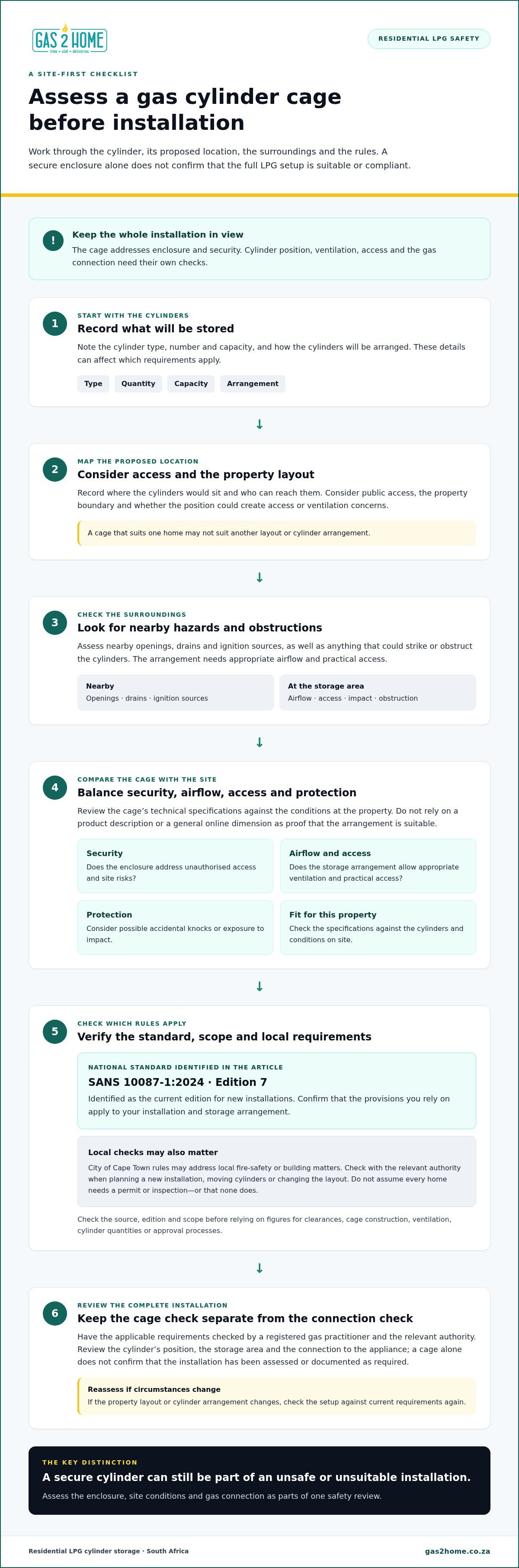
Use this residential gas cylinder cage checklist before installation
Before choosing or changing an enclosure, gather the details that shape the storage assessment. Assess the site before selecting a cage; the cylinder, property layout and applicable requirements should guide the choice. Use this checklist to prepare for a discussion with a registered gas practitioner and identify questions for the relevant authority. It’s a planning tool, not a compliance certificate.
- Record the cylinder and site: Note the cylinder size and quantity, property layout and intended location. If you’re checking a 9kg setup, the 9kg LPG cylinder guide provides cylinder-specific context.
- Map the access route: Check how the cylinder can be reached for handling and connection. Note gates, narrow passages, steps or stored items that could restrict access.
- Look at airflow: Identify walls, cupboards or other features that could obstruct airflow around the proposed storage position. Don’t assume the enclosure’s appearance proves that its opening design meets requirements.
- Check stability and impact exposure: Look for an uneven or unstable surface, and consider whether vehicles, garden equipment or household activity could strike the cylinder or cage.
- Note nearby features: Record doors, windows, drains, heat sources and electrical ignition sources near the intended location. Flag anything that may affect the site assessment.
- Verify current requirements: Check the current edition and applicability of SANS 10087-1, plus any relevant City of Cape Town requirements. Verify cage construction, dimensions, clearances and signage against authoritative sources before buying or modifying an enclosure.
- Review the connection and records: Confirm installation and connection details with a registered gas practitioner. Keep available installation records and compliance documents, and verify which documents apply to your installation.
What to record during a first site check
Make a simple site note with the cylinder size and quantity, proposed position, access route and nearby building features. Take clear photographs from more than one angle, including the approach to the location. Note restricted airflow, heat exposure, vehicle access or an obstructed shut-off point. These details give the practitioner or relevant authority a more useful picture of the site.
What to verify before approving the setup
Don’t approve an enclosure based only on its size or appearance. Check its construction, dimensions, openings, clearances and any signage against the requirements for the specific installation. Confirm how the cylinder will connect to the appliance and whether the proposed position allows practical access. Keep records together, but don’t assume a particular document replaces a required inspection or compliance record.
Use the checklist to resolve questions before installation or changes begin. For a residential LPG cylinder and professional connection in Cape Town, Gas2Home supplies LPG cylinders and connection services.
Plan your next steps for safe LPG cylinder storage in Cape Town
Make a clear plan before installing, moving or using an LPG cylinder. Identify the cylinder and storage arrangement, check current requirements, assess the site, then resolve unanswered questions. Gas cylinder cage requirements for residential property South Africa depend on the installation and property, so don’t treat a general rule of thumb as approval for your specific setup.
Keep two related tasks distinct. The cage concerns how the cylinder is enclosed and positioned. The gas connection concerns how the cylinder links to the appliance and must be considered separately. A secure enclosure doesn’t verify the connection, and a professional connection doesn’t confirm that the storage location or cage meets applicable requirements.
What should homeowners do if a requirement is unclear?
Pause planned changes, and don’t use a setup if you have a safety concern or are unsure whether it’s suitable. Check technical questions against the current applicable standard, seek guidance from the relevant authority, or discuss the installation with a registered gas practitioner. This is particularly important for dimensions, clearances, ventilation and cylinder arrangements. Online advice can help you identify questions, but an unverified distance or design rule shouldn’t determine where a cylinder goes.
Make the discussion practical: have the cylinder details, site notes and photographs ready. Explain what is changing and describe nearby building features or access constraints. This helps focus the query on the relevant requirements rather than a broad answer that may not fit your property. If a concern arises during use, stop and get appropriate guidance before resuming.
How can cylinder delivery and connection fit into the plan?
Once the storage setup is ready, arrange delivery and connection as the next practical step. Gas2Home serves residential customers in Cape Town with LPG cylinder delivery, including a professional connection service. This covers the supply and connection part of your plan. It is separate from checking cage compliance, assessing the site or obtaining applicable documentation.
Before arranging delivery, settle the intended cylinder size and location. If a registered practitioner or authority has raised a question about your storage arrangement, resolve it first. Make sure the cylinder can be accessed for connection without changing the position you’ve had assessed.
Work through the checks in order: identify the setup, verify current national and local requirements, assess the site and resolve uncertainties before use. When your residential storage plan is ready, Gas2Home can deliver and connect your LPG cylinder in Cape Town.
Make your next LPG step with confidence
A well-planned storage setup gives you a stronger starting point for everyday LPG use. Keep a record of what has been checked, and review it if you change the cylinder arrangement or alter the space around it. Gas cylinder cage requirements for residential property South Africa are best approached as a property-specific question, not a one-size-fits-all shopping decision.
Once your storage arrangements are ready, Gas2Home serves Cape Town households with residential LPG delivery and a professional cylinder connection service. Place an order online or through WhatsApp.
Arrange LPG cylinder delivery and connection in Cape Town with Gas2Home.
Frequently Asked Questions
Does every residential gas cylinder in South Africa need a cage?
Not necessarily. Whether an enclosure is required depends on the installation and current rules that apply to the property. Gas cylinder cage requirements for residential property South Africa may differ with the cylinder arrangement, site access and local conditions. Treat public access or potential impact as reasons to investigate, not proof of a specific legal obligation. Check the relevant standard and municipal requirements for your address.
What standard covers residential LPG cylinder storage in South Africa?
SANS 10087-1 is the standard to investigate for residential LPG installation and storage. Before relying on a particular provision, check the current edition and whether its scope covers your installation. A short online summary may omit important conditions or exceptions. Use the applicable standard alongside relevant municipal requirements, and discuss installation-specific questions with a registered gas practitioner. This helps distinguish a general safety tip from a requirement that applies to your setup.
How many gas cylinders can I store at a residential property?
There isn’t a single quantity to assume applies to every residential property. Permitted storage can depend on cylinder sizes, the combined arrangement, where the cylinders are placed and the property setup. Adding another cylinder may change the assessment even if the existing storage area stays the same. Before increasing the quantity, verify the applicable limit with the relevant authority or a registered gas practitioner, using current requirements for your situation.
Can a gas cylinder cage be installed indoors or in a garage?
Don’t assume an indoor room or garage is suitable simply because a cage fits. Suitability depends on current requirements, ventilation, access and the building layout. A garage, for instance, may have doors, stored items or other features that affect the proposed position. Before placing or connecting a cylinder, have the location checked against the applicable standard and professional installation requirements. Don’t move a cylinder indoors to solve an outdoor space problem without first verifying the arrangement.
Does a residential gas cylinder cage need ventilation?
Airflow is an important safety consideration for LPG storage, but that principle doesn’t specify the required opening size or cage design. Check those technical details against current requirements for the installation. Don’t assume widely spaced mesh or a partly open enclosure meets a specification based on appearance alone. Verify the applicable design provisions and have the full arrangement assessed, including whether nearby walls or stored items could obstruct airflow.
Does a locked gas cylinder cage meet South African requirements?
A lock may help control access, but it doesn’t show that the cage or installation meets applicable requirements. Check whether the enclosure design is suitable and whether people responsible for safe operation can reach the cylinder when needed. Don’t assume locks are always required or prohibited; that depends on the applicable rules and setup. Verify the position, access arrangements and any locking requirements against the current standard or with a registered gas practitioner.
Is a gas cylinder cage alone enough to make an installation compliant?
No. A cage alone can’t demonstrate that the entire LPG installation complies. The cylinder’s position, connection to the appliance and conditions around the storage area also need consideration. A secure enclosure won’t resolve a concern about the connection route or a site feature that affects placement. Check the applicable standard and local requirements, then consult a registered gas practitioner about installation-specific questions and work.