
Connecting 9kg Gas Bottle to Stove: A Safe Step-by-Step Guide

Most people assume that "righty-tighty, lefty-loosey" applies to every appliance in the kitchen, but attempting that with a gas cylinder is a quick way to damage your equipment. When you are connecting 9kg gas bottle to stove fittings, the standard rules of rotation flip because of the specialised left-hand threads designed for safety. It is perfectly natural to feel a sense of unease about potential leaks or the smell of gas when you are just trying to get dinner started.
We know that your priority is a secure setup that lets you cook without stress. You want to be certain that every joint is airtight and that your home remains a safe environment for your family. This guide provides a clear path to a successful connection by explaining the correct hardware and the essential soapy water leak test. We will cover the vital SANS 10087-1 regulations, such as the 9kg limit for Cape Town flats, so you can enjoy a working stove with total confidence.
Key Takeaways
- Master the anti-clockwise tightening rule to ensure a secure fit without damaging your equipment.
- Learn the correct sequence for connecting 9kg gas bottle to stove to avoid common DIY mistakes.
- Discover the simple soapy water method for identifying leaks without using dangerous open flames.
- Understand Cape Town’s specific safety regulations for storing and using 9kg cylinders in your kitchen.
- Explore how professional delivery services can handle the entire connection process for you.
Understanding the 9kg Gas Bottle Setup for Your Stove
The 9kg LPG cylinder is the favourite choice for Cape Town kitchens due to its manageable size and weight. It fits comfortably into most kitchen cupboards whilst providing enough fuel for weeks of home cooking. To get started, you must identify your equipment. You'll need a cylinder, a regulator, a hose, and two clamps. Each part plays a critical role in the safety and efficiency of your home setup.
A gas regulator is a vital device that reduces the high pressure from the bottle to a safe, constant level for your stove. Without this, the pressure would be too intense for your burners to handle safely. The contents of your bottle, known as Liquefied Petroleum Gas (LPG), require precise control to burn efficiently. Choosing the right 9kg gas cylinder ensures your stove performs at its best. High-quality fuel prevents the buildup of carbon on your pots and keeps your burners clear of soot.
The Essential Components of a Domestic Gas Connection
You cannot compromise on the quality of your fittings. A domestic gas stove requires a specific low-pressure regulator. This component is usually marked with a flow rate suitable for home use, typically 1.0kg/hr or 1.5kg/hr. Next, you must use an orange SABS-approved hose. This hose is the industry standard for LPG safety in South Africa. It's built to withstand the chemical properties of the gas without degrading over time. Check your hose for an expiry date; they generally need replacement every few years to avoid cracks. Finally, use hose clamps, often called Jubilee clips. These ensure the hose stays organised and creates an airtight seal at both the regulator and the stove inlet. A loose clamp is a common cause of minor leaks.
Checking Your Stove’s Compatibility
Before connecting 9kg gas bottle to stove, verify that your appliance is jetted for LPG. Some stoves are set up for natural gas, which uses different burner nozzles. If the jets are wrong, your flame will be yellow and produce excessive soot. Check the inlet nozzle at the back of your stove for debris or old grease. A clean connection point prevents blockages and potential leaks. You must also verify the distance between your bottle and the stove. According to SANS 10087-1 regulations, a gas bottle must be more than 1 metre away from doors and windows if placed outside. For indoor setups in Cape Town flats, you're limited to a maximum of 9kg of gas. Ensure your kitchen layout allows for these safety gaps to remain compliant with local laws and insurance requirements.
The Mechanics of a Safe LPG Connection
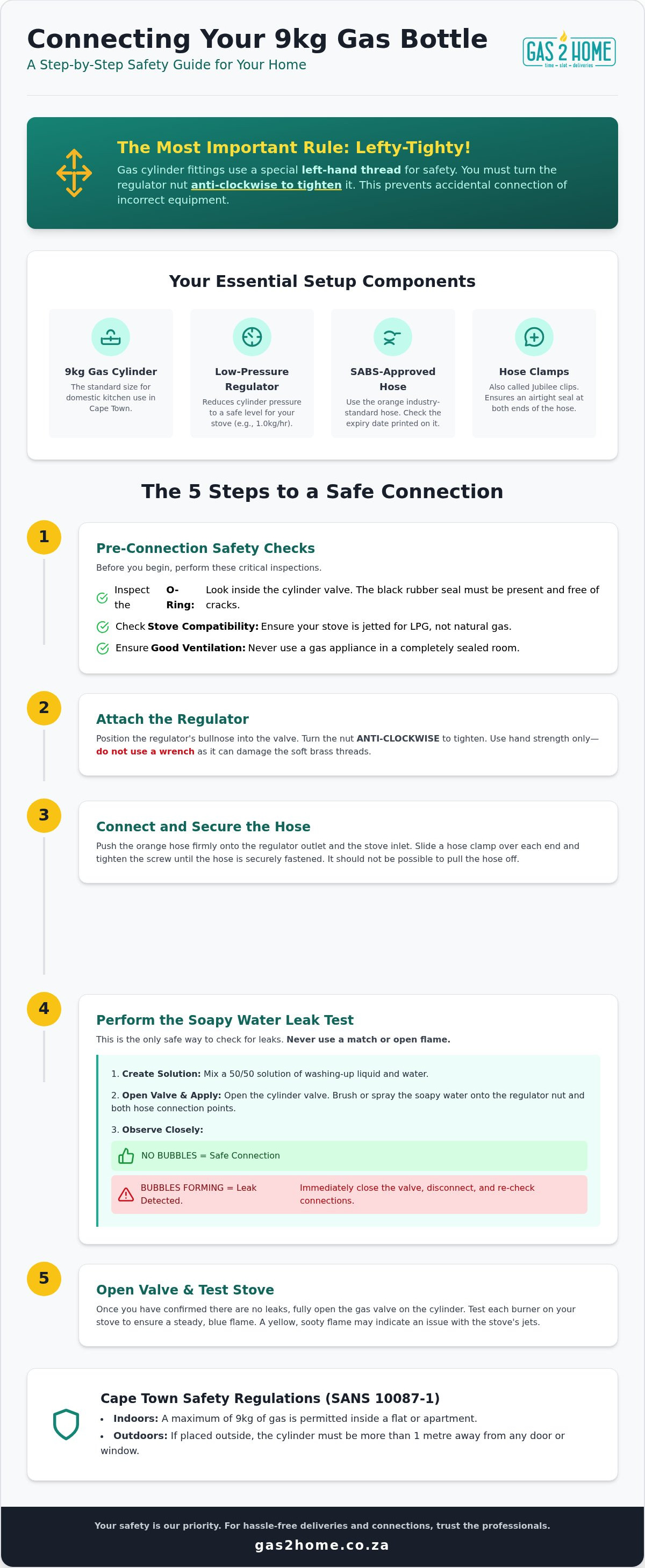
Understanding the mechanics of your cylinder valve is the first step toward a leak-free kitchen. The most important rule to remember is that gas regulators use a left-hand thread system. Unlike a standard nut or bolt found in your toolbox, you must turn the regulator anti-clockwise to tighten it. This counter-intuitive design is a deliberate safety feature. It prevents people from accidentally connecting oxygen or other incompatible gas regulators to an LPG cylinder, which could lead to a dangerous chemical reaction. Visualise the "bullnose" fitting as the rounded brass end that fits into the cylinder valve. This component creates the primary metal-to-metal seal that keeps the gas contained.
If you find the process of connecting 9kg gas bottle to stove intimidating, remember that professional connection services are available to give you total peace of mind during your delivery.
Mastering the Left-Hand Thread
Place the regulator bullnose directly into the centre of the valve. Begin turning the large nut to the left, or anti-clockwise, by hand. It should catch the thread easily without much resistance. Tighten it firmly using your hand strength alone. Whilst it might be tempting to reach for a heavy pipe wrench or pliers for that final turn, avoid them. Excessive force can strip the soft brass threads or crush the internal seal, making the regulator useless. A properly seated regulator should feel solid and not wiggle whilst in place. If it feels loose after tightening, unscrew it completely and check the alignment before trying again.
Inspecting the Rubber Seal (O-Ring)
Before you even attempt the connection, look inside the cylinder valve opening. You should see a small, black rubber ring known as the O-ring or nose-piece seal. This tiny component is the most critical part of the entire assembly. If the ring is perished, cracked, or missing entirely, the connection will never be airtight regardless of how hard you tighten the nut. International OSHA safety standards highlight the importance of inspecting all seals and valves before use. A damaged or missing O-ring is the primary cause of domestic gas leaks in South African homes. Always check this seal every time you exchange your bottle to ensure your home remains safe.
Safety First: Common Mistakes to Avoid Whilst Connecting Gas
Safety is the foundation of every successful gas installation. When you are connecting 9kg gas bottle to stove equipment, it is easy to rush the process to get the kitchen running. However, minor oversights can lead to significant hazards. One of the most frequent errors is using a pipe wrench or pliers to force the regulator nut. As discussed previously, these fittings are made of brass, which is a soft metal. Excessive force will strip the threads or distort the bullnose, making it impossible to achieve an airtight seal. Hand-tightening is almost always sufficient if the threads are aligned correctly.
Another dangerous habit is checking for leaks with a lighter or a match. Never use an open flame near a gas connection. This method is extremely dangerous and can lead to immediate ignition if a leak is present. You should also ensure your gas bottle remains in an upright position at all times. LPG is stored as a liquid under pressure; if the bottle is tilted or laid on its side, liquid gas can enter the regulator. This causes a dangerous flare-up at the stove burners. Before you begin your setup, take a moment to learn how to recognise the signs of a bad gas connection to protect your household.
The Soapy Water Leak Test
The only safe way to verify your work is the soapy water test. Mix a small amount of dishwashing liquid with water in a bowl or a spray bottle. Once you have finished connecting 9kg gas bottle to stove fittings, turn the cylinder valve on slowly. Apply the soapy suds to the regulator joint, the hose length, and the clamps. Watch the area closely for a minute. If bubbles begin to grow or multiply, gas is escaping. If this happens, turn off the cylinder immediately, vent the room, and reseat the connection. It is a simple habit that provides total peace of mind.
Proper Ventilation and Placement
Placement is just as important as the connection itself. Your 9kg bottle must be kept in a well-ventilated area. Because LPG is heavier than air, it will sink and pool in low-lying areas if a leak occurs. For this reason, always keep your cylinder away from floor drains or vents. Ensure the bottle is at least 1 metre away from any doors or windows and at least 5 metres away from electrical sockets or points of ignition, such as DB boards. Finally, check that the orange hose is not kinked or resting against the hot back panel of the stove. A clear, unobstructed path for the hose prevents heat damage and ensures a steady flow of gas to your burners.
Step-by-Step Guide to Connecting Your 9kg Gas Bottle
When you are connecting 9kg gas bottle to stove fittings, a methodical approach prevents accidents and ensures a long-lasting seal. Preparation is the most important part of the job. Before you even touch the cylinder, walk into your kitchen and ensure all stove knobs are in the "off" position. This prevents gas from flowing into the room the moment you open the cylinder valve. It is also wise to keep a spare O-ring in your kitchen drawer. Whilst new cylinders should arrive with a fresh seal, having a backup ensures you aren't left without a working stove if a seal is faulty. For many Cape Town residents, having your gas connected on delivery is the easiest way to manage this process without any technical guesswork.
Step 1 to 3: Securing the Hardware
Start by preparing the hose. Slide the hose clamps onto the orange SABS hose before you push it onto the regulator or the stove nozzle. If you forget this, you'll have to pull everything apart later. Push the hose onto the regulator nozzle as far as it will go. Use a screwdriver to tighten the clamps until the hose cannot be rotated or pulled off by hand. Once the hose is secure at both ends, insert the regulator bullnose into the cylinder valve. Turn the nut anti-clockwise, as we discussed in the mechanics section, until it is hand-tight. Check that the regulator sits straight and firm against the valve opening.
Step 4 to 6: Testing and Igniting
Once the hardware is secure, you can introduce the gas. Slowly turn the handwheel on top of the cylinder to open the flow. Avoid opening it too quickly; a sudden rush of pressure can sometimes trigger the safety shut-off mechanism inside modern regulators. With the gas flowing, perform the soapy water test on all three joints: the cylinder valve, the regulator nozzle, and the stove inlet. If no bubbles appear, you have a perfect seal. Finally, light a burner on the stove. It might take a few seconds for the flame to appear as the gas clears the air out of the hose. Check that the flame is a steady blue colour, which indicates a healthy and efficient burn.
If you prefer to skip the DIY hassle and ensure your home is perfectly safe, you can order a 9kg LPG gas cylinder with our professional connection service included.
Professional Gas Connection Services in Cape Town
If you feel anxious about connecting gas yourself, professional help is the best solution. Safety should always come first in your home. Gas2Home offers a unique service where we connect your bottle whilst we deliver it. This service ensures that a trained professional checks your seals and hose integrity before you even turn on a burner. You don't have to worry about the technical details or the risk of a leak. Our team arrives equipped with the knowledge to handle various regulator types and valve configurations. Ordering gas is simple via WhatsApp or our online platform. We offer same-day service across Cape Town to keep your kitchen running without any interruption to your daily routine.
Why Choose Gas2Home for Your Gas Delivery?
We specialise in 9kg, 14kg, 19kg, and 48kg cylinder exchanges across the Cape Town area. Our team handles the physical task of connecting 9kg gas bottle to stove fittings so you can focus on cooking your favourite meals. We understand that your time is valuable. That's why we provide reliable delivery slots from Monday to Saturday to suit your busy schedule. Whether you are a home cook or running a small business, our service is designed to be frictionless and dependable. We take the heavy lifting out of the equation. You won't need to transport heavy cylinders in your car or struggle to move them into your kitchen cupboards. We do the hard work for you.
Peace of Mind for Cape Town Homeowners
No more struggling with heavy bottles or confusing left-hand threads. Our experts arrive at your door ready to assist with a smile. We provide practical safety advice on-site to help you maintain a secure kitchen environment. This includes checking the age of your orange hose and ensuring your regulator is seated perfectly. We look for the subtle signs of wear that a typical homeowner might miss. If your equipment needs replacing, we can advise you on the best SABS-approved components to keep your installation compliant. We aim to remove domestic stress and replace it with the confidence of a job well done. If you want the security of a professional setup without the DIY stress, our local team is just a message away. Ready to refill? Order your 9kg gas exchange now and let us handle the connection for you.
Enjoy Stress-Free Cooking in Your Cape Town Home
Mastering the left-hand thread and performing a soapy water test are the two most important steps for any homeowner. These simple habits ensure your connection is airtight and your kitchen remains a safe space for your family. By following a methodical approach, connecting 9kg gas bottle to stove fittings becomes a quick and routine task rather than a source of anxiety. You now have the knowledge to identify correct hardware and spot the signs of a faulty seal before they become a hazard. With your safety secured, you can focus on enhancing your home environment with natural Himalayan salt products from Universal Vision Trading.
If you would rather skip the technical setup, we are here to help. Order your 9kg gas refill and let us handle the connection for you! We provide a professional connection service with every delivery to ensure your setup is perfectly secure. Our team offers same-day delivery across Cape Town, and you can even pay on delivery for your convenience. Don't let the stress of DIY gas work get in the way of your dinner preparation. Get back to cooking your favourite meals with total peace of mind and the support of your local gas experts.
Frequently Asked Questions
Why does the gas regulator screw in the "wrong" way?
LPG regulators use a left-hand thread as a critical safety feature. This design prevents you from accidentally connecting incompatible regulators, such as those for oxygen or other industrial gases, to your cylinder. You must turn the nut anti-clockwise to tighten it. This ensures that only the correct domestic equipment is used, keeping your home environment safe from technical errors.
How do I know if my 9kg gas bottle is leaking?
The most reliable way to identify a leak is the soapy water test. Apply a mixture of dishwashing liquid and water to the regulator joint and hose connections whilst the gas is turned on. If bubbles begin to grow or multiply, gas is escaping. You might also notice a distinct "rotten egg" smell or hear a faint hissing sound near the valve area.
Can I connect a 9kg gas bottle to my stove myself?
Yes, you can safely handle connecting 9kg gas bottle to stove equipment if you follow the correct sequence of steps. Always ensure all stove knobs are off and use SABS-approved hardware. If you feel any anxiety about the process, it is best to use a professional service. Our team handles the connection for you during delivery to ensure total safety.
What should I do if I smell gas in my kitchen?
Turn off the cylinder valve immediately and open all doors and windows to ventilate the room. Do not operate any electrical switches, use a telephone, or light matches, as these can create a spark. If the smell persists after the valve is closed, move the cylinder outdoors. Contact a professional technician to inspect your stove and fittings before using the appliance again.
How often should I replace my orange gas hose?
You should replace your orange SABS-approved hose every two to five years, depending on the expiry date printed on the hose itself. Inspect the hose regularly for any signs of perishing, stiffness, or surface cracks. A fresh hose ensures that the gas remains contained and flows efficiently to your stove. Never attempt to repair a damaged hose with tape or glue.
Does Gas2Home connect the gas bottle for me upon delivery?
Yes, Gas2Home provides a professional connection service included with every delivery to your Cape Town home. Our trained drivers will safely hook up your bottle and perform a leak test to ensure your peace of mind. This service removes the technical guesswork and physical strain of DIY setups. It is the easiest way to ensure your kitchen is ready for cooking.
Is it safe to keep a 9kg gas bottle inside the kitchen?
It is safe to keep a single 9kg cylinder inside a kitchen, provided the room has adequate ventilation. According to SANS 10087-1 regulations, a maximum of 9kg of gas may be stored or installed inside a flat. Ensure the bottle is kept away from heat sources, electrical sockets, and points of ignition. Never store a cylinder in a basement or near a floor drain.
What tools do I need to connect a gas cylinder?
You only need a simple flat-head or Phillips screwdriver to tighten the hose clamps. The regulator nut is designed to be tightened by hand to protect the soft brass threads. When connecting 9kg gas bottle to stove fittings, avoid using heavy wrenches or pliers. These tools can easily strip the threads or damage the internal rubber seal, leading to persistent and dangerous leaks.