
LPG vs Electricity for Cooking in Cape Town: The 2026 Cost and Reliability Comparison

How much more are you willing to pay for a hot meal before the cost of an electric stove becomes a genuine burden? With the City of Cape Town implementing electricity tariff increases of up to 7.5 per cent in July 2026, your kitchen has become an expensive place to spend time. When weighing up LPG vs electricity for cooking Cape Town households are no longer just looking at price. They are looking for a way to keep the stove running when the lights go out. You've likely noticed those municipal bills creeping up whilst load shedding continues to disrupt your evening routine.
It's a frustrating cycle, but you can take control of your energy spend and your dinner schedule. This comparison reveals whether gas or electricity offers the best value, performance, and reliability for your home in 2026. We'll look at the latest July 2026 pricing, compare cooking control, and show you how a professional gas connection provides the peace of mind you deserve. Discover how to lower your monthly costs and finally achieve true independence from the power grid.
Key Takeaways
- Understand the financial impact of the 2026 tariff increases and how energy density makes gas a cost-effective choice for Cape Town families.
- Learn why the LPG vs electricity for cooking Cape Town debate is now centred on reliability, ensuring you can prepare meals regardless of the load shedding schedule.
- Discover the professional advantages of gas, including instant heat and precise temperature control that electric hobs often struggle to match.
- Clear up confusion regarding gas safety by learning about Flame Failure Devices (FFDs) and the necessity of a professional connection service.
- Get a step-by-step guide on transitioning your kitchen, from choosing between hybrid hobs to selecting the right 9kg or 14kg cylinder for your needs.
The Cape Town Energy Landscape: LPG vs Electricity in 2026
The energy market in Cape Town has reached a turning point. On 1 July 2026, the City of Cape Town implemented a tariff increase of 7.5 per cent, adding immediate pressure to already stretched household budgets. This shift makes the choice of LPG vs electricity for cooking Cape Town kitchens a critical financial decision. Families now seek ways to bypass the grid. It isn't just about saving money anymore. It's about ensuring you can cook a hot meal during the persistent cycles of load shedding that continue to disrupt the Western Cape. Liquefied Petroleum Gas (LPG) serves as a portable, high-energy alternative that operates entirely independently of the municipal infrastructure. It provides a reliable backup that stays ready even when the lights go out.
Understanding City of Cape Town Electricity Tariffs
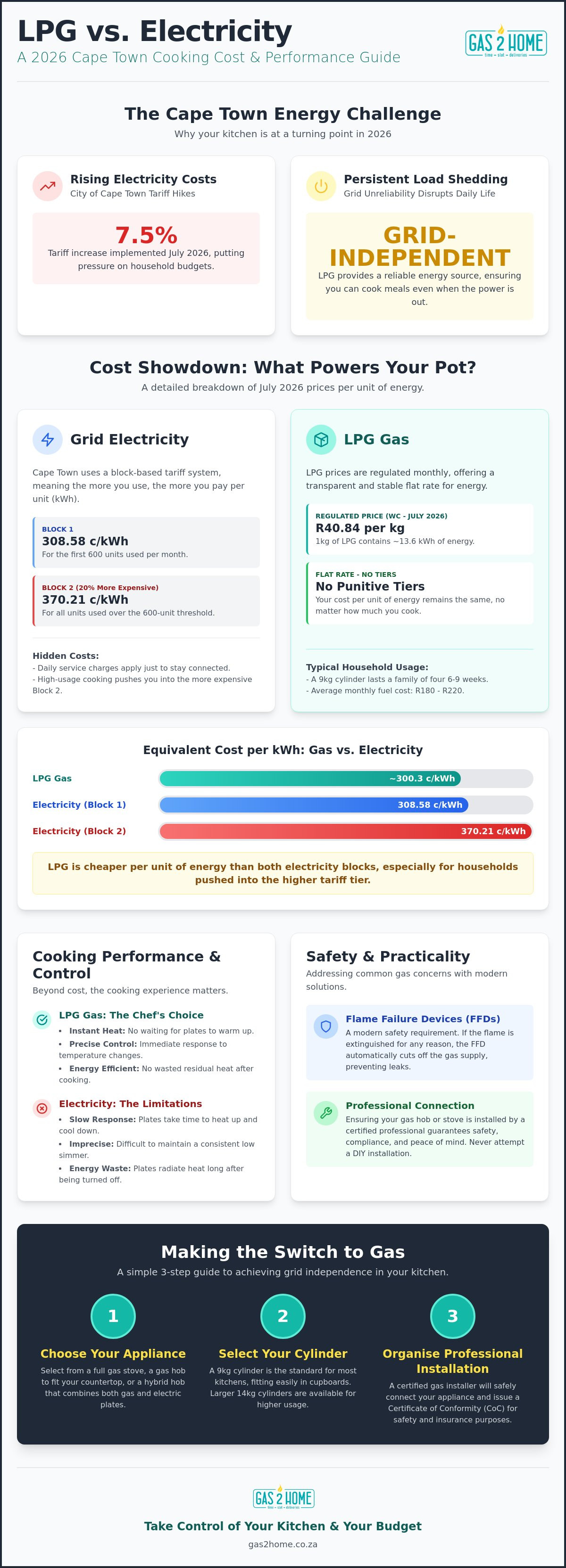
Cape Town uses a block-based tariff system to manage residential consumption. This structure means the more electricity you use, the more you pay per unit. As of July 2026, a "Domestic User" pays 308.58 c/kWh for the first 600 units. Once you cross that threshold, the price jumps significantly to 370.21 c/kWh. These NERSA-approved hikes happen every July, often exceeding the standard rate of inflation. For a household that cooks three meals a day on an electric stove, these costs accumulate quickly. High-usage homes are frequently pushed into the more expensive second block, making every meal a costly exercise. Switching to gas allows you to pull that heavy cooking load off your electric meter entirely.
LPG: The Regulated Alternative
Unlike electricity, which sees massive annual price shocks, gas prices are regulated by the Department of Mineral Resources and Energy. These prices change on the first Wednesday of every month based on international petroleum costs. This month-to-month adjustment provides a level of transparency that municipal billing often lacks. As of 1 July 2026, the maximum retail price for LPG in the Western Cape is R40.84 per kilogram. While prices do fluctuate, they remain a stable alternative to the volatile spikes seen in the power sector. Most local cooks find that a 9kg gas cylinder is the ideal starting point. It's easy to handle, fits into standard kitchen cupboards, and provides enough fuel for several weeks of daily cooking. This section sets the stage for a deeper look at how these two energy sources compare in terms of monthly spend and cooking performance.
Cost Comparison: Is Cooking with Gas Cheaper than Electricity?
Crunching the numbers is the only way to settle the LPG vs electricity for cooking Cape Town debate. To compare them fairly, we must look at energy density. One kilogram of LPG contains roughly 13.6 kWh of potential energy. At the July 2026 price of R40.84 per kg, gas provides energy at a rate that competes directly with the municipal Block 1 tariff. However, the real savings appear when you consider how electricity usage is calculated. Most Cape Town households quickly exceed their 600-unit monthly limit. When you enter Block 2, you pay 370.21 c/kWh. Gas doesn't have these punitive tiers. It remains a flat, predictable cost regardless of how much you cook.
Electricity also carries hidden burdens. Many residents pay a daily service charge just to stay connected to the grid. By moving your cooking load to gas, you reduce your total monthly kWh consumption. This often keeps your remaining electricity usage, like lights and refrigeration, inside the cheaper Block 1 bracket. The initial cost of a gas hob or stove is an investment, but the monthly operational savings usually pay for the appliance within 18 to 24 months. It's a long-term strategy for domestic budget stability.
The 9kg Cylinder: The Residential Workhorse
For a standard family of four, a 9kg cylinder typically lasts between six and nine weeks. This depends on whether you cook every meal or just dinner. Based on 2026 prices, your monthly cooking fuel cost would average around R180 to R220. This is significantly lower than the equivalent cost on a high-usage electric tariff. To keep your kitchen running without interruption, using a reliable gas delivery Cape Town service ensures you never run out mid-meal. It turns your energy supply into a frictionless utility that you control.
Efficiency and Heat Loss
Electric plates are notorious for energy waste. They require several minutes to reach cooking temperature and continue to radiate heat long after you turn them off. That residual heat is energy you've paid for but cannot fully use. LPG offers a different experience. The flame provides instant heat the moment you click the igniter. When you turn it off, the energy consumption stops immediately. You can check your stove's efficiency by looking at the flame. A crisp, blue flame indicates perfect combustion. If you see yellow tips, your burner might need a quick clean to maintain its cost-saving performance. If you're ready to optimise your kitchen, a professional gas connection service can ensure your equipment is tuned for maximum efficiency.
Cooking Performance: Why Control Matters
Beyond the cost factors of LPG vs electricity for cooking Cape Town homes, the actual experience of preparing food changes when you switch to gas. Most professional chefs prefer gas because it offers a level of control that electricity simply cannot match. It isn't just about the heat. It's about the speed of response. When you turn the dial on a gas stove, the flame reacts immediately. There's no waiting for a coil to warm up or a glass plate to glow. This instant reaction is a game-changer for busy families trying to get dinner on the table after a long day. You save time at every stage of the process.
Whether you're simmering a delicate sauce or searing a steak, gas provides the nuance needed for high-quality results. It's also far more versatile with your favourite cookware. Heavy cast iron skillets and round-bottomed woks thrive on a gas flame. Electric hobs, particularly induction or ceramic versions, often require perfectly flat-bottomed pans to work efficiently. Gas doesn't care about the shape of your pot. It wraps the heat around the vessel, ensuring even distribution and better flavour development. This flexibility allows you to use the best tools for the job without worrying about plate contact.
Visual Heat Management
One of the greatest advantages of gas is the ability to see exactly how much energy you're using. You don't need to guess if a specific dial setting is too hot. You simply look at the flame. This visual feedback allows you to organise your cooking flow with much higher precision. You can prevent pots from boiling over before it happens. In contrast, electric hobs suffer from significant residual heat. even after you turn the plate off, it stays hot enough to continue cooking your food. This often leads to overcooked vegetables or burnt sauces. With gas, "off" means "off". The heat stops the second you turn the knob.
Reliability During Load Shedding
We've all experienced the frustration of a "load shedding dinner". Trying to boil water on a tiny camping stove or eating cold sandwiches because the power cut at 6:00 PM is exhausting. Upgrading to a permanent gas hob transforms your kitchen into a grid-independent sanctuary. It ensures your kitchen remains the warm centre of the home regardless of the municipal power schedule. You can host friends and feed your family with total confidence. It's a lifestyle upgrade that removes the stress of checking the load shedding app before you start meal prep. Your stove works every time you need it.
Safety and Practicality: Addressing Common Concerns
Safety is often the primary concern for families weighing up LPG vs electricity for cooking Cape Town meals. While some feel more comfortable with a traditional electric plate, modern gas technology has made LPG incredibly safe for domestic use. Most new gas hobs feature a Flame Failure Device (FFD). This safety component automatically shuts off the gas flow if the flame is extinguished by a draught or a pot boiling over. It prevents gas from accumulating in your kitchen, making it a reliable choice for any home. Legal compliance is also straightforward. South African regulations require that all permanent gas installations are performed by a registered technician to ensure they meet strict national safety standards.
Practical storage is equally important for maintaining a safe environment. Whether you keep your cylinder inside a kitchen cupboard or in an external cage, follow these essential safety steps:
- Always keep cylinders upright: This ensures the safety valve functions correctly.
- Ventilation is key: Never store gas in a completely sealed or unventilated space.
- Distance from ignition: Keep cylinders at least one metre away from electrical points or open flames.
- Clear the area: Ensure the surrounding space is free from dry leaves, paper, or other flammable materials.
Professional Connection vs. DIY
Many people try to fit their own regulators to save time, but incorrect DIY installation is the leading cause of minor leaks. A cross-threaded regulator or a worn-out washer can lead to wasted gas and potential hazards. Choosing a service that includes a professional connection upon delivery removes this risk entirely. A trained driver can verify that the seal is airtight and the valve is functioning perfectly before they leave your property. It’s the easiest way to ensure your kitchen remains a safe space for your family. If you want total peace of mind, you can book a professional gas connection service to get your system started correctly.
Maintenance and Upkeep
Maintaining your gas setup is simple but necessary. You should perform the "soapy water test" on your hoses every few months. Simply brush some soapy water over the hose and connections whilst the gas is on. If you see bubbles forming, you have a leak. It's a quick, no-cost check that anyone can do. Regulators also have a lifespan. You should replace them every five to ten years, or sooner if the rubber seal looks perished. Finally, manage your "empty for full" exchange cycle proactively. Don't wait until the flame dies mid-dinner to think about your next bottle. Keeping a spare cylinder or ordering as soon as one feels light ensures your cooking flow is never interrupted.
Making the Switch: How to Transition to Gas in Cape Town
The choice between LPG vs electricity for cooking Cape Town kitchens has never been clearer. The 2026 energy landscape, defined by steep tariff hikes and the ongoing need for grid independence, makes gas the most logical choice for the modern home. Transitioning is a straightforward process that offers immediate rewards. Most residents start by choosing between a full freestanding gas stove or a hybrid hob. A hybrid setup, which combines gas burners with an electric oven, is a popular middle ground. It allows you to enjoy the precision of a flame whilst still using your electric oven for baking. It’s a practical way to reduce your dependence on the municipal supply without a total kitchen overhaul.
Once your appliance is ready, the next step is securing a reliable fuel supply. You don't need to worry about complex logistics or transport. Same-day delivery services across the Mother City mean you can have your kitchen up and running in hours. Ordering your first cylinder is as simple as sending a message. This convenience, combined with the professional support available, removes the traditional barriers to switching. You gain a kitchen that works on your terms, regardless of what the local power grid is doing.
Choosing Your Cylinder Size
Selecting the right bottle depends on your household's cooking frequency and the space available in your kitchen. We provide a range of sizes to suit every requirement:
- 9kg LPG Gas Cylinder: The standard choice for most home hobs. It fits easily into most kitchen cupboards and is light enough to move without effort.
- 14kg or 19kg LPG Gas Cylinder: Ideal for larger families who cook multiple meals every day. These sizes offer a longer exchange cycle, meaning fewer deliveries.
- 48kg LPG Gas Cylinder: Best for heavy users or homes that use gas for both cooking and water heating.
The exchange process is frictionless. When your bottle is empty, you simply swap it for a full one. You only pay for the gas, making it a predictable and manageable utility expense.
The Gas2Home Advantage
We've designed our service to be a dependable neighborhood partner. You can organise your delivery via WhatsApp or our online platform in seconds. We understand that safety and convenience are your top priorities. That is why we include a professional connection with every delivery. Our team doesn't just drop off a bottle at your gate. We bring it to your kitchen, connect it to your regulator, and perform a safety check to ensure everything is airtight. It’s a masterclass in local logistics designed to give you total peace of mind. Order your LPG delivery today and take control of your kitchen's energy future.
Take Control of Your Kitchen Energy Today
Deciding between LPG vs electricity for cooking Cape Town homes is no longer just a matter of preference. It's a strategic move to lower your monthly spend and bypass the frustrations of load shedding. You've seen how gas offers superior heat control whilst protecting you from rising municipal tariff blocks. By switching to a 9kg or 14kg cylinder, you ensure that your kitchen remains functional and efficient regardless of the state of the power grid.
Transitioning to gas provides immediate peace of mind. You don't have to worry about complicated logistics or running out of fuel at the wrong time. We've made the process effortless by handling the local logistics for you. Our service prioritises your safety and convenience at every step, ensuring a frictionless experience from order to ignition.
Order your gas bottle for same-day delivery in Cape Town and start cooking on your own terms. We include a professional connection with every delivery to ensure your setup is airtight. Same-day delivery slots are available, and you can pay on delivery for total peace of mind. Take the first step toward a more reliable, cost-effective kitchen today.
Frequently Asked Questions
Is cooking with LPG gas really cheaper than electricity in Cape Town?
Yes, for most households, gas is more cost-effective. The July 2026 City of Cape Town electricity tariff increases mean you pay significantly more once you exceed 600 units of power. Moving your cooking load to gas helps you stay within the cheaper electricity block. It provides a flat, predictable cost that doesn't penalise you for cooking more often.
How long does a 9kg gas bottle last for a family of four?
A 9kg cylinder typically lasts between six and nine weeks for a standard family. This estimate assumes you cook dinner every night. If you use your stove for every meal of the day, you'll likely need a refill closer to the six-week mark. It remains one of the most efficient ways to manage your kitchen's energy consumption.
Can I install a gas hob myself in South Africa?
No, you cannot legally perform a permanent gas installation yourself. South African law requires all gas hobs and stoves to be connected by a registered practitioner. This ensures the setup meets national safety standards and keeps your household insurance valid. A professional connection is the only way to guarantee your kitchen is safe.
What happens if I smell gas in my kitchen?
Turn off the cylinder valve immediately and open all your windows and doors. Don't flip any light switches or use electrical appliances, as a small spark could ignite the gas. Move outside into the fresh air. You should then contact a professional to inspect your hoses and regulator for any potential leaks or wear.
Is it safe to store a gas cylinder inside my house?
It is safe to store a cylinder up to 9kg inside your kitchen, provided the cupboard is ventilated. Never store gas in a basement or near a floor drain because LPG is heavier than air and will sink to the lowest point. Always keep the bottle upright and at least one metre away from any electrical sockets or heat sources.
Does Gas2Home deliver gas on weekends in Cape Town?
We provide delivery services from Monday to Saturday across the Mother City. Sunday delivery is not available. If you find your cylinder is light on a Friday evening, we recommend booking a Saturday morning slot. This ensures you have a full bottle ready for the rest of the weekend's meal prep.
Which is better for the environment: LPG or electricity?
LPG is a cleaner-burning fuel at the point of use compared to coal-heavy electricity. It produces fewer carbon emissions and releases no soot or smoke during combustion. When considering LPG vs electricity for cooking Cape Town homes, gas is often the more environmentally conscious choice for those looking to reduce their direct carbon footprint.
Do I need a compliance certificate (CoC) for a gas stove?
Yes, a Certificate of Conformity (CoC) is a legal requirement for all permanent gas installations. This document confirms that a qualified professional installed your stove according to South African safety regulations. You will need this certificate for insurance purposes and it is mandatory when you sell your home or change ownership.