
How to Connect Gas Bottle Safely: A Step-by-Step Home Guide for 2026

Did you know that domestic gas usage in South Africa has surged to over 500,000 metric tons as more households move away from the unstable power grid? It's a brilliant move for your home, but you might feel a bit of nerves when learning how to connect gas bottle safely for the first time. You aren't alone if you worry about turning the thread the wrong way or missing a potential leak. That hesitation is actually a healthy sign; it shows you prioritise your family's safety and want to get the job done right.
Mastering this process replaces uncertainty with total confidence. This guide provides a clear, action-oriented framework to ensure your connection is secure and compliant with the latest SANS 10087-1:2024 standards. We will walk through the essential "check-connect-test" routine, explain the difference between left and right-hand threads, and show you the simple bubble test that guarantees a leak-free setup. You will soon know exactly how to manage your LPG cylinders, and more importantly, you will recognise the specific moments when it is time to call in a professional installer.
Key Takeaways
- Learn exactly how to connect gas bottle safely by following a methodical "check-connect-test" sequence that eliminates domestic risk.
- Identify your specific regulator type and learn how to spot signs of hose fatigue before starting your installation.
- Master the soapy water test to instantly verify a leak-free seal and gain total confidence in your setup.
- Understand the latest storage regulations for Cape Town homes to ensure your LPG cylinders are kept in a secure, ventilated area.
- Discover why professional delivery and connection services provide the ultimate peace of mind for busy households.
Preparation: What You Need Before Connecting Your Gas Bottle Safely
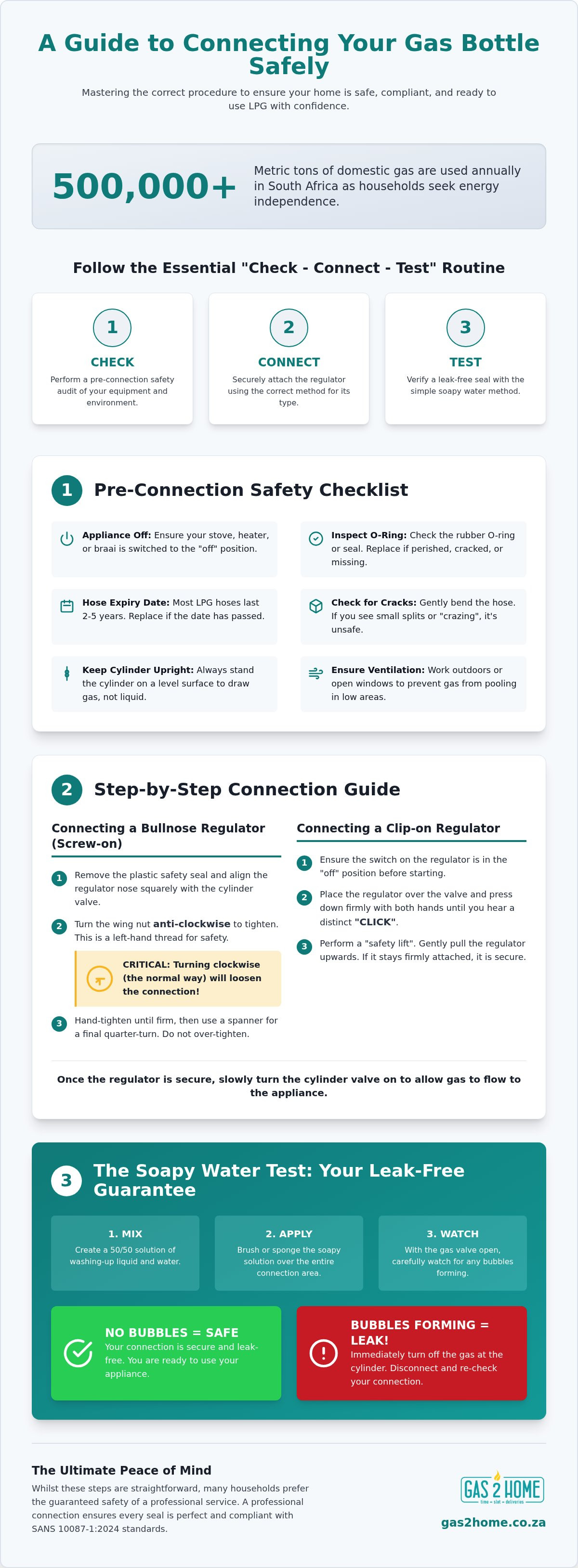
Safety starts long before you pick up a spanner. Handling Liquefied Petroleum Gas (LPG) requires a methodical approach to prevent domestic accidents. To learn how to connect gas bottle safely, you must begin with a thorough inspection of your equipment. Ensure your stove, heater, or braai is switched to the "off" position. This prevents gas from escaping immediately once you open the cylinder valve. Check your rubber O-ring or seal inside the regulator or cylinder valve mouth. If this tiny component is perished, cracked, or missing, you will face a leak regardless of how tight you turn the fitting.
Understanding Your Regulator: Bullnose vs Clip-on
Identifying your regulator type is essential for a secure fit amongst the common South African varieties. The Bullnose regulator is the standard for 9kg gas cylinders and larger units. It features a brass stem that fits directly into the cylinder valve. It's vital to remember that Bullnose regulators use a left-hand thread. This means you must turn the nut anti-clockwise to tighten it. Clip-on regulators are often used for smaller cylinders or specific indoor gas heaters. These don't use threads but instead snap onto the valve mouth with a locking mechanism. Never force a regulator that doesn't seem to fit; the components should align smoothly without excessive pressure.
The Pre-Connection Safety Checklist
Before you start the physical connection, run through this quick safety audit to ensure compliance with SANS 10087-1:2024 standards.
- Verify the hose expiry date. Most orange LPG hoses have a lifespan of 2 to 5 years. Replace any hose that feels brittle or has reached its end-of-life date.
- Inspect the gas hose for visible cracks. Bend the hose gently; if you see "crazing" or small splits, it is unsafe to use.
- Keep the cylinder upright. Cylinders must stand on a level surface to ensure the valve draws gas rather than liquid.
- Work in a well-ventilated space. Open nearby windows or work outdoors to prevent gas from pooling in low areas if a small leak occurs.
Following these steps ensures your home remains a safe environment whilst you learn how to connect gas bottle safely on your own. Whilst these checks are straightforward, many Cape Town residents prefer having a professional handle the setup. Gas2Home includes a connection service with every delivery to give you total peace of mind and ensure every seal is perfect.
Step-by-Step Guide: How to Connect a Gas Bottle Safely
Once you have completed your pre-connection checks, you are ready to physically hook up your cylinder. This process requires a steady hand and a calm environment. Start by removing the plastic safety seal from the new cylinder valve. You can usually pull this off by hand or use a pair of pliers if it's stubborn. Be careful not to damage the valve mouth or the internal threads whilst doing this. Mastering how to connect gas bottle safely involves precision rather than brute force.
Insert the regulator nose into the cylinder valve mouth squarely. It must be perfectly aligned before you begin to tighten. If the regulator is tilted, you risk cross-threading the fitting, which can lead to permanent damage and dangerous leaks. Once the nose is seated, you can begin the tightening process using the correct direction for your specific regulator type.
Connecting a Bullnose Regulator (Screw-on)
Most 9kg to 48kg cylinders in South Africa use the Bullnose system. Align the regulator nose with the valve and turn the wing nut anti-clockwise. Because gas fittings use a left-hand thread, this "backwards" motion is what secures the connection. Tighten the nut by hand until it is firm. Use a gas spanner for a final quarter-turn to ensure a gas-tight seal. Do not over-tighten the nut; excessive force can crush the rubber O-ring and actually create a leak path rather than preventing one.
Connecting a Clip-on Regulator
Clip-on regulators are common for indoor heaters and smaller cylinders. First, ensure the switch on the regulator is in the "off" position. Place the regulator over the valve and press down firmly with both hands until you hear a distinct click. This sound confirms the locking mechanism has engaged correctly. Always perform a "safety lift" by gently pulling the regulator upwards. If it stays firmly in place, it's secure. If it pulls away, the mechanism hasn't locked. This simple check is a vital part of how to connect gas bottle safely at home.
With the regulator secured, turn the cylinder valve on very slowly. Only open it a half-turn initially to pressurise the system. Listen intently for any hissing sounds. If you hear a high-pitched whistle or smell gas immediately, close the valve at once. Whilst following these steps ensures a safe connection, you don't have to handle the technical details alone. If you would prefer an expert to manage the installation, our team provides a professional gas connection service with every delivery across Cape Town.
The Soapy Water Test: How to Detect LPG Leaks Instantly
Once you've followed the steps on how to connect gas bottle safely, you must verify that the seal is airtight. Never assume a connection is safe just because it feels tight. The most reliable and cost-effective way to confirm a secure setup is the soapy water test. This simple procedure identifies microscopic gaps that are invisible to the naked eye but could lead to a dangerous gas build-up over time. It's a non-negotiable final step for every new cylinder installation.
Start by mixing a simple solution of one part dishwashing liquid to four parts water in a spray bottle or a small bowl. Open the cylinder valve slightly to pressurise the system. Apply the soapy water generously to the connection point, the regulator body, and the entire length of the gas hose. If you're using a bowl, use a sponge or a paintbrush to lather the solution onto the fittings until they are completely covered in suds.
What a Gas Leak Actually Looks Like
Observation is key during this test. You need to differentiate between "static" bubbles created by the soap application and "growing" bubbles caused by escaping gas. If you see bubbles that are expanding or multiplying, you have a leak. This indicates that gas is pushing through the soapy film. Whilst the distinctive smell of rotten eggs is a secondary warning sign of a leak, it isn't always reliable in well-ventilated areas. You must never use a lighter or a flame to test for leaks; this is an extremely dangerous practice that can cause an immediate fire or explosion.
Troubleshooting a Failed Leak Test
If you see growing bubbles, don't panic. Close the cylinder valve immediately to stop the flow of gas. Most leaks occur because the connection isn't seated correctly or a component is failing. Disconnect the regulator and perform these three checks:
- Inspect the rubber O-ring inside the valve or regulator. If it's missing, perished, or misaligned, it cannot form a seal.
- Check for cross-threading. If the nut was forced on at an angle, the threads won't align perfectly.
- Examine the hose for tiny pinholes that only appear under pressure.
Try to re-connect the regulator squarely and run the soapy water test again. If bubbles still appear after a second attempt, the equipment may be faulty. In these cases, it's best to stop what you're doing and contact gas delivery Cape Town experts. Our team at Gas2Home handles these technical checks as part of our standard delivery service, ensuring your home remains safe without the guesswork.
Safe Storage and Usage Rules for Your Cape Town Home
Safety doesn't end once you've learned how to connect gas bottle safely. Proper storage is just as critical as the connection itself. You must always store your LPG cylinders in an upright position. This orientation ensures that the safety relief valve remains in the vapour space of the cylinder rather than the liquid space. If a leak occurs whilst the bottle is on its side, liquid LPG can escape, expanding 270 times its volume into gas and creating a far more dangerous situation. Keeping the bottle upright is the simplest way to prevent this risk.
Your storage area must be at ground level and exceptionally well-ventilated. Because LPG is heavier than air, any escaping gas will pool in low-lying areas like basements or drains. Keep your cylinders away from direct heat sources, open flames, and electrical points. In South Africa, strict regulations under SANS 10087-1:2024 limit indoor storage to a maximum of 9kg per flat or cupboard. For those in larger houses, the limit is 19kg, but it is always safer to store larger cylinders outdoors in a dedicated, ventilated cage. Never store gas bottles near electrical DB boards or sockets.
What to Do if You Smell Gas
If you detect the scent of gas in your home, act immediately. Do not operate any electrical switches, including light switches or appliances, as even a tiny spark can ignite the gas. Extinguish all open flames, such as candles or cigarettes, straight away. If it is safe to do so, turn off the gas at the cylinder valve by turning it clockwise. Open every door and window to disperse the gas whilst moving all occupants outside into the fresh air. Do not return inside until the smell has completely dissipated and you are certain the area is clear.
Handling Empty Cylinders
Managing your empty bottles correctly prevents accidental leaks and prepares you for your next delivery. Always close the valve on an empty cylinder before you disconnect the regulator. This prevents any residual gas from escaping into your home. Replace the plastic safety cap or screw-in plug on the empty bottle to protect the valve threads during transport. Once your bottle is empty, you should order a gas cylinder exchange to ensure you aren't left without fuel for cooking or heating.
Organising a swap promptly keeps your household running smoothly. Our team at Gas2Home handles the heavy lifting and ensures your new cylinder is positioned correctly. We verify that your storage setup meets safety standards every time we visit. This proactive approach, combined with your knowledge of how to connect gas bottle safely, creates a secure energy environment for your family.
Professional Gas Connection: The Safest Way to Swap Your Cylinder
Gas2Home simplifies this process by including a professional connection service with every delivery. Our team doesn't just drop off a bottle; they act as your local safety partners. During every exchange, our experts perform a visual inspection of your gas hose and regulator. They look for signs of fatigue, perishing, or O-ring wear that you might overlook. This routine check is essential for maintaining a safe system and preventing leaks before they start. It's a no-nonsense approach to home safety that prioritises your family's well-being.
The Gas2Home Advantage in Cape Town
Our drivers are specifically trained to handle 9kg, 14kg, 19kg, and 48kg cylinders with total expertise. When we arrive at your home, we don't just hand over the cylinder. We connect it, secure the fittings, and perform the necessary safety tests on the spot. We serve a wide range of areas across the city, providing same-day efficiency from Sea Point and Camps Bay to Milnerton and the Southern Suburbs. Safety is our ultimate priority; our team won't leave your property until they have verified a perfect, leak-free connection. This ensures you can use your stove or heater immediately with total confidence.
How to Book Your Next Safe Gas Delivery
Getting a fresh supply of LPG has never been more straightforward. You can manage the entire process through our digital platforms without any complication. Our system is designed to value your time and provide a frictionless experience from start to finish. If you don't want to worry about how to connect gas bottle safely yourself, let our professionals handle the logistics.
- Visit our online store and choose the cylinder size that matches your requirements. We stock everything from 9kg for cooking to 48kg for larger installations.
- Select a convenient time slot that fits into your daily schedule. We prioritise speed and reliability so you aren't left waiting.
- Confirm your order via our website or WhatsApp, and our team will handle the transport, connection, and safety verification for you.
If you are ready for a hassle-free exchange, you can order your gas bottle and connection service here today. We are committed to providing a dependable neighbourhood service that removes the stress of gas management. Let us handle the technical details whilst you enjoy the peace of mind that comes with professional expertise and local reliability.
Enjoy Total Peace of Mind with Your Home Gas Setup
You now have the practical tools to handle your LPG cylinders with total confidence. By following the "check-connect-test" routine, you ensure that every meal cooked and every room heated is done so without risk. Remember that a simple soapy water test is your best defence against leaks, and keeping your equipment in peak condition is a non-negotiable part of home safety. Learning how to connect gas bottle safely empowers you to manage your home energy more effectively whilst keeping your family protected.
Whilst these steps are straightforward, you don't have to handle the technical details by yourself. You can book your gas delivery and let our experts handle the connection for you. We include a professional connection service with every order to give you absolute peace of mind. With same-day delivery available in Cape Town and the ease of WhatsApp ordering, managing your fuel has never been more efficient. Switch to a reliable, local partner today and enjoy a frictionless experience that prioritises your safety above all else.
Frequently Asked Questions
Which way do you turn a gas bottle regulator to tighten it?
Most South African regulators use a left-hand thread, so you must turn the nut anti-clockwise to tighten it. This is the opposite of standard domestic plumbing fittings. Always ensure the threads align smoothly by hand before applying any pressure with a tool. If you feel significant resistance, stop and check the alignment to avoid cross-threading the valve, which can cause permanent damage and gas leaks.
Is it normal to smell a little gas when connecting a bottle?
A faint, momentary whiff of gas whilst connecting the regulator is common as a tiny amount of vapour escapes the valve. However, a persistent smell of "rotten eggs" is a clear warning sign of a leak. If this occurs, close the cylinder valve immediately and re-seat the connection. You must perform a soapy water test to confirm the setup is airtight before attempting to light any appliances.
How often should I replace my gas regulator and hose?
It is recommended to replace your orange gas hose every 2 to 5 years, depending on the manufacturer’s instructions and visible wear. Regulators generally have a longer lifespan and should be replaced every 5 to 10 years. Regularly check your equipment for cracks or perishing. This ensures you continue to learn how to connect gas bottle safely without using compromised components that could fail under pressure.
Can I connect a 9kg gas bottle to my indoor heater myself?
Yes, you can connect a 9kg gas bottle to your indoor heater provided you follow the correct safety sequence and perform a leak test. Ensure the heater is in the "off" position, secure the regulator squarely, and check the O-ring for damage. Whilst it is possible to do this alone, many Cape Town residents prefer professional assistance. Our team provides this connection service with every delivery for total peace of mind.
What tools do I need to connect a gas bottle safely?
Most South African cylinders require a dedicated gas spanner or a shifting spanner to achieve a secure fit. You can usually hand-tighten the wing nut initially, but a final snug fit with a tool is recommended for a gas-tight seal. To understand how to connect gas bottle safely, remember that you only need a quarter-turn past hand-tight. Over-tightening can crush the internal rubber seals and actually create a leak path.
What should I do if the regulator nut won’t turn?
Do not force the nut if it feels stuck or jammed. First, confirm you are turning it the correct way, which is anti-clockwise for Bullnose regulators. Check the threads for dirt, grit, or debris that might be causing an obstruction. If the nut still won't budge, the threads may be stripped or cross-threaded. In these cases, it is best to contact a professional for advice rather than risking damage to the cylinder valve.