
Gas Cylinder Storage Laws at Home in South Africa

Could an LPG cylinder be acceptable in a house but exceed the indoor limit in a flat? Published guidance gives different maximum amounts: 19kg for a house and 9kg for a flat. That’s why the legal requirements for storing gas cylinders at home South Africa residents need to follow can’t be reduced to one rule for every property.
It’s understandable to be unsure which advice is law and which is a safety recommendation. National standards, including SANS 10087-1:2024, set technical requirements, while municipal rules may also apply. The right answer can depend on how much LPG you store, where the cylinders are placed and whether you live in a house or a flat.
This guide explains which authoritative requirements to check, how to confirm local rules and what safer storage involves. You’ll also learn when local approval or guidance from a registered gas professional may be needed, so you can make a practical plan for your home.
Key Takeaways
- Understand how national legislation, technical standards and municipal rules can each affect home LPG storage.
- Learn how the legal requirements for storing gas cylinders at home South Africa may depend on your property type, cylinder quantity and storage location.
- Distinguish verified placement requirements from general precautions around ventilation, heat and ignition sources.
- Use a practical checklist to record your cylinders and storage arrangement before checking the rules that apply.
- See why cylinder size alone doesn’t establish compliance, and when professional guidance may be needed.
Home Gas Cylinder Storage Rules in South Africa
Home LPG storage requirements depend on the applicable law, technical standards, total cylinder quantity and local rules. Start by identifying what you store, where you keep it and whether it forms part of a fixed installation. This is a more reliable starting point than relying on a general safety tip or cylinder size alone.
Here, “storage” means keeping an LPG cylinder at your home, whether it is connected to an appliance or held separately. Connecting a cylinder, operating an appliance, transporting a cylinder and refilling it are different activities, and may involve separate requirements. Don’t assume a storage rule also answers questions about installation or handling. For a general introduction to LPG and its properties, see this Liquefied Petroleum Gas (LPG) Overview. It is background reading, not a South African legal source.
First compliance check: record your property type, cylinder location and total LPG quantity. Then compare those details with the current Pressure Equipment Regulations, relevant SANS provisions and your municipality’s rules.
Which South African rules and standards should homeowners check?
The Occupational Health and Safety Act and the Pressure Equipment Regulations form part of South Africa’s safety framework for pressure equipment, including gas equipment. Their application depends on the equipment and work involved. For technical requirements, check the relevant provisions of SANS 10087-1:2024, the current edition identified for LPG installations, through the South African Bureau of Standards. A summary or general advice from an installer is not a substitute for the applicable standard.
Municipal requirements may also apply. In Cape Town, check the City’s Community Fire Safety By-law and current Fire and Rescue Service guidance for rules relevant to your property and the amount stored. If you live elsewhere, consult your municipality. A safety recommendation, such as keeping the cylinder clear of clutter, may be sensible practice, but it isn’t automatically a statutory requirement. Confirm the wording and source before treating any distance or limit as law.
Does one rule apply to every home and cylinder quantity?
No single cylinder-size rule establishes compliance for every home. The relevant requirements may vary with the installation, combined LPG quantity, cylinder position and property context. A cylinder in a house, flat or shared residential building may raise different considerations. Check the applicable standard and local rules against the actual arrangement.
Count all cylinders kept at the property, not only the one currently connected, and note their marked capacities. A 9kg cylinder does not, by itself, tell you whether the overall setup meets the rules. Nor does a common household size prove that its placement is acceptable. If a fixed installation is involved or the requirements remain unclear, seek guidance from a suitably qualified gas professional or the relevant authority before changing the setup.
Keep this distinction in mind as you read further: a legal requirement comes from an applicable law, regulation, standard or municipal rule; a precaution is safety advice unless an authoritative requirement makes it compulsory. This helps you act carefully without mistaking a useful recommendation for a legal limit.
How National LPG Rules, SANS Standards and Cape Town By-laws Fit Together
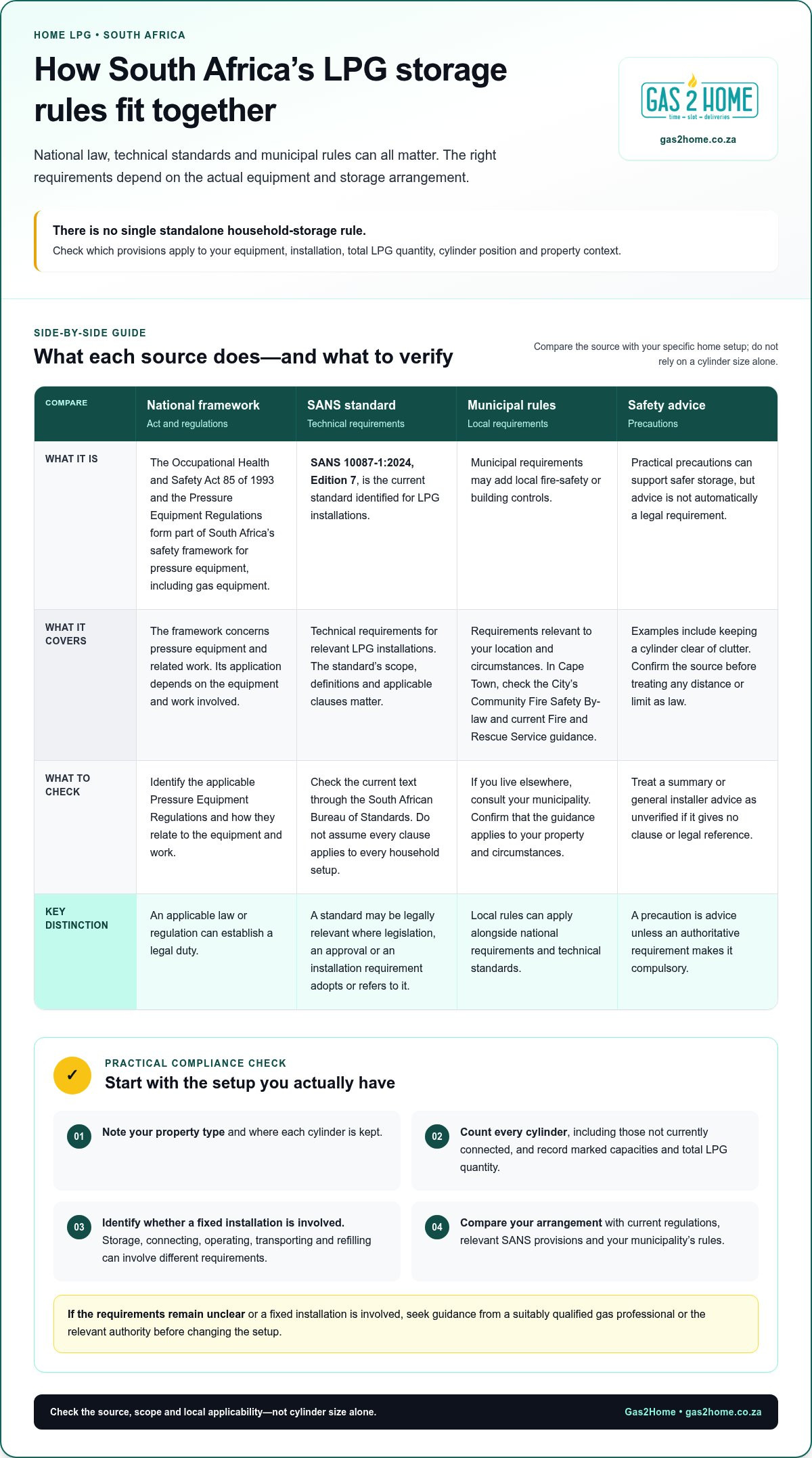
South African LPG compliance is not set out in one standalone household-storage rule. Legislation establishes the safety framework, technical standards give detailed requirements for relevant equipment and installations, and municipal rules may add local fire-safety or building controls. The legal requirements for storing gas cylinders at home South Africa residents need to follow therefore depend on which provisions apply to their specific arrangement.
A standard and a safety tip are not interchangeable. A legal duty comes from an applicable Act, regulation, incorporated standard or municipal rule; a recommended safety practice is advice unless an authoritative requirement makes it compulsory. The Occupational Health and Safety Act 85 of 1993 and the Pressure Equipment Regulations form part of the national framework. SANS 10087-1:2024 provides technical requirements for LPG installations, but its exact application to a particular storage setup must be checked against the standard and relevant legal instrument.
What do the Pressure Equipment Regulations and SANS references cover?
The Pressure Equipment Regulations sit under occupational health and safety law and address pressure equipment and related work. SANS 10087-1:2024, Edition 7, is the current standard identified for LPG installations. That does not mean every clause applies to every household or that the standard alone answers every storage question. Its scope, definitions and relevant clauses matter.
Check the current text through the South African Bureau of Standards and compare it with the applicable regulation. Standards can become legally relevant where legislation, an approval or an installation requirement adopts or refers to them. Don’t assume a standard is automatically law in every situation. If an online summary gives no clause or legal reference, treat its interpretation as unverified and seek clarification from the authority responsible for the requirement.
When should Cape Town residents check municipal requirements?
Check the City of Cape Town’s current Community Fire Safety By-law and its official fire-safety or building guidance if the property is within the City. Confirm that the information applies to your location and circumstances. A municipal rule may address matters that national technical documents do not resolve for a particular site.
Flats and shared buildings deserve an extra check. A building’s approved arrangements, common areas, body corporate rules or landlord requirements may affect where a cylinder can be kept, alongside national provisions. These controls are not all municipal law, so identify who issued each rule and what it covers. Don’t infer a permit, clearance or quantity threshold from a general web summary.
Before relying on online advice, check the document’s issuing authority, publication date, amendments and jurisdiction. Make sure a cited SANS edition is current, and distinguish a national requirement from a City by-law or a building-specific rule. If you’re replacing a cylinder after confirming the suitable arrangement, LPG cylinder delivery and connection can be a practical next step in Cape Town.
Where Can You Store a Gas Cylinder Safely at Home?
Choose a location only after considering ventilation, nearby ignition sources, exposure to heat or damage, and the rules that apply to your property. An outdoor position is not automatically compliant, and a sheltered cupboard is not automatically safe. The legal requirements for storing gas cylinders at home South Africa residents must follow depend on the specific setup and applicable standard or local rule.
Outdoor storage, balconies and enclosed spaces
LPG can present a fire risk if it escapes and reaches an ignition source. Ventilation helps prevent leaked gas from building up, so don’t assume a small enclosed space is suitable simply because it is outdoors or out of sight. Balconies and partly enclosed areas need careful assessment: walls, screens, openings and the cylinder’s position can all affect airflow and whether the location meets applicable requirements.
The figures below are commonly reported as technical placement criteria for outdoor cylinders. Check the current SANS 10087-1 text and its scope before treating any measurement as a legal requirement for your particular setup.
| Category | What to consider |
|---|---|
| Reported technical placement criteria | Keep at least 1 metre sideways from doors, windows and airbricks; 2 metres from drains, pits and manholes; and 5 metres from electrical ignition sources. A reduced distance for an elevated ignition source, and any boundary-wall exception, must be checked against the current standard and the exact site conditions. |
| General safety precautions | Keep cylinders upright and protected from knocks, excessive heat and combustible clutter. These are practical precautions; confirm whether a specific condition is also required by the applicable rule. |
Don’t treat the table as a substitute for checking the standard. The precise wording, exceptions and application can depend on the installation. A three-metre combustible-free zone is also commonly cited in guidance, but verify its source and scope before treating it as a binding rule.
Garages, cupboards and shared residential buildings
A garage may seem convenient, but the guidance cited in this article states that a fixed gas installation is not permitted inside a garage. Check the current standard and installation requirements for the exact meaning and application before making changes. A cupboard can also restrict ventilation. Don’t place a cylinder inside an enclosed cabinet unless the arrangement is designed and permitted for that purpose.
For flats and shared buildings, check building-management or body-corporate rules alongside municipal and national requirements. A balcony may be private space but still form part of a regulated building arrangement. Confirm the approved location rather than relying on a neighbour’s setup or on shelter from rain as proof of compliance.
If you notice unusual smells, damaged components or other warning signs around a connection, stop using the appliance if safe to do so and follow appropriate safety guidance. Learn to recognise signs of a bad gas connection, and arrange qualified help for concerns about a gas installation.
A Homeowner’s Checklist for Checking Gas Cylinder Storage Compliance
Start with facts about your actual setup, not a rule of thumb based on one cylinder. The legal requirements for storing gas cylinders at home South Africa homeowners need to check may depend on the total quantity, property type, location and applicable local rules. Keep a written record so you can compare like with like when consulting an authoritative source.
Five steps to verify the rules for your property
- List every cylinder. Record how many you keep, each cylinder’s marked capacity and whether it is connected to an appliance or stored separately. Include spare or empty cylinders in your notes rather than assuming they can be disregarded.
- Describe the property. Note whether you live in a detached house, flat or shared building, and whether you own or rent. Record any relevant building-management or landlord rules as a separate source, not as national law.
- Map the storage location. Write down whether the cylinder is indoors or outdoors, the exact area, whether it is enclosed, and what is nearby, such as openings, drains, electrical equipment or combustible materials. A clear description helps an authority assess the arrangement.
- Check current national sources. Review the Occupational Health and Safety Act, the Pressure Equipment Regulations and relevant provisions of the current SANS 10087-1 standard. Verify the standard’s scope and the exact clause that relates to your setup. Don’t rely on a copied excerpt with no edition or clause reference.
- Check local requirements and save your sources. Consult your municipality’s current fire-safety and building information. For a Cape Town property, check the City’s applicable guidance and by-laws. Record the source title, issuing authority, date accessed and any amendment details. If the wording remains unclear, seek an interpretation from the responsible authority or a suitably qualified gas professional.
If you’re researching the phrase “legal requirements for storing gas cylinders at home South Africa”, use this process to match guidance to your home. A 9kg gas cylinder guide can explain that cylinder size, but size alone cannot establish whether a storage arrangement complies.
What should you do if your current storage setup raises concerns?
Separate a routine compliance question from an immediate hazard. If you suspect a leak, don’t treat it as paperwork to resolve later. Move people away from the suspected danger and follow current emergency guidance from the relevant authorities. Avoid investigating or handling a cylinder if doing so could put anyone at risk. Contact emergency services from a safe location if there is an immediate threat.
For a non-urgent concern, pause any planned changes and get an authoritative interpretation before relying on assumptions. If you need a suitable replacement cylinder after reviewing your setup, or a connection service, arrange an LPG cylinder delivery and connection. A delivery or connection service does not itself confirm that your storage arrangement meets legal requirements.
Choose and Handle a Home Gas Cylinder with Safety in Mind
Safe LPG use brings three things together: checking the rules that apply to your property, choosing a cylinder that suits your appliance and household needs, and handling it carefully. A cylinder’s capacity alone doesn’t establish that it can be stored in a particular place. The legal requirements for storing gas cylinders at home South Africa residents need to meet depend on the complete setup, including the total quantity and property context.
Before replacing a cylinder, use the storage checklist in this guide to confirm what you have, where it will be kept and which authoritative requirements apply. Then choose a suitable option for your use. Don’t treat a familiar size, a neighbour’s arrangement or a convenient storage spot as proof of compliance.
What to consider when replacing a household cylinder
Gas2Home supplies LPG cylinders in 9kg, 14kg, 19kg and 48kg options. These are different capacity choices, not a recommendation that one size suits every household. Consider the appliance’s requirements and your household’s needs, then assess the planned storage arrangement separately against the applicable rules.
For example, switching to a larger cylinder may change the total quantity of LPG kept at the property. That can affect which requirements need checking, even if the cylinder will stand in the same place. Record the capacity shown on each cylinder, including any spare, and review the combined setup. Keep the cylinder upright and handle it carefully; don’t force a connection or make changes to a fixed installation based on guesswork.
How delivery and connection can simplify the next step
Once you’ve checked the suitable capacity and storage conditions, arranging a replacement can be straightforward. Gas2Home delivers LPG cylinders in Cape Town, and delivery includes a cylinder connection service. This provides practical help with the cylinder handover and connection, but it is not a legal inspection, permit or Certificate of Conformity. Keep compliance checks separate from ordering and connection arrangements.
If you’re unsure about your property’s requirements, resolve that question with the relevant authority or a suitably qualified gas professional before changing the storage setup. If a connection appears damaged or you suspect a leak, treat it as a safety concern rather than a routine replacement; follow current emergency guidance and keep people away from immediate danger.
With the storage rules checked and a suitable cylinder selected, you can plan the next step with more confidence. For a replacement in Cape Town, order or exchange an LPG cylinder in Cape Town.
Make Your Next Gas Decision with Confidence
Make storage checks part of your household routine, not an afterthought. Recheck the applicable rules if you change the cylinder arrangement, move home or alter the space around it. Keep a record of the source of any legal advice you rely on, so you can revisit it if your circumstances change.
Looking up the legal requirements for storing gas cylinders at home South Africa is a useful starting point, but the practical next step is to apply authoritative guidance to your own setup. If anything remains unclear, resolve that uncertainty before changing where or how a cylinder is kept. Careful planning helps you make a considered choice without assuming a convenient option is automatically suitable.
When you’re ready to arrange a household cylinder, Gas2Home can help with delivery and connection in Cape Town. Order or exchange an LPG cylinder in Cape Town, then move forward with a clear plan for using and storing it safely.
Frequently Asked Questions
Can I store an LPG cylinder inside my house in South Africa?
Possibly, but the answer depends on your home, the quantity stored and the applicable requirements. Check current national provisions, relevant SANS guidance and municipal rules for your property before deciding. A general safety tip about indoor storage isn’t automatically law, and advice that applies to one property type may not apply to another. Record whether the cylinder is connected or spare, then verify the rules for that exact arrangement.
How many gas cylinders can I legally store at home in South Africa?
There isn’t one number that can safely be applied to every home without checking its circumstances. The total LPG quantity, cylinder capacities, installation and property type can affect which requirements apply. For example, consider two smaller cylinders together rather than assessing them one at a time. Check the current national and local rules for your address, and treat any online threshold as context-specific until you verify its source and scope.
Do I need permission to keep a gas cylinder at home in Cape Town?
Not every household can be given the same answer. Permission or approval may depend on the property, the amount stored and applicable municipal or building rules. In Cape Town, look up the City’s current fire-safety and building information and check whether it covers your property arrangement. Flats, rented homes and shared buildings may also have rules from a landlord or building manager. Don’t assume those private rules replace municipal or national requirements.
Is it legal to store an LPG cylinder in a garage?
Don’t rely on a blanket yes or no. A garage’s layout, ventilation, ignition sources, cylinder quantity and installation type all matter. Guidance identifies restrictions on fixed gas installations in garages, but that does not automatically settle every question about a separate cylinder. Check the current South African standard and local requirements for your exact setup. Treat concerns such as poor airflow or nearby ignition sources as safety issues, even before confirming their legal status.
Can I keep a gas cylinder on a balcony in a flat?
A balcony isn’t automatically suitable just because it’s outdoors. Screens, walls and the building’s layout can affect airflow, while building rules or fire-safety requirements may restrict where cylinders can be kept. Check your building’s current rules and the relevant municipal requirements before placing or moving a cylinder. If the building manager’s guidance conflicts with an official rule, get clarification from the responsible authority rather than relying on a neighbour’s arrangement.
Which South African standard covers LPG cylinder storage at home?
SANS 10087 is the standard family to investigate, but the applicable part and clauses depend on the installation and situation. SANS 10087-1:2024 is identified as the current edition for LPG installations; check the South African Bureau of Standards for the official text, scope and any amendments. Don’t assume every provision applies to every home. An undated online summary may omit important definitions or exceptions, so verify the clause before relying on it.
What should I do if I smell gas near a stored cylinder?
Treat a suspected leak as an urgent safety concern, not a routine compliance query. Keep people away from the suspected danger and follow current emergency and supplier safety instructions. If there’s an immediate threat, contact emergency services from a safe location. Don’t attempt repairs or investigate the cylinder if doing so could expose anyone to danger. Once the immediate risk has been addressed, have the setup assessed before putting it back into use.