
Cape Town Catering Gas: 2026 Logistics & Compliance

Imagine it's a busy Saturday night in a bustling City Bowl kitchen; the orders are piling up, and suddenly your burners go cold because a 48kg cylinder has run dry. It's a nightmare scenario that every restaurant owner fears, especially when a delivery driver refuses to help with the heavy lifting. Finding reliable gas for catering Cape Town is about more than just a price per kilogram; it's about ensuring your kitchen never stops moving.
You already know that managing fuel logistics and complex SANS safety regulations can feel like a full-time job. We'll show you how to master your gas supply chain, from navigating CoC requirements to securing dependable deliveries that include professional setup. This article provides a clear roadmap for your commercial connection, covering the updated August 2026 pricing trends and essential cylinder placement rules. You'll learn how to build a reliable energy supply that prevents downtime and keeps your business fully compliant with South African safety standards.
Key Takeaways
- Understand the critical SANS 10087-1 safety standards and why a valid Certificate of Compliance is essential for your business insurance.
- Learn how to choose the most efficient cylinder sizes for your kitchen's volume, from 19kg units to heavy-duty 48kg setups.
- Discover how to secure a dependable supply of gas for catering Cape Town to prevent costly downtime during peak service hours.
- Identify the benefits of partnering with a delivery service that includes professional connection and safety checks as standard.
- Master your energy logistics with same-day delivery strategies that keep your hospitality operations running smoothly from Monday to Saturday.
The Role of LPG in the Cape Town Catering Landscape
Cape Town caterers are increasingly moving away from the electrical grid to secure their operations. In 2026, energy reliability is the defining factor for success in the local hospitality and tourism sectors. If the lights go out, the kitchen shouldn't stop. Switching to Liquefied Petroleum Gas (LPG) allows businesses to maintain a consistent service regardless of municipal infrastructure failures. It is the most reliable way to manage gas for catering Cape Town and ensures your production line stays active.
Commercial gas demand is vastly different from domestic requirements. While a household might use a small cylinder for months, a professional kitchen requires the high-volume output of 19kg or 48kg cylinders. This high-pressure environment demands a reliable energy supply that can handle peak service hours without losing heat intensity. Decentralised energy gives small catering enterprises better control over their overheads. You pay for what you consume, making it easier to manage cash flow during seasonal fluctuations.
Navigating Load Shedding with Gas Power
Gas provides a massive competitive advantage during unpredictable power outages. Unlike solar systems that often struggle with high-draw cooking appliances or diesel generators that are noisy and expensive to maintain, gas offers instant heat. When you use gas for catering Cape Town, you avoid the steep peak-hour electricity tariffs that hit during busy dinner shifts. It's a pragmatic solution for keeping the stoves hot when the rest of the street goes dark. Relying on gas means your service remains uninterrupted, keeping your customers happy and your staff productive.
LPG as a Sustainable Business Choice
Choosing LPG is a smart move for future-proofing your business against rising costs. It has a cleaner environmental profile compared to the coal-heavy electricity usually supplied by the grid. Modern gas connections are highly efficient and significantly reduce the carbon footprint of commercial kitchens. By integrating gas now, you protect your catering enterprise against the volatility of municipal energy prices. It's a clean-burning fuel that meets the growing demand for sustainable business practices in the Western Cape. Secure your supply today to ensure your business remains both profitable and environmentally responsible.
Commercial Gas Connection Regulations and Compliance
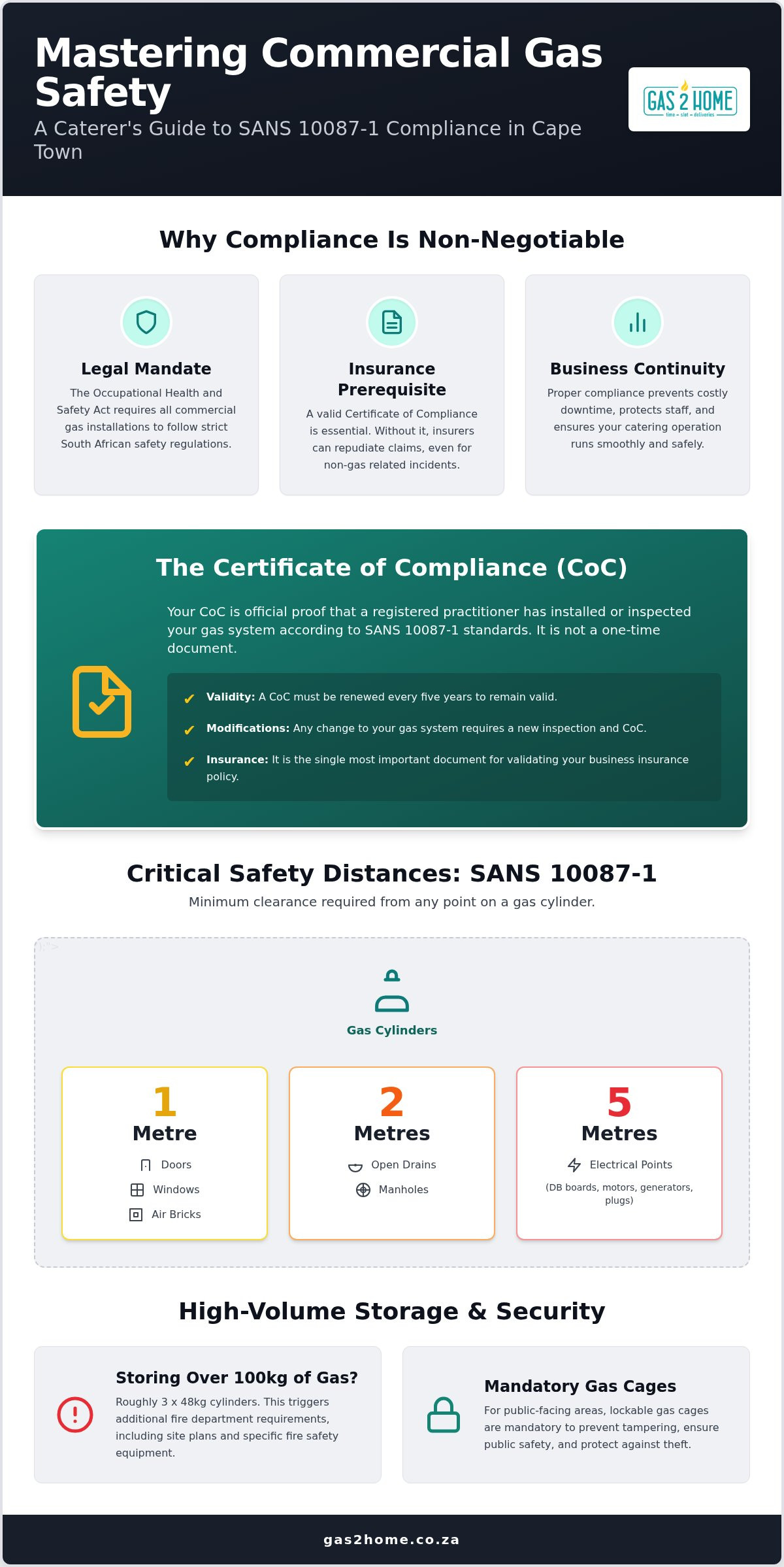
Compliance is the backbone of any professional kitchen. In South Africa, the Occupational Health and Safety Act mandates that all commercial gas installations follow South African gas safety regulations. If you're running a high-volume operation using gas for catering Cape Town, you're likely handling large manifolds. Storing over 100kg of gas, which is roughly equivalent to three 48kg cylinders, triggers additional fire department requirements. This includes submitting site plans and ensuring specific fire safety equipment is on hand. It's a legal necessity that ensures your business stays open and your staff remain safe.
The Certificate of Compliance (CoC) Explained
A Certificate of Compliance (CoC) is your proof that a registered practitioner installed or inspected your system according to SANS 10087-1 standards. It's not a one-time document. You must re-certify your commercial catering connection every five years or whenever you modify the system. Most importantly, your business insurance depends on it. If a fire occurs and you don't have a valid CoC, insurers can repudiate the claim entirely, even if the fire wasn't gas-related. Operating without one is a risk that could bankrupt your enterprise overnight.
Safety Distances and Manifold Requirements
SANS 10087-1 defines strict safety distances to prevent accidents in a busy catering environment. You cannot place cylinders closer than 1 metre to a door, window, or airbrick. If there's an open drain or manhole, the distance increases to 2 metres to prevent gas from pooling in low areas. Electrical points, such as DB boards, motors, or generators, require a 5-metre clearance. For public-facing areas, lockable gas cages are mandatory to prevent tampering and theft. Proper ventilation is equally critical; while indoor connections have very strict weight limits, outdoor manifolds allow for the larger 48kg setups required for heavy-duty cooking.
Ensuring these distances are met while managing heavy 48kg cylinders is a significant physical challenge for any kitchen team. You can simplify this by choosing a professional connection service that handles the heavy lifting and safety checks for you. It's the most efficient way to maintain a compliant workspace without distracting your chefs from their service.
Selecting the Right Gas Cylinder Size for Your Kitchen
Selecting the right cylinder size is about balancing your kitchen's physical footprint with operational uptime. You don't want to swap bottles mid-service, but you also can't afford to waste floor space on oversized inventory. Choosing the correct gas for catering Cape Town depends on your equipment's total heat output and your daily cooking duration. Most professional kitchens rely on a combination of cylinders to ensure they never run dry during a rush.
A manifold system is often superior to a single large tank for business flexibility. It allows you to link multiple cylinders together, providing a continuous supply while one bottle is being exchanged. This setup is particularly effective for managing the energy needs of high-output commercial burners. It gives you the ability to scale your supply up or down as your business grows without needing to install permanent, bulky infrastructure.
19Kg vs 48kg: A Commercial Comparison
The 19kg cylinder is the best choice for small cafes and low-volume food prep areas. It is easy to handle and fits into tighter spaces while still providing several days of consistent heat for a few burners. In contrast, the 48kg cylinder is the workhorse of Cape Town restaurants. It offers a much longer burn time and is far more cost-efficient for heavy daily usage. Large caterers typically use 48kg cylinders in pairs to ensure there is always a backup ready. Following safe handling and storage practices is vital when dealing with these larger units, as their weight requires professional connection to avoid injury or leaks.
Specialised Sizes for Specific Applications
Not every catering job requires a massive manifold. A 9kg bottle is the right choice for mobile catering units or dedicated braai stations at outdoor events. It's portable and swap-ready for quick setups. The 14kg cylinder serves as an ideal middle-ground for boutique guest houses that offer breakfast and light meals but don't run a full-scale commercial kitchen. To determine your optimal cylinder count, look at your peak service hours. Multiply the number of burners you use by the hours they stay lit. If you're running more than four burners for six hours a day, a 48kg setup is your most reliable path to uninterrupted service. This ensures you have enough gas for catering Cape Town events even during your busiest weekends.
Managing Logistics: Delivery and Professional Connection
In the fast-paced hospitality world, timing is everything. Running out of fuel during a lunch rush is a disaster. That's why same-day delivery is the gold standard for gas for catering Cape Town. You need a partner who understands that a four-hour delay costs you money. Beyond speed, the physical act of swapping a cylinder is where safety often fails. Many suppliers simply drop the bottle at the kerb. This forces your kitchen staff to struggle with heavy 48kg cylinders that weigh nearly 90kg when full. This isn't just a health and safety risk for your team; it's a recipe for a bad connection. Professional connection on delivery is a safety-critical service that keeps your staff focused on cooking rather than logistics.
Organising a delivery schedule that matches your business peak hours is essential. You don't want a delivery truck blocking your entrance or a technician in the kitchen during a busy service. A reliable supplier will work around your prep times to ensure the swap happens when it's most convenient for your workflow. This methodical approach ensures that your gas supply is never a source of stress. It allows you to maintain a reliable energy chain without the physical strain of managing large cylinders.
Streamlining the Ordering Process
Catering managers don't have time for long phone calls or complex web forms. Using WhatsApp for rapid gas ordering allows you to request a refill in seconds between busy kitchen shifts. Look for services that offer specific time-slot deliveries. This allows you to ensure a manager is present to oversee the swap and sign off on the safety check. During the process, it's vital to watch for signs of a bad gas connection, such as hissing sounds or the distinct smell of gas. Identifying these issues immediately prevents operational downtime and keeps your kitchen safe.
Safe Connection Protocols for Delivery
A professional delivery technician follows a strict sequence to ensure safety. First, they inspect the regulator and pigtail hoses for signs of perish or wear. After securing the new cylinder, they perform a bubble test. This involves applying a soapy solution to the joints to check for leaks. Any bubbles indicate a fault that must be fixed before the gas is turned on. You must also ensure your staff are trained to recognise gas leaks and understand emergency procedures. They should know how to shut off the main valve and evacuate the kitchen if they suspect a leak. Training your team to spot these risks is just as important as the connection itself.
Secure your kitchen's energy supply and avoid heavy lifting by booking a professional commercial gas delivery today.
Why Gas2Home is the Trusted Partner for Cape Town Caterers
Gas2Home is built on a deep commitment to the local catering and business community. We understand that your reputation depends on every plate that leaves the kitchen. Providing reliable gas for catering Cape Town means more than just dropping off a cylinder. It involves being a proactive partner in your operational success. We focus on the details that matter to busy managers: speed, safety, and straightforward transactions. Our model is designed to remove the friction from energy sourcing so you can focus on your guests.
We offer the convenience of same-day delivery and expert connection for gas for restaurants Cape Town. This ensures your kitchen setup is always safe and compliant without requiring your staff to handle heavy equipment. Transparency is at the core of our service. We provide clear pricing and flexible pay-on-delivery options for commercial accounts. This helps you manage your catering cash flow effectively without the burden of complex credit applications or hidden fees. Our expansive gas delivery Cape Town network ensures that whether you are in the heart of the CBD or the Atlantic Seaboard, your supply is secure.
Reliability You Can Count On
Our team understands the Monday to Saturday business grind. We operate during the hours when you need us most, providing a consistent safety net for your hospitality operations. We have a proven track record of fast delivery in Seapoint, the CBD, and the Southern Suburbs. Every delivery includes a professional connection and a rigorous safety check. This focus on safety protects your staff and your property while maintaining your vital CoC status. We act as your eyes and ears on-site, ensuring your gas installation remains in top condition week after week.
Get Started with Your Commercial Supply
Setting up your first delivery is a simple process. Contact us via WhatsApp to discuss your specific kitchen requirements. We create customised delivery plans for high-volume catering users to ensure you never hit a "gas out" situation. Whether you need a single 19kg exchange or a full 48kg manifold refresh, we handle the logistics with precision. Don't let energy supply become a bottleneck in your kitchen. Organise your commercial gas delivery today and experience a service that values your time as much as you do.
Secure Your Kitchen’s Future with Reliable Energy
Securing a dependable supply of gas for catering Cape Town is the most effective way to protect your business against energy volatility and municipal infrastructure failures. By mastering your local logistics and strictly adhering to SANS safety regulations, you ensure your kitchen remains a productive and compliant environment. You now understand how the correct cylinder manifold and a valid Certificate of Compliance safeguard your operations, your staff, and your insurance status. Don't let the physical burden of heavy lifting or the stress of delivery delays interrupt your peak service hours.
Take control of your energy chain with a partner who understands the fast-paced hospitality world. With same-day delivery available Monday to Saturday, professional connection included with every exchange, and the convenience of WhatsApp ordering, managing your fuel has never been simpler. Order your commercial gas delivery and connection now to keep your burners lit and your focus exactly where it belongs: on your guests. Your success in the Cape Town hospitality sector depends on consistent performance, and we're ready to help you deliver it every single day.
Frequently Asked Questions
Do I need a special permit for a commercial gas connection in Cape Town?
You need a permit from the City of Cape Town Fire and Rescue Services if your total gas storage exceeds 100kg. This threshold is reached when you have more than two 48kg cylinders on-site. The fire department must inspect your storage area to ensure it meets ventilation and safety distance requirements. Always keep your site plans updated to reflect any changes in your gas for catering Cape Town setup to avoid fines.
How often should my commercial catering gas installation be inspected?
Your commercial gas installation requires a new Certificate of Compliance every five years. However, high-volume kitchens should ideally schedule professional safety checks annually. Frequent use puts strain on regulators, pigtails, and valves. Regular inspections ensure that your system remains efficient and that any minor leaks are caught before they become dangerous. This proactive maintenance also ensures your business insurance remains valid throughout the year.
What is the price difference between residential and commercial gas cylinders?
The Maximum Retail Price (MRP) for LPG is regulated by the South African government and adjusted monthly. As of August 2026, the price decreased by R5.03 per kilogram in the Western Cape. While the rate per kilogram is consistent, commercial kitchens save money by using 48kg cylinders, which reduce the frequency of delivery fees. Using larger cylinders is the most cost-effective way to manage gas for catering Cape Town.
Can I use a 9kg gas bottle for my commercial restaurant kitchen?
You can use a 9kg cylinder for low-output appliances like a single burner or a small grill, but it isn't practical for a full restaurant kitchen. High-volume commercial burners draw gas quickly, which can cause smaller bottles to "freeze up" and lose pressure. For a consistent flame and fewer interruptions during service, restaurants should opt for 19kg or 48kg cylinders that are designed for heavy-duty cooking.
How do I get a gas Certificate of Compliance (CoC) for my business?
To obtain a gas Certificate of Compliance, you must hire a gas practitioner registered with SAQCC Gas. They will inspect your entire installation to ensure it meets SANS 10087-1 standards. This includes checking safety distances, ventilation, and pressure-testing the lines. Once the practitioner is satisfied that the system is safe and compliant, they will issue a legal CoC, which you must keep on file for insurance and fire safety inspections.
What should I do if I smell gas in my commercial kitchen?
If you smell gas, immediately turn off the supply at the cylinder valves and extinguish any naked flames. Do not operate any electrical switches, as a small spark could trigger an explosion. Open all doors and windows to ventilate the area and evacuate your staff. Once everyone is safe, contact a professional technician to find and fix the leak. Never attempt to restart your kitchen until a qualified expert gives the all-clear.
Does Gas2Home provide same-day delivery for 48kg cylinders?
Yes, Gas2Home provides same-day delivery for 48kg cylinders across Cape Town from Monday to Saturday. We understand that running out of gas can halt your business, so we prioritise rapid response times. You can place your order via WhatsApp for immediate processing. Every exchange includes a professional connection service, ensuring your heavy-duty cylinders are safely installed and leak-tested by our expert team before we leave your premises.
Is it safer to store commercial catering gas bottles inside or outside?
It is significantly safer and often a legal requirement to store commercial cylinders outside. SANS regulations restrict the amount of gas you can store indoors to prevent the risk of gas pooling in enclosed spaces. Outdoor storage allows for natural ventilation, which disperses any minor leaks safely into the atmosphere. Ensure your outdoor cylinders are housed in a lockable, ventilated gas cage to protect them from tampering and the elements.