
Apartment Gas Cylinder Delivery in Cape Town: Rules and Safe Setup

Before arranging apartment gas cylinder delivery Cape Town residents need to check more than delivery access. Landlord or body corporate permission, building rules and a suitable cylinder location can all affect the setup. The first step is to find out whether your building allows an individual cylinder in your flat.
Building rules and gas safety requirements are separate checks. Permission to use a cylinder does not confirm that a proposed location or connection is safe, and a suitable setup may still be restricted by the building. An individual cylinder also works differently from a shared gas supply.
This guide covers the permissions to check, how to identify your apartment’s gas arrangement, what to consider when choosing a cylinder location, and how to prepare for delivery. Gas2Home delivers LPG cylinders in Cape Town and provides professional cylinder connection on delivery. With the building arrangements clear first, you can plan the practical steps with fewer surprises.
Key Takeaways
- Check building permission separately from gas safety requirements before arranging apartment gas cylinder delivery in Cape Town.
- Find out whether your flat uses an individual cylinder or a shared gas supply before placing an order.
- Assess possible cylinder locations for ventilation, access and nearby hazards, and follow current requirements and building rules.
- Prepare by confirming permission, deciding whether you need a new cylinder or an exchange, and noting clear access instructions.
- Gas2Home offers supported cylinder sizes, online and WhatsApp ordering, delivery time slots and professional connection on delivery.
Apartment gas cylinder delivery in Cape Town: which rules apply?
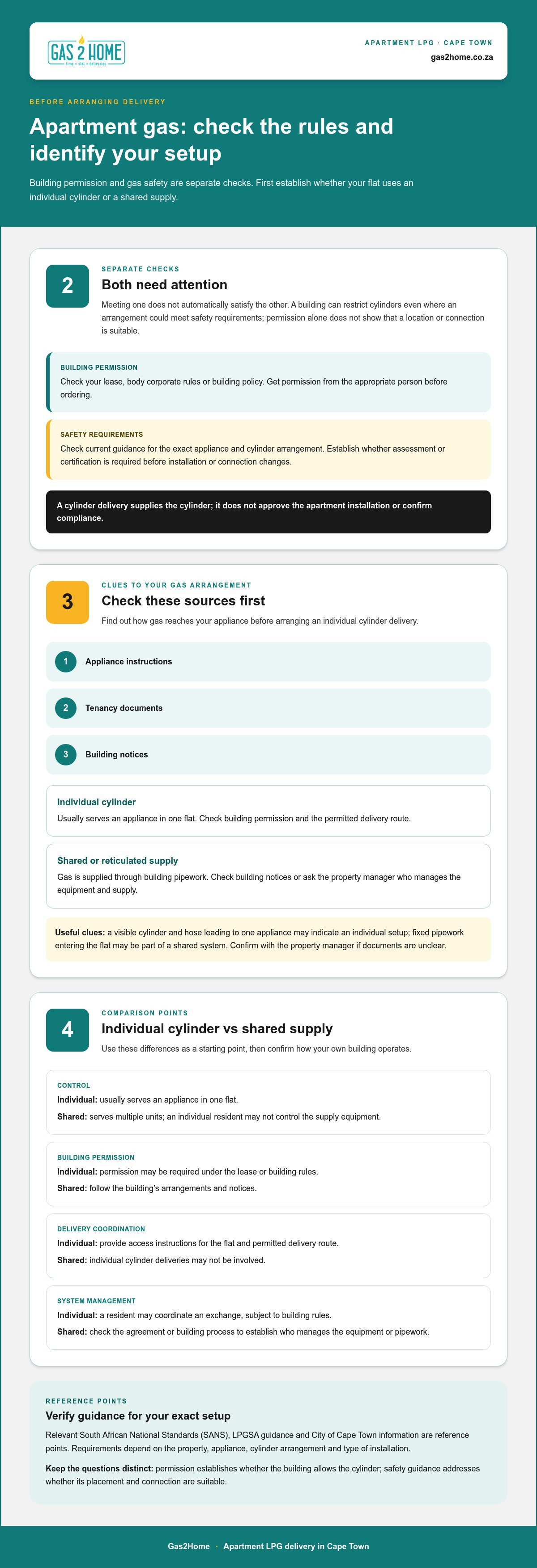
Two checks shape a safe LPG setup in a flat: applicable safety requirements and permission from the building owner or body corporate. Meeting one does not automatically satisfy the other. A building may restrict cylinders even where an arrangement could meet safety requirements, while permission alone does not establish that a location or connection is suitable.
The relevant requirements depend on the property, appliance, cylinder arrangement and type of installation. A portable cylinder used with one appliance may raise different questions from a fixed connection or shared supply. Before arranging apartment gas cylinder delivery in Cape Town, identify your setup and check the current requirements that apply to it. Do not assume a neighbour’s arrangement is a suitable precedent.
Use the relevant South African National Standards (SANS), LPGSA guidance and City of Cape Town information as reference points. For general background on cylinder types and handling, see Gas cylinder safety and handling. If the setup involves a fixed appliance or a changed connection, establish whether current requirements call for certification or inspection before work begins.
What should residents verify about LPG requirements?
Check the guidance for the exact appliance and cylinder arrangement. Advice for a freestanding home or a different appliance may not apply to your flat. Consult relevant SANS and local guidance, and establish whether the installation needs assessment or certification. Requirements can depend on what is being installed, not simply on whether a cylinder is being delivered.
A cylinder delivery supplies the cylinder; it does not approve the apartment’s installation or confirm compliance.
- Identify whether the appliance uses a portable cylinder, a fixed connection or a shared supply.
- Check which current safety guidance applies to that arrangement.
- Confirm any assessment or certification requirements before installation or changes to a connection.
How do apartment rules fit alongside safety requirements?
Your lease, body corporate rules or building policy may set additional conditions or restrict cylinders in particular areas. Read the relevant documents and get permission from the appropriate person before ordering. A landlord’s approval is not proof that a setup meets safety requirements, just as a location that appears suitable is not automatically permitted by the building.
Keep the checks distinct: permission answers whether the building allows the cylinder; safety guidance addresses whether its placement and connection are suitable. If you are unsure which building rule applies, ask the landlord or managing agent to clarify it in writing. This guide is not a substitute for current regulatory advice or advice specific to your building. Requirements can change, so verify them before arranging delivery or changing an installation.
Individual cylinders or shared gas: understand your apartment’s setup
Before arranging apartment gas cylinder delivery in Cape Town, find out how gas reaches your appliance. A cylinder serving one flat is different from a shared or reticulated system, where gas is supplied through building pipework. If an appliance is already connected to a shared supply, ordering an individual cylinder may not be appropriate. Identify the existing connection first.
How can you tell which gas arrangement your flat uses?
Start with the appliance instructions, tenancy documents and building notices. Look for references to a cylinder kept for your flat, a central gas supply, shared meters or building-managed maintenance. A visible cylinder and hose leading to one appliance may indicate an individual setup, while fixed pipework entering the flat may be part of a shared system. These clues can help, but confirm the arrangement with the property manager if the documents are unclear.
Use this comparison as a starting point, not as a substitute for your building’s own information:
- Control: An individual cylinder usually serves an appliance in one flat. A shared supply serves multiple units, so an individual resident may not control the supply equipment.
- Building permission: A cylinder for one flat may require permission under the lease or building rules. Shared systems are managed under building arrangements, so follow the relevant notices and procedures.
- Delivery coordination: An individual-cylinder order needs access instructions for the flat and the permitted delivery route. A shared supply may not involve individual cylinder deliveries for each resident.
- System management: A resident may coordinate an individual cylinder exchange, subject to building rules. For shared equipment or pipework, check the applicable agreement or building process to establish who manages it.
What should tenants, owners and body corporates consider?
Tenants should read the lease and obtain any required property permission before arranging a cylinder. Owners should check the building rules and consider whether delivery or placement would affect shared areas. Body corporates and managing agents can clarify the building’s process, access arrangements and how a shared supply is managed. Responsibilities vary between properties, so refer to the relevant agreement or written rule rather than assuming the same person handles every part.
Focus on practical questions. Does your appliance connect to an individual cylinder, or receive gas through building pipework? Do you need a new cylinder or an exchange? Who needs to approve access or use of a shared area? Clear answers help you avoid ordering for the wrong arrangement and give the delivery team useful access details.
Once you have identified an individual-cylinder setup and followed the applicable building process, choose a cylinder that suits the appliance and your usage. Gas2Home delivers cylinders and provides professional connection on delivery. You can arrange LPG cylinder delivery with your apartment access details ready.
Cylinder placement and apartment safety: compare the practical options
A convenient corner is not automatically a safe or permitted place for an LPG cylinder. When planning apartment gas cylinder delivery in Cape Town, assess possible locations against current safety requirements and the building’s rules. The right position depends on the installation and layout, so do not rely on a general rule of thumb or copy a neighbour’s setup.
What makes a cylinder location suitable for an apartment?
Consider airflow, access and nearby hazards together. The location must meet the requirements for the cylinder and appliance, while remaining accessible for delivery, inspection and any necessary work. Check whether the space is enclosed, whether heat or ignition sources are nearby, and whether people or objects could knock or damage the cylinder.
Balconies, cupboards and shared areas are not automatically suitable. A balcony may be exposed to weather or restricted by building rules. A cupboard can limit airflow unless its design meets applicable requirements. A shared passage or common area may obstruct access or escape routes, and may not be allowed under the building’s policy. Treat each as an option to assess, not a default solution.
Before deciding, consult current South African National Standards, relevant LPGSA guidance, City of Cape Town information and your apartment’s rules. Verify any exact clearance, ventilation or placement measurement against the requirements for your installation. Do not rely on an unverified distance or alter a location yourself to make it appear compliant.
- Airflow: Check whether the proposed space meets the ventilation requirements for your setup.
- Access: Make sure the cylinder can be reached without blocking doors, walkways or an escape route.
- Nearby hazards: Consider heat and possible ignition sources, and places where the cylinder could be struck or damaged.
- Building rules: Confirm that the location is permitted, particularly if it involves a balcony or shared area.
When should a resident pause and seek guidance?
Pause if you cannot establish whether a proposed spot is allowed, if the connection or equipment appears damaged, or if you suspect a gas leak. Do not continue using an arrangement that concerns you, and do not try to adjust or repair the connection yourself. For immediate danger, move away from the area and follow emergency guidance from the relevant authorities.
If you are unsure what to look for, use this guide to signs of a bad gas connection to understand what may warrant attention. It complements, but does not replace, advice specific to your building or a qualified assessment of the installation.
Once the permitted position and access plan are clear, delivery can be arranged with fewer surprises. Share relevant apartment access instructions and keep the cylinder location consistent with the approved setup.
Before arranging apartment gas delivery in Cape Town: use this checklist
Preparation makes apartment gas cylinder delivery in Cape Town more straightforward. Work through these checks in order: confirm permission, identify your gas setup, prepare the delivery details, then place your order. This reduces the risk of a mismatch between the cylinder you request, the appliance connection and the building’s access arrangements.
- Confirm permission. Review your lease or building rules and get any required approval before ordering. Check that the intended cylinder location and access route are acceptable for the property.
- Identify the setup. Establish whether your appliance is supplied by an individual cylinder or connected to a shared system. Check the existing connection, and do not order an individual cylinder for an appliance that uses a building supply.
- Choose new or exchange. Select a new cylinder if you need to purchase one. Choose an exchange if you have an empty cylinder to swap for a replacement. State clearly which option you need when ordering.
- Prepare access details. Note the full address, flat or unit number, entrance instructions, parking information and any lift or security arrangements. Include your preferred delivery time slot where available.
What information should you prepare before ordering?
Have the cylinder size and new-or-exchange requirement ready, along with the complete delivery address. Gas2Home offers 9kg, 14kg, 19kg and 48kg cylinders. The right size depends on your appliance, setup and usage. Before ordering, make sure you have addressed building permission and that the intended connection point suits the arrangement. Include access instructions that will help the delivery team find the correct entrance and apartment.
Keep the details together, especially if your building has more than one entrance or a security desk. Give specific instructions: which entrance to use, how the delivery team should announce their arrival, and which unit is receiving the cylinder. Share a time-slot preference when ordering, taking account of the service’s stated terms.
How can you avoid delays on delivery day?
Make sure the delivery route and intended cylinder location are accessible. If parking, a locked gate, building security or a particular entrance could affect access, provide the relevant instructions when ordering. Keep the route clear of stored items and arrange any required entry permission in advance. This helps the delivery team reach the right apartment without avoidable confusion.
Gas2Home offers delivery time slots and professional cylinder connection on delivery. The connection service can help with the handover once the apartment arrangements are in place. Keep someone available to provide access and point out the intended location, but do not request a location that has not been permitted or assessed for your setup.
See Cape Town gas delivery options and prepare your cylinder choice and apartment access details.
How Gas2Home makes apartment cylinder delivery simpler
Once your apartment’s gas arrangement, permission and intended cylinder position are clear, placing an order is straightforward. Gas2Home delivers LPG cylinders in Cape Town and provides professional cylinder connection on delivery. Choose a supported size, order online or through WhatsApp, and share clear instructions for reaching your building and flat.
For apartment gas cylinder delivery in Cape Town, residents can order a new cylinder or request an exchange. Gas2Home offers same-day delivery with time slots, subject to the service’s stated terms. The service operates Monday to Saturday, and payment is made upon delivery.
What happens when you order from Gas2Home?
Choose from 9kg, 14kg, 19kg or 48kg cylinder options, based on your appliance and the arrangement permitted for your apartment. Select a new cylinder if you do not already have one to exchange. If you have an empty cylinder to swap for a replacement, make that clear when ordering.
Order online or through WhatsApp. Include the complete delivery address, flat number and useful entry details, such as the correct gate or entrance and any security instructions. Select a delivery time slot in line with the options and terms provided. Payment is due upon delivery.
- New cylinder: Choose this if you need a cylinder rather than an exchange.
- Exchange: Choose this if you have an empty cylinder to swap for a replacement.
- Delivery details: Provide your unit number, entry instructions and relevant access information.
What should apartment residents expect at connection?
Gas2Home provides professional cylinder connection on delivery. Before delivery, settle any building permission and placement questions, and make sure the intended connection point is appropriate for your setup. The service makes the practical handover simpler, but it does not replace building approval or determine whether an apartment’s gas arrangement is permitted.
Give clear access instructions and keep the route to the approved cylinder position unobstructed. If your flat uses a shared gas supply rather than an individual cylinder, identify that before ordering so you do not arrange the wrong type of supply. Gas2Home’s gas delivery across Cape Town information provides local service-area context for planning your order.
When your cylinder choice and apartment access details are ready, you can order online or through WhatsApp. View Gas2Home’s Cape Town cylinder delivery service.
Make your apartment’s gas setup easier to manage
Keep your building’s permission and access details somewhere easy to find. If you move flats or your building changes its rules, review them again rather than assuming the previous arrangement still applies. Planning ahead helps you make a more confident decision about apartment gas cylinder delivery in Cape Town and avoid rushing a setup that needs clarification.
When you are ready, Gas2Home can help with delivery and professional cylinder connection. Order online or through WhatsApp, and have your apartment details ready so the process is clear from the start.
Arrange your Cape Town gas cylinder delivery with your cylinder choice and apartment access details prepared.
Frequently Asked Questions
Does an apartment in Cape Town need a gas certificate for an LPG cylinder?
Not necessarily for the cylinder delivery alone. A permanent gas installation, such as a fixed appliance connected to a cylinder, generally requires a valid Gas Certificate of Conformity (CoC) issued by a practitioner registered with the South African Qualification and Certification Committee (SAQCC). The requirement depends on the installation, so check the current rules for your setup. A CoC does not replace your landlord’s or body corporate’s permission.
Can a tenant arrange an LPG cylinder delivery without the landlord’s permission?
Do not assume you can. Check your lease and building rules before arranging apartment gas cylinder delivery in Cape Town, as they may require the landlord’s approval or restrict cylinders altogether. For example, a lease might require written consent before you add or change a gas connection. Get the relevant permission before booking and keep a written record of the agreed conditions.
Can I keep an LPG cylinder in a cupboard in my flat?
Only if the cupboard is permitted for your particular setup and meets the applicable ventilation and safety requirements. A standard kitchen cupboard is not suitable simply because the cylinder fits inside. Do not drill vents or alter the cupboard yourself as a workaround. Check the current requirements and apartment rules, and have the location assessed if you cannot establish whether it is appropriate.
What if my apartment building does not allow individual gas cylinders?
Do not bring a cylinder into the flat against the building’s rules. First establish whether your appliance is already connected to a shared gas supply, as ordering an individual cylinder may not suit that arrangement. If the building has no shared system, ask the landlord or managing agent about the formal process for raising the restriction. Keep the appliance on its existing supply until you have permission and a suitable arrangement.
Can an LPG cylinder be delivered to an apartment balcony?
Possibly, but a balcony is not automatically an acceptable location. Suitability depends on the apartment’s rules, the cylinder and appliance arrangement, and current safety requirements. Consider whether the proposed position affects access, nearby hazards or the route out of the flat. Do not request delivery to a balcony unless its use has been permitted and the proposed placement has been checked against the requirements for your installation.
Does Gas2Home connect an LPG cylinder when delivering to a Cape Town apartment?
Yes. Gas2Home provides professional cylinder connection with delivery. Before delivery, make sure you have permission to use a cylinder and that the intended position is suitable for your apartment’s arrangement. Provide clear entry instructions and identify the approved connection point when the team arrives. Connection support makes the handover simpler, but it does not grant building permission or establish that a location is compliant.