
9kg vs 14kg Gas Bottle: Which Size is Right for Your Cape Town Home?

You are halfway through preparing a family meal during a scheduled power cut when the gas stove suddenly dies. It's a frustrating scenario many Cape Town residents face, especially when the shops are closed and the backup cylinder is empty. Deciding on the right 9kg vs 14kg gas bottle for your home is the first step toward avoiding these domestic mini-crises. While the smaller bottle is a local favourite for its portability, the larger option offers a significant boost in longevity for frequent cooks.
We understand that you want a reliable fuel source that doesn't require constant delivery call-outs or back-breaking lifting. This guide breaks down the practical differences between these two sizes to ensure you choose the most cost-effective and convenient solution for your household. We'll look at everything from storage safety regulations in the city to which cylinder actually fits your specific appliance. You will learn about indoor storage limits and how to organise your setup for maximum efficiency. By the end, you'll have total peace of mind regarding your home's gas connection and safety.
Key Takeaways
- Discover how the 14kg cylinder provides extended cooking time and reduces the frequency of delivery call-outs for busy households.
- Compare the physical dimensions of a 9kg vs 14kg gas bottle to ensure your chosen cylinder fits perfectly inside your kitchen cupboards.
- Learn how to save on long-term costs by balancing refill prices against the convenience of fewer total deliveries.
- Understand local safety regulations for indoor storage to ensure your gas setup remains compliant and secure at all times.
- Find out how professional connection services take the stress out of handling and installing larger, heavier gas cylinders.
Understanding the 9kg and 14kg LPG Cylinder Sizes
Most Cape Town residents rely on Liquefied petroleum gas (LPG) to power their kitchens and keep their homes warm during the winter. This fuel is a mixture of flammable hydrocarbon gases that provides a portable, high-energy heat source. In South Africa, the domestic market is dominated by two specific sizes. Choosing between a 9kg vs 14kg gas bottle depends on your available space, your physical ability to handle the cylinder, and how often you use your appliances.
The 9kg cylinder is the standard for most households. It is versatile and easy to move. However, the 14kg cylinder is gaining popularity as a high-capacity alternative. It sits in the "sweet spot" for residential use. It offers more fuel than the standard size without the extreme weight and bulk of the industrial 19kg or 48kg options. Understanding the physical reality of these bottles helps you avoid the stress of an unexpected empty tank.
What is a 9kg Gas Bottle?
Standing roughly knee-height, the 9kg cylinder is compact and manageable. It's the industry standard for portability. You'll find it powering gas braais on balconies and portable heaters in lounges. It's the most popular choice for apartment living in Cape Town because it fits easily into small kitchen cupboards and is light enough for most people to transport in a car. If you only cook occasionally or use gas primarily for a weekend braai, this size is usually sufficient. To elevate your outdoor cooking experience, learn more about Tools & Grill for premium barbecue accessories. It's easy to swap at almost any local supplier, making it a low-effort fuel solution.
What is a 14kg Gas Bottle?
The 14kg cylinder has a taller profile and a significantly larger fuel reservoir. Its primary purpose is to serve permanent gas stove installations and heavy-duty heating systems. While it takes up more vertical space, it provides a much longer run-time for dedicated cooks. When you compare a 9kg vs 14kg gas bottle, the 14kg version is the clear winner for families who prepare three meals a day on a gas hob. It reduces the frequency of delivery call-outs, which saves you time and logistical headaches.
While some suppliers suggest a 9kg bottle is enough for a family of four, we've found that active households often find it runs out too quickly. A 14kg cylinder provides that extra buffer. It ensures you aren't constantly checking the weight of your bottle. Because it's heavier, we recommend using a professional delivery and connection service to ensure it's installed safely and correctly in your home. This prevents the physical strain of lifting and gives you peace of mind that the seals are tight.
Usage Scenarios: How Long Will Your Gas Bottle Last?
Predicting the lifespan of your fuel source helps you avoid the frustration of a cold stove mid-meal. Several variables influence how quickly you empty your tank. Burner size, your preferred heat settings, and how many people you cook for all play a role. A large wok burner consumes gas much faster than a small simmering plate. For a typical family of four in Cape Town, the debate over a 9kg vs 14kg gas bottle often comes down to the frequency of delivery call-outs and the logistical effort of managing refills.
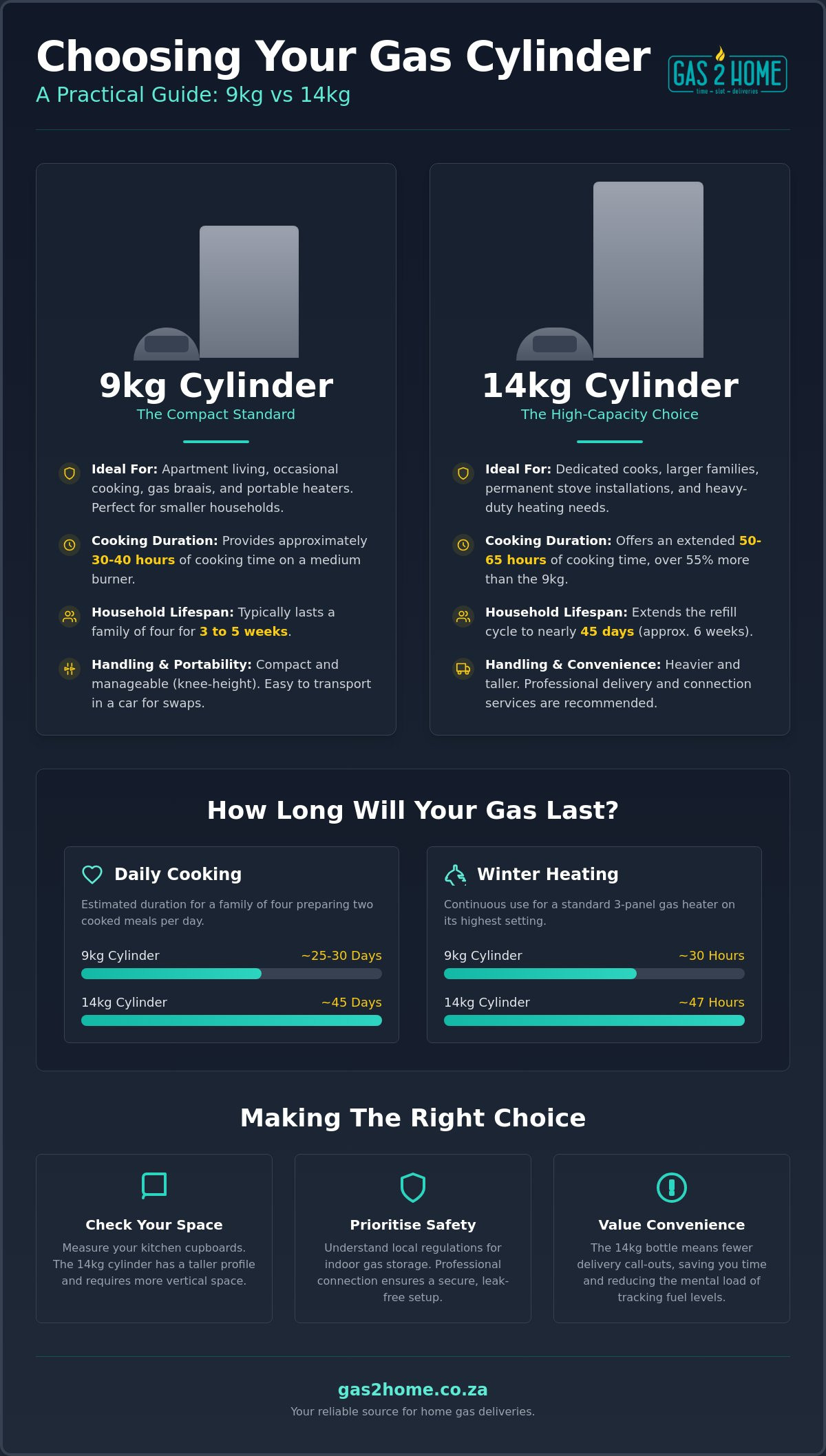
The math is simple. A family of four preparing two cooked meals a day plus morning coffee will typically exhaust a 9kg bottle in roughly 25 to 30 days. Switching to a 14kg bottle extends this window to nearly 45 days. This shift from a three-week cycle to a six-week cycle makes household management much simpler. It reduces the mental load of tracking your gas levels whilst ensuring you always have enough fuel for the next loadshedding block.
Cooking Duration: 9kg vs 14kg
A 9kg cylinder generally offers 30 to 40 hours of continuous cooking time on a medium-sized burner. This usually lasts a standard household about three to five weeks depending on their habits. Upgrading to a 14kg bottle increases your cooking time to roughly 50 to 65 hours. This extra reservoir acts as a vital safety net. It significantly reduces the risk of running out of gas on a Tuesday evening when shops are closed. If you are leaning toward the smaller size for its portability, check out our resource on The 9kg Gas Cylinder: Cape Town’s Ultimate Guide to LPG for more specific usage tips and tricks.
Heating and Seasonal Demands
During Cape Town’s damp winter months, gas heaters become essential for comfort. A standard 3-panel heater on its highest setting uses approximately 300g of gas every hour. A 9kg bottle provides about 30 hours of heat, whereas a 14kg bottle keeps your home warm for nearly 47 hours. This extended duration is far more convenient when the rain is pouring and you don't want to leave the house for a swap.
Safety is paramount when using these appliances indoors. You must adhere to South African safety regulations regarding ventilation and hose maintenance. We always recommend keeping a second bottle as a spare to ensure you aren't left in the cold. It's the only way to maintain a frictionless experience during the winter peak. You can easily organise a spare cylinder delivery to ensure your home remains a warm sanctuary.
Practical Considerations: Weight, Dimensions, and Storage
Handling a 9kg vs 14kg gas bottle involves more than just choosing a fuel capacity. It's about the physical effort required to swap cylinders and the space available in your kitchen or utility area. If you've ever struggled to lug a full bottle from your car boot to the kitchen, you know that weight matters. Understanding these physical limits helps you decide if you can manage the swap yourself or if you need professional assistance to get the job done safely.
Transporting these bottles also requires a suitable vehicle. While a 9kg cylinder fits easily behind a passenger seat or in a small boot, a 14kg cylinder is more cumbersome. It requires a stable, upright position to prevent it from rolling during transit. Because of the increased height, it can be a tight squeeze in smaller hatchbacks. Many Cape Town residents find that the logistical headache of transporting the larger bottle is the main reason they switch to a reliable delivery service.
Weight Comparison and Handling
The "Lifting Test" is the quickest way to decide which size suits your lifestyle. A full 9kg cylinder weighs between 18kg and 20kg. This is roughly equivalent to a large suitcase and is manageable for most people to lift over short distances. In contrast, a full 14kg cylinder tips the scales at approximately 28kg to 30kg. This is a significant jump in weight. Lifting 30kg requires a certain level of physical strength and carries a higher risk of back strain if handled incorrectly. Our professional delivery and connection service removes this burden entirely. We handle the heavy lifting and ensure the bottle is positioned safely so you don't have to break a sweat.
Dimensions and Cupboard Space
Space is the next hurdle for your home setup. A 9kg bottle is roughly 450mm tall with a diameter of 300mm. Most standard South African kitchen cupboards are designed to accommodate this height comfortably. A 14kg bottle shares a similar diameter but is considerably taller, usually reaching about 600mm. Before you commit to the larger size, measure the vertical clearance in your dedicated gas cupboard. You must ensure there is enough room for the regulator and the hose to curve naturally without being pinched against the top of the cupboard.
Storage isn't just about fit; it's about legal compliance. You must follow South African gas safety standards to protect your household. For instance, cylinders stored indoors must be in a well-ventilated centre and never in a garage. Research indicates that while a single 9kg bottle is often permitted indoors, larger setups or multiple cylinders often require outdoor placement. Outdoor cylinders must be kept on a firm, level surface and situated at least 1 metre from property boundaries and 2 metres from drains or air vents. Following these rules ensures your installation remains compliant for insurance purposes and keeps your family secure.
Cost-Benefit Analysis: Value for Money and Refill Frequency
Comparing a 9kg vs 14kg gas bottle isn't just about physical dimensions. It's a calculation of your long-term household expenses. While the maximum retail price of LPG is regulated by the South African government, the way you manage your supply impacts your total spend. Choosing a larger cylinder often provides better value when you factor in the logistical costs of keeping your kitchen running.
The 14kg cylinder is often the secret to more affordable home energy. It contains over 55% more gas than the standard 9kg unit. This doesn't just mean more cooking time; it means you're reducing the overheads associated with every refill. For homeowners interested in broader energy-saving strategies, the Carbon Saving Group offers insights into optimising renewable energy systems for maximum efficiency. Every time you call for a delivery, there is a logistical cost involved. By opting for a higher-capacity bottle, you effectively halve these service requirements over the course of a year. It's a simple way to streamline your domestic budget without changing your cooking habits.
Refill Frequency and Convenience
Think about how much you value your time and peace of mind. If you use a 9kg bottle for all your meals, you might find yourself ordering a refill every three weeks. By switching to the 14kg option, you extend that cycle significantly. This reduced frequency means you're less likely to be caught without fuel on a busy evening. We provide reliable gas delivery in Seapoint, Camps Bay, CBD, Southern suburbs, and Milnerton to ensure you never have to worry about an empty tank. Moving to a larger bottle simply makes this service even more efficient for your household.
The Initial Investment
You will face a higher upfront cost when purchasing a new 14kg cylinder compared to a 9kg one. This deposit is a one-time investment in your home's energy infrastructure. If you're a dedicated home cook or rely on gas for heating during the winter, this initial spend pays for itself through convenience and reduced delivery fees. The exchange system is straightforward; you simply trade your empty bottle for a full, safety-checked one. It's a frictionless process that ensures you always have a high-quality cylinder in your home. Ready to upgrade your kitchen's efficiency? Order your 14kg gas cylinder today and experience the benefits of a high-capacity fuel solution.
Choosing the Perfect Cylinder for Your Household Needs
Selecting between a 9kg vs 14kg gas bottle ultimately comes down to how your household functions on a daily basis. If your gas usage is limited to occasional weekend braais or a small portable heater, the 9kg cylinder remains the most practical choice. It's easy to store and simple to swap. However, if you've transitioned to full-time gas cooking to bypass loadshedding, the 14kg cylinder is a superior long-term partner. It offers the stability of a larger fuel reserve and drastically cuts down on the administrative task of monitoring your gas levels.
Consider these specific scenarios to help you decide:
- Stick with the 9kg cylinder if: You live in a small apartment, use gas primarily for outdoor braais, or need a portable fuel source for camping trips.
- Upgrade to the 14kg cylinder if: You cook for a family of three or more, use your gas stove daily, or rely on a three-panel gas heater during the winter.
- Choose the "Hybrid" approach if: You want total security. Keep a 14kg bottle for the kitchen and a 9kg bottle for the braai to act as an emergency backup.
The Final Verdict
For households with one or two occupants, a 9kg cylinder is usually sufficient for a month of moderate cooking. If you have three or more people under one roof, or if you use a large four-burner stove daily, upgrade to the 14kg model. Many savvy Cape Town residents choose the hybrid strategy mentioned above. They use a 14kg bottle for their main kitchen installation and keep a 9kg cylinder for the balcony. This 9kg bottle doubles as a vital safety net if the main stove runs dry on a Sunday evening. It's the ultimate strategy for domestic peace of mind and ensures you never miss a meal.
Ordering Your Gas with Confidence
We know that handling larger cylinders can feel daunting. That's why Gas2Home provides a professional connection service with every delivery. Our team takes care of the heavy lifting and ensures your regulator is fitted correctly before we leave. You don't need to struggle with heavy bottles or worry about potential leaks. We offer same-day delivery across Cape Town to keep your home running without interruption. You can even place your order via WhatsApp for maximum convenience. It's the fastest way to organise your fuel supply without the fuss. Order your 9kg or 14kg gas bottle today for fast delivery in Cape Town and let us handle the logistics for you.
Streamline Your Cape Town Home Energy Today
Choosing between a 9kg vs 14kg gas bottle is about balancing your daily cooking needs with the practical space in your home. The 9kg cylinder remains a versatile choice for apartment living and outdoor braais. However, upgrading to a 14kg bottle offers the longevity required for busy families and the extra warmth needed during Cape Town's winter months. Always check your cupboard dimensions and consider the weight of a full cylinder before you commit to a specific size.
We take the stress out of managing your fuel supply. Our team provides same-day delivery from Monday to Saturday across the city. Every delivery includes a professional connection service to ensure your home remains safe and compliant. You don't need to struggle with heavy lifting or complex regulators. Just use our easy WhatsApp ordering system for a frictionless experience that fits your busy schedule.
Get your gas delivered and connected today in Cape Town and enjoy a seamless cooking experience. We are ready to help you keep your household running efficiently.
Frequently Asked Questions
Can I swap a 9kg empty bottle for a 14kg full one?
No, you cannot typically swap a 9kg empty for a 14kg full cylinder. The exchange system operates on a like-for-like basis to maintain accurate stock levels. To upgrade your setup, you must purchase a new 14kg cylinder deposit. Once you have the larger bottle, you can continue to exchange it for full 14kg units during all your future deliveries. This ensures you always have the correct capacity for your household needs.
Will a 14kg gas bottle fit under my standard gas stove?
A 14kg cylinder may not fit in every standard kitchen cupboard due to its increased height. While a 9kg bottle is roughly 450mm tall, a 14kg unit reaches approximately 600mm. Measure the vertical clearance inside your cupboard before ordering to ensure there is enough room for the regulator and hose. They must sit comfortably without being pinched against the top shelf or the bottom of your stove to ensure safe operation.
How much heavier is a full 14kg bottle compared to a 9kg bottle?
A full 14kg cylinder is approximately 10kg heavier than a full 9kg unit. A full 9kg bottle weighs roughly 18kg to 20kg, whereas a full 14kg bottle weighs between 28kg and 30kg. This weight difference is the primary reason many customers prefer our professional delivery service. We handle the heavy lifting and installation so you don't have to worry about physical strain or potential injury while managing your fuel supply.
Is it safer to keep a 9kg bottle indoors than a 14kg bottle?
South African regulations state that a gas cylinder up to 9kg may be stored indoors in a well-ventilated cupboard. Larger cylinders are generally better suited for outdoor placement to meet specific safety standards and municipal bylaws. Regardless of the size you choose, you must ensure the storage area is clear of electrical points and drains. Our team can advise you on the safest location for your specific 9kg vs 14kg gas bottle setup during delivery.
What happens if I run out of gas on a Saturday in Cape Town?
You don't have to wait until Monday for a refill because we provide same-day delivery across Cape Town from Monday to Saturday. If you run out mid-meal, simply send us a message via WhatsApp to organise a quick replacement. This service ensures your weekend plans and family dinners continue without interruption. It is the most efficient way to manage your 9kg vs 14kg gas bottle requirements during the busy weekend period.
Do I need a different regulator for a 14kg gas bottle?
No, you do not need a different regulator when switching between these two sizes. Both the 9kg and 14kg domestic cylinders in South Africa use the standard 5/8-inch Bullnose regulator with a left-hand thread. As long as your current regulator and hose are in good condition and meet safety standards, they will fit the larger bottle perfectly. Our delivery team will check the condition of your connection for you during the installation process.
How do I know when my 9kg or 14kg gas bottle is nearly empty?
The most accurate method is to check the weight of the cylinder or use the warm water test. Pour warm water down the side of the bottle; the gas inside absorbs the heat, and a line of condensation or a cold patch will form at the fuel level. Some users prefer to keep a spare bottle on hand to avoid guesswork. This ensures a frictionless transition when one cylinder eventually runs dry during a cooking session.
Does Gas2Home connect the 14kg bottle for me upon delivery?
Yes, we include a professional connection service with every delivery we make at no extra cost. Whether you choose a 9kg vs 14kg gas bottle, our trained team will swap the cylinders and test the connection for leaks. This service is designed to provide you with total peace of mind and remove the domestic stress of handling heavy equipment. We ensure your appliance is ready for immediate and safe use before our team leaves your property.