
What Size Gas Bottle Do I Need? The Complete Guide for South African Homes

You are halfway through searing a steak on the braai when the flame flickers and dies. It is a frustrating moment that most South Africans have faced at least once. Asking yourself, "what size gas bottle do I need?" before you buy is the best way to prevent these mid-cook disasters. Choosing the right cylinder is about more than just capacity; it is about safety, weight, and how much space you have available in your kitchen or patio.
We understand that the thought of heavy lifting or navigating the new SANS 10087-1:2024 safety standards can be stressful. You want a reliable energy source without the headache of complicated valves or running out of fuel at the worst time. This guide will help you discover the perfect LPG cylinder size for your stove, heater, or braai using our expert selection checklist. We will explain the legal indoor limits for flats and houses, estimate how long each bottle lasts, and show you how to find a service that handles the delivery and connection for you.
Key Takeaways
- Learn how to match your appliance energy consumption to the right cylinder volume to avoid running out of fuel unexpectedly.
- Discover the legal limits for indoor gas storage in South African flats and houses to ensure your installation remains compliant.
- Use our selection checklist to answer "what size gas bottle do I need" based on your available storage space and physical handling preferences.
- Understand the difference between bullnose and L-shape regulators to ensure a safe and secure connection for your specific appliance.
- Identify when to scale up to a 48kg changeover system for high-demand households that require a continuous gas supply.
Understanding LPG Cylinder Sizes in South Africa
Most South African households rely on Liquefied Petroleum Gas (LPG) as a dependable alternative to the national power grid. Whether you are avoiding the frustration of load shedding or searing a steak on the patio, gas provides instant and controllable heat. It is a clean-burning fuel that remains a staple for cooking, heating water, and warming living spaces. While the chemical composition of the gas is identical across all containers, the physical dimensions of the cylinder determine how much energy you have at your disposal.
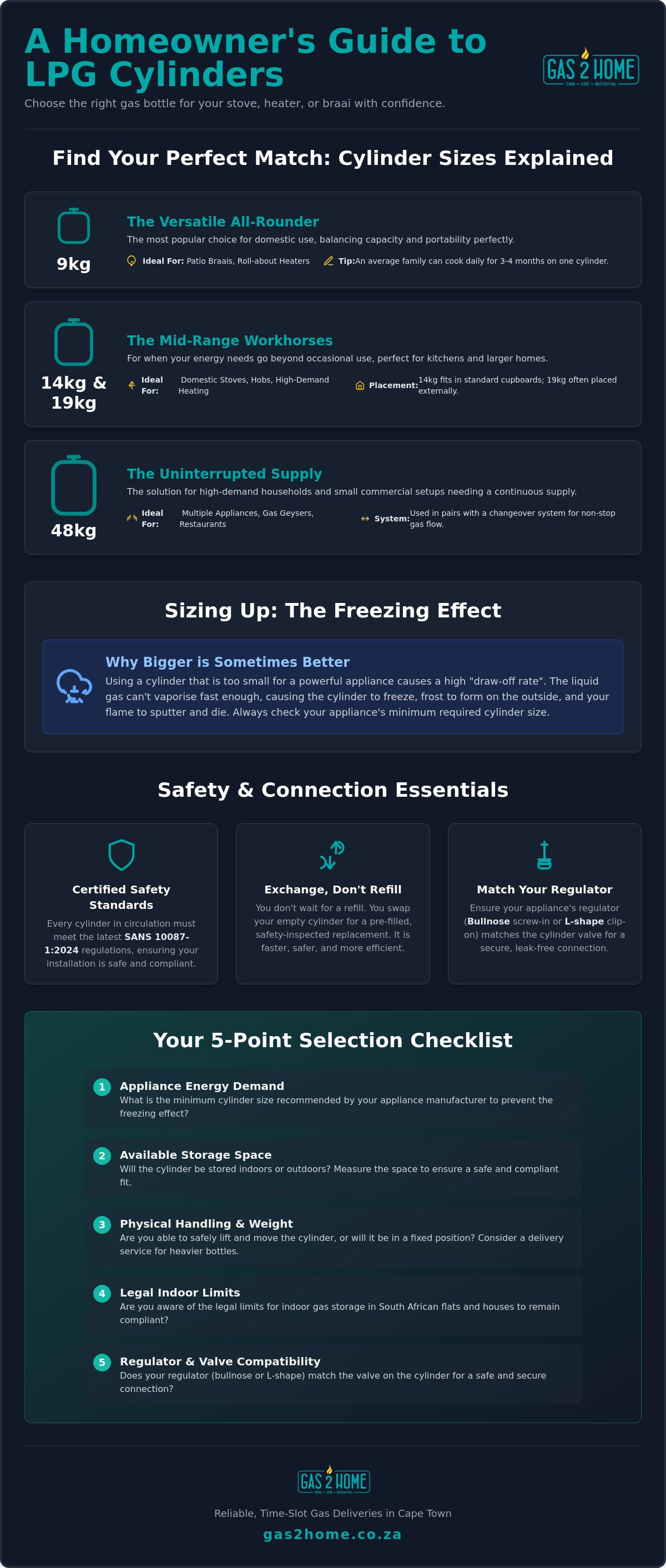
The standard range in South Africa includes the 9kg, 14kg, 19kg, and 48kg LPG Gas Cylinders. When you ask yourself, "what size gas bottle do I need", you should consider both the physical space available and your appliance's consumption rate. Larger cylinders don't just hold more fuel; they also allow for a higher draw-off rate. This is the speed at which the liquid gas turns into vapour. If your bottle is too small for a high-demand appliance, the cylinder can freeze up, causing your flame to sputter or die out completely.
It is also useful to understand how the supply chain works. In most professional circles, "refilling" is actually a cylinder exchange process. You don't wait for your specific bottle to be filled. Instead, you swap your empty, certified cylinder for a pre-filled, safety-checked replacement. This ensures that every bottle in circulation meets the latest safety standards, including the SANS 10087-1:2024 regulations. It is a fast, efficient system that keeps your home running without unnecessary delays.
The 9kg Gas Bottle: The Versatile All-Rounder
The 9kg LPG Gas Cylinder is the most popular choice for domestic users. It strikes an ideal balance between capacity and weight. You can easily lift it into a car or move it around the garden for a weekend braai. It is the standard size for patio gas grills and portable indoor heaters. When choosing these appliances, retailers like elevenpast offer contemporary designs that blend style with functionality. Most standard regulators fit this size perfectly, making it a simple, plug-and-play solution for the average home.
14kg and 19kg Cylinders: The Mid-Range Workhorses
When your gas needs move beyond occasional grilling, you'll need more volume. The 14kg LPG Gas Cylinder is a favourite for domestic gas stoves and hobs. It fits comfortably inside most standard kitchen cupboards designed for gas storage. For larger families or high-demand heating, the 19kg LPG Gas Cylinder is the next logical step. It serves as an entry-level solution for small commercial setups or large homes. These cylinders are often placed in a fixed external location and connected via piping to your appliances.
Matching Your Appliance to the Correct Gas Bottle Size
Selecting the right cylinder starts with your appliance's energy demand. If you use a bottle that is too small for a powerful burner or heater, you risk the "freezing" effect. This happens when the liquid gas cannot turn into vapour fast enough to keep up with the heat demand. Frost forms on the outside of the cylinder, and your flame will eventually sputter or die. Always check your appliance manual before making a purchase. Manufacturers usually specify a minimum cylinder size to ensure the unit operates according to LPG safety standards.
You must also consider the regulator type. Most South African appliances use either a bullnose or an L-shape (clip-on) regulator. Bullnose regulators screw into the internal thread of the valve, while L-shape versions snap onto the top. Ensuring your cylinder valve matches your regulator is vital for a secure, leak-free connection. If you feel uncertain about the setup, using a professional gas connection service ensures your home stays safe and functional.
Gas Stoves and Hobs: Finding the Sweet Spot
When asking "what size gas bottle do I need for my kitchen," the answer depends on your space. While a 9kg bottle is common, the 14kg LPG Gas Cylinder is often preferred for built-in hobs because it offers a more consistent flow for multiple burners. These 14kg units are designed to fit perfectly into standard 600mm kitchen cupboards. For an average family of four, a 9kg bottle used for daily cooking typically lasts between three and four months.
Gas Heaters and Braais: Portability vs Longevity
Roll-about heaters are specifically designed with a rear compartment that fits a 9kg LPG Gas Cylinder. Attempting to use a larger bottle makes the unit unstable and unsafe to move. For braai enthusiasts, the 9kg is also the industry standard. While smaller 5kg bottles exist, they often run out mid-session during slow-cooked roasts. A helpful winter tip: keep a spare 9kg bottle as a backup instead of trying to lug a heavy 19kg cylinder between different rooms.
The 48kg Gas Cylinder: When Should You Scale Up?
The 48kg LPG Gas Cylinder is the industrial-strength solution for South African homes with heavy energy requirements. While 9kg and 19kg bottles are excellent for single appliances, the 48kg unit is designed for permanent, high-volume installations. When you ask yourself, "what size gas bottle do I need for a full kitchen and multiple bathrooms," this is the size that provides true peace of mind. These cylinders are almost always installed as a pair in what is known as a "changeover" system.
In a changeover setup, two 48kg bottles are connected to a single manifold. You use one bottle until it is empty, then simply switch to the second standby cylinder. This ensures you never run out of gas in the middle of a shower or a dinner party. Beyond the convenience of a backup, larger bottles maintain more consistent pressure during high-demand periods. This prevents the freezing issues common with smaller containers. Legally, these installations fall under the Occupational Health and Safety Act, which requires specific safety protocols for high-pressure gas systems.
High-Demand Households and Large Properties
If your property features multiple gas geysers, a large six-plate gas range, or a whole-home gas heating system, scaling up is essential. A single 48kg LPG Gas Cylinder can last several months even with daily heavy use. This reduces the frequency of deliveries and ensures you aren't constantly managing empty bottles. In residential areas like Cape Town, professional exchange services ensure these heavy units are delivered, positioned, and connected safely. This removes the domestic stress of handling bulky equipment yourself.
Safety and Placement Regulations for 48kg Bottles
Safety is paramount with large-scale gas storage. According to the SANS 10087-1:2024 standard, 48kg cylinders must be stored outdoors in a well-ventilated area. They cannot be placed in internal cupboards or garages amongst other household items. You must ensure they sit on a solid, level base, typically a concrete slab, to prevent them from tipping. These cylinders also require a minimum clearance of 1 metre from doors, windows, and airbricks, and 5 metres from electrical points. A professional installation ensures you remain compliant with insurance requirements and local safety laws.
Your Final Selection Checklist: 5 Questions to Ask
Before you place an order, you must evaluate your home's physical layout and your own lifestyle. Deciding "what size gas bottle do I need" is easier when you break the choice down into practical requirements. Use this five-point checklist to ensure your selection provides both safety and convenience.
- Where will the bottle be stored? South African regulations limit indoor storage to 9kg for flats and 19kg for houses. External storage allows for larger 48kg units but requires a secure, well-ventilated cage.
- How much weight can you safely manage? Remember that the "9kg" label refers only to the gas. A full cylinder weighs nearly double that amount.
- How often do you want to organise a delivery? If you cook daily for a large family, a 9kg bottle might feel like a constant errand. A 14kg or 19kg unit reduces the frequency of exchanges.
- What is your connection type? Most South African appliances use a bullnose valve or a 5/8" Right Hand thread. Check your regulator before you buy.
- Do you have a backup? Avoid the stress of running out mid-meal. Keeping a spare 9kg bottle is a simple way to maintain a continuous supply.
Measuring Your Space
Space is often the deciding factor in urban homes. A standard 9kg LPG Gas Cylinder stands approximately 460mm tall with a 310mm width. In contrast, a 19kg LPG Gas Cylinder is significantly taller, reaching about 800mm. Always measure your cupboard or storage area before ordering. You must allow an extra 150mm of height for the regulator and the natural bend of the gas hose. Ensure your storage centre has enough ventilation to prevent gas build-up in the event of a minor leak.
The Weight Factor: Managing the Logistics
Handling gas cylinders requires physical effort. A full 9kg bottle weighs between 17kg and 19kg, which can be a strain to carry from a car to the kitchen. A 19kg cylinder weighs roughly 38kg when full, making it difficult to move without a trolley. If you choose a 48kg LPG Gas Cylinder, the weight exceeds 80kg, which is impossible for one person to handle safely. You don't have to struggle with these heavy loads yourself. You can order your gas delivery online and let a professional team handle the heavy lifting and connection for you.
Reliable Gas Delivery and Connection in Cape Town
Managing your home's energy shouldn't be a chore. Gas2Home acts as your reliable neighbourhood partner, taking the guesswork out of local gas logistics. Whether you live in Sunset Beach or the surrounding Cape Town suburbs, we ensure you never face a cold shower or a half-cooked meal. If you are still wondering, "what size gas bottle do I need", our team is ready to provide immediate, expert advice tailored to your specific household setup. We pride ourselves on being a no-nonsense problem solver that values your time and convenience above all else.
We operate from Monday to Saturday to accommodate even the busiest professional schedules. Our system is designed for maximum efficiency and speed. You can place an order via WhatsApp or through our online portal for a fast turnaround. We often provide same-day delivery across our service areas, ensuring that a replacement cylinder is at your door exactly when you need it. There is no need to wait days for a basic utility when a professional, local solution is just a message away. We move quickly from identifying your requirement to offering a streamlined solution that keeps your home running smoothly.
Why Professional Connection is a Game-Changer
Most guides focus on the capacity of the cylinder but ignore the physical difficulty of moving and connecting it. A 19kg or 48kg bottle is heavy and awkward to handle without proper equipment. Our delivery team handles all the heavy lifting for you, protecting your back and your floors. We don't just drop the bottle at your gate. We carry it to your storage area, secure the connection, and perform a professional leak check to ensure everything is airtight. This gives you total peace of mind that your stove, heater, or geyser is safe and ready to use immediately. Safety isn't an optional extra; it is a fundamental part of our frictionless service.
Simple Ordering and Transparent Pricing
Exchanging your empty 9kg or 19kg bottle should be a frictionless process. We have simplified our system to remove domestic stress and save you a trip to the petrol station. You don't need to worry about complex paperwork or hidden fees. We even offer a "pay on delivery" option to build trust and ensure you are completely satisfied before any money changes hands. This transparent approach has made us a favourite amongst local residents who value honesty and efficiency. We act as a helpful neighbour who is also a professional expert, combining community belonging with high standards. We are here to make your transition to gas energy as effortless as possible, giving you more time to discover My Wellness for premium natural health products.
Order your gas bottle exchange today and let us handle the connection!
Secure Your Home Energy Supply Today
Finding the right balance between appliance demand and storage space ensures your home runs without interruption. You now know that 9kg cylinders are the favourite for portability, whilst 14kg and 19kg bottles provide the mid-range power needed for consistent daily cooking. For households with multiple gas geysers or large ranges, a 48kg changeover setup remains the ultimate industrial-strength solution for continuous supply. Deciding what size gas bottle do I need is the first step toward a safer and more efficient home environment.
You don't have to worry about the physical strain of heavy lifting or the technical details of a safe connection. We are here to handle the logistics so you can focus on enjoying your home. Our team provides same-day delivery across Cape Town and includes a professional connection service to ensure your safety. You can even organise your next exchange via WhatsApp for a truly frictionless experience. Order your LPG gas delivery in Cape Town now and let us take care of the rest. Enjoy the peace of mind that comes with a reliable, local partner who understands your needs.
Frequently Asked Questions
How long does a 9kg gas bottle last on a gas stove?
For an average family of four using a stove for daily meals, a 9kg cylinder typically lasts between three and four months. This duration depends heavily on your cooking habits and the number of burners you use simultaneously. It remains one of the most cost-effective ways to power a South African kitchen whilst avoiding the high costs of electricity.
Can I use a 19kg gas bottle for my portable room heater?
No, you should only use a 9kg cylinder for a standard roll-about heater. These units are specifically designed with a rear compartment that fits the dimensions of a 9kg bottle. Using a 19kg cylinder makes the heater unstable, top-heavy, and dangerous to move. It also violates the manufacturer's safety specifications for portable indoor heating.
What is the difference between a bullnose and a L-shape regulator?
A bullnose regulator features a threaded nose that screws into the internal thread of the cylinder valve. An L-shape regulator, also known as a clip-on regulator, snaps onto the top of the valve without screwing. You must ensure your regulator matches the valve type on your bottle to create a safe, airtight seal. Most 9kg and 19kg cylinders in South Africa use the bullnose standard.
Do I need a special permit to have a 48kg gas bottle at home?
You don't need a personal permit, but your installation must have a valid Certificate of Compliance (CoC) issued by a registered gas practitioner. The SANS 10087-1:2024 standard requires specific outdoor placement and high-pressure piping for these large units. This certification is essential for your home insurance and must be updated every five years or whenever the system is modified.
Is it cheaper to buy a larger gas bottle?
Yes, purchasing gas in larger volumes generally offers better value per kilogram. When you are deciding what size gas bottle do I need for a high-use appliance like a geyser, the 19kg or 48kg options are more economical over time. You also reduce the total number of delivery fees paid throughout the year by choosing a higher-capacity cylinder.
What should I do if I smell gas near my cylinder?
Extinguish all open flames and close the main cylinder valve immediately. Open all doors and windows to ventilate the area and do not operate any electrical switches, as these can create a spark. Use a soapy water solution to check for bubbles around the regulator and hose. If the smell persists, move the cylinder outdoors and contact a professional installer for assistance.
Does Gas2Home deliver gas on Saturdays in Cape Town?
Yes, we offer delivery services from Monday to Saturday to accommodate busy household schedules. We understand that many customers are only home during the weekend to oversee the exchange and connection. Whilst we don't deliver on Sundays, our Saturday service ensures you are ready for the week ahead without any energy gaps.
Will the delivery driver connect my new gas bottle for me?
Yes, our professional Gas Connection Service is included with every delivery we make. Our team handles the heavy lifting, secures the cylinder in its storage area, and connects it to your appliance. We also perform a mandatory safety leak check before we leave to ensure your stove or heater is ready for immediate use.