
Reliable Gas for Cape Town Load Shedding: Buying Guide

A cylinder that runs out mid-outage is no backup at all. Planning a reliable gas supply for load shedding Cape Town households can count on starts with the appliances you need most, then matches cylinder size and replenishment to your actual use.
Power interruptions can disrupt dinner and leave heating routines uncertain. The right LPG setup can keep compatible gas appliances running, but it won’t replace household electricity. Before choosing a cylinder, consider what you’ll connect, how often you’ll use it and where it can be safely installed and stored.
This guide explains how to identify suitable appliances, compare 9kg, 14kg, 19kg and 48kg cylinders, and plan ahead to reduce the risk of running short. In Cape Town, Gas2Home delivers cylinders and exchanges Monday to Saturday, with delivery time slots and professional cylinder connection. A practical setup and a replenishment plan based on your household’s use can help you prepare for power interruptions.
Key Takeaways
- Identify which essential cooking or heating appliances are compatible with LPG, and plan around those rather than treating gas as a replacement for household electricity.
- Choose a cylinder size based on your appliances, household use and available space. How long it lasts depends on consumption and how often each appliance runs.
- Build a reliable gas supply for load shedding Cape Town households can manage by tracking use and arranging replenishment before the cylinder is empty.
- Use a safety checklist for cylinder placement, ventilation and ignition sources, and consult current City of Cape Town guidance on applicable requirements.
- Plan your order or exchange, delivery time slot and access in advance to make replenishment more straightforward.
Reliable gas supply for load shedding in Cape Town: what LPG can power
A reliable gas supply for load shedding Cape Town households can use starts with a clear distinction: LPG fuels compatible gas appliances, but it doesn’t replace household electricity. During an interruption, a gas hob or LPG water heater may still work if it is designed for gas and correctly connected. Lights, routers and ordinary electrical appliances won’t run from a cylinder.
In brief: LPG is a fuel supply for compatible gas appliances during a power interruption, not a whole-home electricity backup system. LPG is commonly used for cooking and heating; What is Liquefied Petroleum Gas (LPG)? offers an overview of the fuel and its uses.
Which household tasks can LPG support during load shedding?
The City of Cape Town’s guidance highlights gas cooking and water heating as ways to support selected household needs during load shedding. Start with the tasks that matter most to your routine, rather than assuming every appliance can switch to gas. A gas hob can help you prepare a meal, for example, while an LPG water heater can supply hot water if it is designed for that fuel.
- Cooking: Use a gas stove or hob made for LPG to prepare meals.
- Hot water: Use a gas water heater designed for LPG, rather than an electric geyser.
- Heating: Use only a heater specifically designed for gas and connected appropriately.
Check each appliance’s fuel type and instructions before planning around it. A gas appliance must be safely connected, and a professional gas connection service can help with cylinder connection. Don’t assume an appliance will work simply because it has a flame or can be plugged in. How long your supply lasts also depends on the appliance and how often you use it, so avoid relying on a fixed runtime estimate.
What LPG cannot replace in a Cape Town home
A cylinder supplies fuel, not electrical power. It won’t automatically keep your lights on, restore Wi-Fi or run a television, fridge, microwave or electric kettle. Those appliances still need an electricity source, even if gas is available for cooking or hot water.
To make a practical plan, list the tasks you want to maintain during an outage. Identify which can be handled by compatible gas appliances and which still depend on electricity. A gas stove may let you cook, for instance, but it won’t power the kitchen light or keep an electric appliance operating. Treat LPG as targeted backup for selected needs, not as a generator or a universal solution for the home.
Choose a gas cylinder for your Cape Town load-shedding needs
The right cylinder depends on what you plan to run, how often you’ll use it and where it can be safely placed. Start with your compatible appliances, not a guess about how many days a cylinder should last. A 9kg cylinder may suit lighter or occasional use, while a household planning for more frequent use or several gas appliances may consider a larger option, subject to safe storage and connection requirements.
Match cylinder size to household use, not guesswork
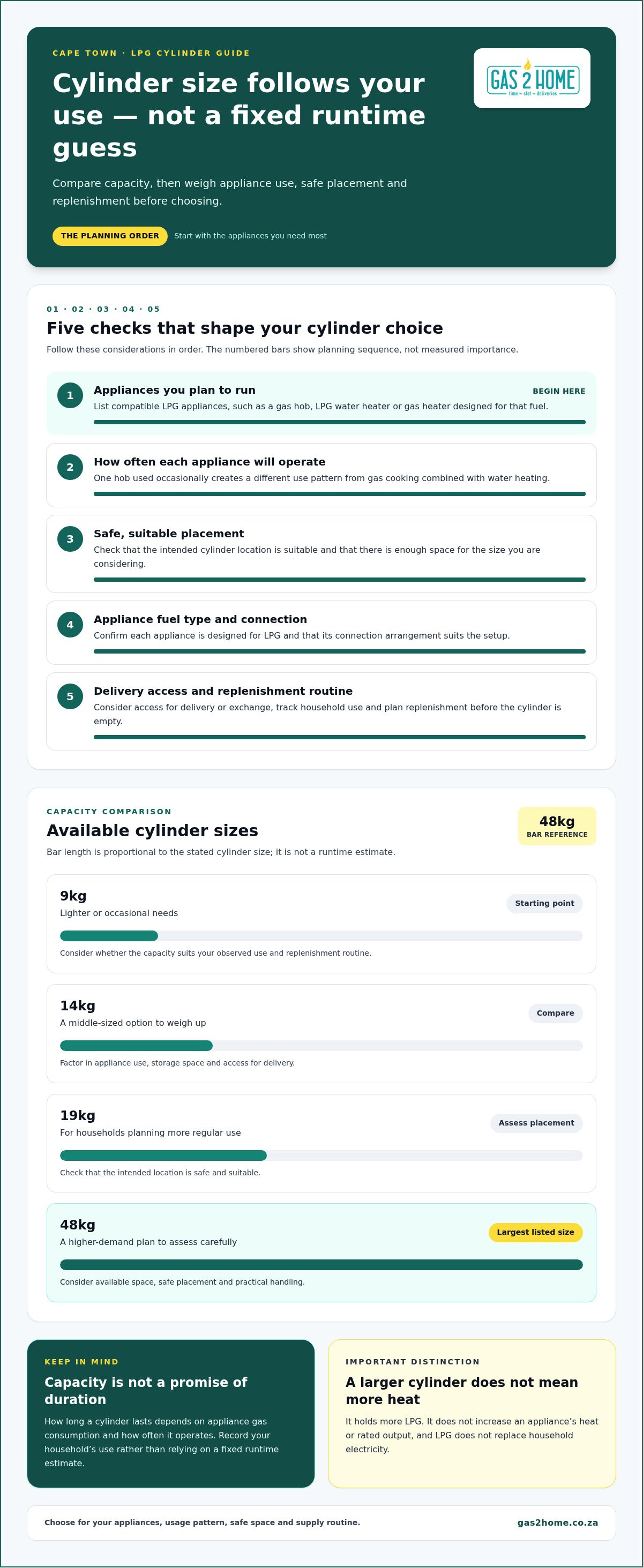
List the gas appliances you expect to use and how often they’ll be switched on. A household using one hob occasionally has a different pattern from one relying on gas cooking and water heating. The table is a starting point for comparing available sizes, not a promise of runtime. Actual duration varies with each appliance’s gas consumption and how often it operates.
| Cylinder size | A practical starting point | Consider before choosing |
|---|---|---|
| 9kg | Lighter or occasional needs | Whether its capacity suits your observed use and replenishment routine |
| 14kg | Households weighing a middle-sized option | Appliance use, storage space and access for delivery |
| 19kg | Households planning for more regular use | Whether the intended placement is safe and suitable |
| 48kg | Higher-demand plans to assess carefully | Available space, safe placement and practical handling |
These descriptions are decision prompts, not consumption estimates. A larger cylinder doesn’t make an appliance produce more heat or increase its rated output. It holds more LPG, while actual use still depends on the appliance and your routine. Record how often you use each appliance, then review that pattern before settling on a size.
Check the appliance and connection before choosing
Before ordering, check that each appliance is designed for LPG and that its connection arrangement suits the setup. Don’t assume that every gas appliance uses the same fuel or connection. The cylinder’s planned location must be suitable for safe placement and accessible for delivery and exchange. The LPG Safety Guidelines in South Africa provide guidance on safe use, storage and handling.
If you’re comparing options for a reliable gas supply for load shedding Cape Town residents can plan around, balance household use with available space and delivery access. Gas2Home offers 9kg, 14kg, 19kg and 48kg cylinders for order or exchange, with delivery time slots and professional cylinder connection. You can order an LPG cylinder online or through WhatsApp.
Plan a dependable LPG supply in Cape Town, beyond the cylinder choice
A suitable cylinder is only part of the plan. To reduce the chance of running short during a power interruption, keep track of how your household uses LPG and arrange an exchange before your usual supply is exhausted. A routine based on your actual use is more useful than a guess about how long a cylinder should last.
A planned reserve helps you prepare for interruptions, but it can’t guarantee uninterrupted energy. Your gas supply still depends on actual use, safe storage and arranging replenishment in time.
Create a simple cylinder check and replenishment routine
Make checking the supply part of a regular household routine, and follow any level indicator or usage guidance supplied with the cylinder or appliance. Note when you start using a cylinder and roughly how often appliances run. That record gives you a household-specific guide instead of an assumed runtime that may not match your needs.
- Check the supply regularly. Use the cylinder or appliance guidance, and don’t rely on guesswork or unsafe handling to estimate what remains.
- Record household use. Note how frequently you cook or use other connected appliances, especially when your routine changes.
- Set a replenishment reminder. Use your observations to decide when to arrange an exchange, before the cylinder reaches empty.
- Plan ahead for expected interruptions. Review your supply and arrange delivery in advance where possible, rather than waiting until an outage is under way.
Revisit the routine if you add an appliance or begin using gas more often. A change in household habits can affect how quickly you need to replenish, so update your notes instead of relying on an old estimate.
Use local delivery logistics to reduce last-minute stress
Gas2Home operates in Cape Town from Monday to Saturday and offers delivery time slots and same-day delivery. Build delivery into your replenishment routine: arrange an order or exchange while you still have supply, select a time slot, and make sure the delivery route and intended cylinder location are safely accessible.
Access matters. Keep the planned placement clear so the delivery team can reach it without moving household items at the last minute. Follow the applicable safety guidance for where a cylinder may be positioned; convenience shouldn’t come at the cost of safe placement. You can order through Gas2Home online or through WhatsApp and plan around the delivery times offered.
For a reliable gas supply for load shedding Cape Town households can manage, treat replenishment as part of the setup, not an emergency response. Your usage notes help you choose when to reorder, while a planned delivery slot makes the exchange easier to organise.
Prepare safely for gas use during Cape Town load shedding
Get a gas setup ready before an electricity interruption, rather than improvising during one. Safe placement, a suitable appliance and a sound connection all matter. Use this checklist to review the basics before relying on LPG at home.
- Check appliance compatibility. Use appliances designed for LPG and follow the manufacturer’s instructions.
- Choose a suitable location. Keep the cylinder in an appropriate, ventilated place, away from heat and ignition sources. Follow the relevant safety guidance for its placement.
- Keep the area clear. Make sure the cylinder and appliance are accessible, and don’t store items where they could obstruct ventilation or access.
- Look for warning signs. If you suspect a leak or notice a connection that appears unsafe, stop using the appliance. Don’t use flames or operate electrical switches nearby; move away and seek appropriate professional help.
Check the setup before relying on gas in an interruption
Review the appliance instructions and the condition of the setup before use. If you notice a gas smell, unusual behaviour or other signs of a bad gas connection, don’t try to diagnose or fix it yourself. Stop using the appliance and prioritise safety. A convenient cylinder location isn’t suitable if it compromises ventilation or places the cylinder near a heat or ignition source.
Know when professional connection and local guidance matter
Gas2Home provides professional cylinder connection with delivery, helping make cylinder replacement more straightforward. This service doesn’t remove the need to follow appliance instructions or applicable installation and safety requirements. Requirements can depend on the setup, so don’t assume every home has identical approval obligations.
Before installing or changing a gas setup, consult the latest City of Cape Town guidance for information on applicable approvals and safe installation. Check the guidance relevant to your property and planned arrangement, rather than relying on an old rule of thumb. Keep the details handy as part of your household preparation.
A reliable gas supply for load shedding Cape Town households can use depends on more than having LPG available. Make safe placement, compatible appliances and professional connection part of the plan. To arrange a cylinder delivery or exchange, order an LPG cylinder from Gas2Home and have it connected as part of delivery.
Get your Cape Town gas supply ready with Gas2Home
Once you’ve settled on a suitable cylinder size, you can arrange delivery or an exchange with Gas2Home. The company supplies LPG cylinders in Cape Town and provides professional cylinder connection with delivery. Plan your order around the appliances you intend to use, your household’s observed gas use and the safe, accessible location prepared for the cylinder.
Order or exchange a cylinder for your household
Choose from 9kg, 14kg, 19kg and 48kg cylinders. If you already have a cylinder, arrange an exchange; otherwise, order the size that fits your intended use and available space. Gas2Home accepts orders online or through WhatsApp. For a step-by-step overview, use the how to order gas online in Cape Town guide.
Keep your selection practical. Consider how many compatible appliances you’ll connect, how often you expect to use them and whether the planned cylinder location can accommodate the size safely. If you’re deciding between two options, review your household’s actual use rather than relying on a general runtime estimate. Cylinder size affects the amount of LPG available, not an appliance’s rated output.
Arrange delivery and get the cylinder connected
Gas2Home operates Monday to Saturday and offers delivery time slots and same-day delivery. Choose a suitable time when arranging your order, then make sure there’s clear, safe access to the planned cylinder location. Preparing the route and placement helps avoid moving items at the last minute.
- Choose your cylinder size. Select from the 9kg, 14kg, 19kg or 48kg options based on intended appliance use and safe placement.
- Place an order or arrange an exchange. Order online or through WhatsApp.
- Select a delivery time slot. Gas2Home operates Monday to Saturday and offers same-day delivery.
- Prepare access. Keep the route and the planned cylinder location clear, and follow the relevant safety guidance for placement.
- Have the cylinder connected. Professional cylinder connection is included with delivery. Payment can be made upon delivery.
This gives your household a clear route from choosing a cylinder to having it delivered and connected. It also makes replenishment easier to organise before your current supply runs out. A reliable gas supply for load shedding Cape Town households can plan around starts with a suitable cylinder and delivery arrangement that fits their routine.
To organise your cylinder delivery or exchange, arrange your gas delivery with Gas2Home.
Make your gas plan part of household preparation
A useful backup plan should fit your home as it is now and be easy to review when your needs change. If you add a gas appliance, change how often you cook or alter the space available for a cylinder, review your setup and supply routine. This helps keep your arrangements practical instead of relying on assumptions.
For a reliable gas supply for load shedding Cape Town households can plan around, choose the cylinder arrangement that suits your needs and organise delivery before you’re caught short. Gas2Home offers online and WhatsApp ordering, with professional cylinder connection included with delivery.
Arrange a convenient gas delivery with Gas2Home and take a practical step towards being better prepared.
Frequently Asked Questions
Does LPG work during load shedding in Cape Town?
Yes, LPG can fuel compatible gas appliances during a power cut, provided the appliance and its connection are working safely. It won’t supply electricity to other parts of your home. For a reliable gas supply for load shedding Cape Town households should check whether each appliance can operate without mains power. Some models may use electrical components, such as an ignition system, so check the manufacturer’s instructions before relying on them.
Can a gas stove work when the electricity is off?
Often, yes, but it depends on the stove’s ignition system. A hob with ignition that relies on mains electricity may not light during an outage, even though it uses LPG for cooking. Check the manufacturer’s instructions for your specific model and follow its recommended lighting method. Don’t improvise or use a flame if you’re unsure how the appliance should be operated.
Can a gas cylinder power a whole house during load shedding?
No. A standard LPG cylinder provides fuel for compatible gas appliances, not electricity for a home. It won’t automatically run lights, a Wi-Fi router, a fridge or other electrical equipment. For example, a gas hob may let you cook while the power is off, but it won’t keep an electric kettle working. Plan separately for any electrical devices you need during an interruption.
How do I know when my gas cylinder is nearly empty?
Use any level indicator or checking guidance supplied with your cylinder or appliance, if available, and note when the cylinder goes into use. Track changes in household habits too, such as cooking more often. This helps you identify your own replenishment pattern. Don’t rely on an assumed number of days or try improvised checks; arrange an exchange before your usual supply runs out.
Is it safe to keep an LPG cylinder inside the house?
Indoor storage is restricted, and the applicable limit depends on the type of home. Current guidance states a maximum of 9kg for a flat and 19kg for a house. These figures aren’t a substitute for checking the rules that apply to your property and setup. Consult current City of Cape Town guidance, and follow safe placement requirements for ventilation and distance from heat or ignition sources.
Does Gas2Home deliver gas during load shedding?
Gas2Home delivers LPG cylinders in Cape Town and operates Monday to Saturday. You can order online or through WhatsApp, with delivery time slots and same-day delivery available. To avoid needing a cylinder during an outage, plan your order or exchange ahead of time and ensure the delivery team can safely access the intended cylinder location.
Can I use a gas heater during load shedding?
Yes, if the heater is designed for LPG and can operate without mains electricity. Check its instructions, including whether ignition or any control feature needs electrical power. Use the heater only in the setting it’s intended for, with the required ventilation, and keep it away from combustible materials. If you’re uncertain about its fuel type or safe operation, don’t use it until the instructions are clear.